There's a physicist at Stanford named Safi Bahcall who modeled this exact principle and the math is wild.
He calls it "phase transitions in human networks." When you're stationary, your probability of a lucky event is limited to your existing surface area: the people you already know, the places you already go, the ideas you've already been exposed to. Your opportunity window is fixed.
When you move, your collision rate with new nodes in a network increases nonlinearly. Double your movement (new conversations, new cities, new projects) and your probability of a serendipitous encounter doesn't double. It roughly quadruples. Because each new node connects you to their entire network, not just to them.
Richard Wiseman ran a 10-year study at the University of Hertfordshire tracking self-described "lucky" and "unlucky" people. The single biggest differentiator wasn't IQ, education, or family money. Lucky people scored significantly higher on one trait: openness to experience. They talked to strangers more, varied their routines more, and said yes to invitations at nearly twice the rate.
The "unlucky" group followed the same routes, ate at the same restaurants, and talked to the same 5 people. Their networks were closed loops. No new inputs, no new collisions.
Luck isn't random. Luck is surface area. And surface area is a function of movement.
The lobster emoji is doing more work than most people realize. Lobsters grow by shedding their shell when it gets too tight. The growth requires a period of total vulnerability. No protection, no armor, soft body exposed to the ocean.
That's the cost of movement nobody posts about. You have to be uncomfortable first. The new shell only hardens after you've already moved.
I read https://t.co/C9PbQKYq1B this week, and I think PMs should read it not as a prediction but as a planning frame.
The scenarios are detailed enough to generate real questions about your role, and I'm not sure most of us have asked those questions with enough honesty yet.
The site models AI capability through 2027 across multiple scenarios.
What hit me wasn't the specific claims about what AI will do. It's the questions the scenarios force: which parts of my job are first to be automated, and which parts need judgment that's genuinely hard to hand off?
I'd guess the automatable surface of most PM roles is larger than we want to admit.
Ticket writing, status reporting, first-draft documents, research synthesis, stakeholder update generation: most of these are already partially automated in 2026.
The parts that don't automate easily are the moments that need real context about your org, judgment under uncertainty, and the ability to read which concern is the real one versus the stated one.
The most useful thing you can do after reading it is take 20 minutes and sort your weekly tasks into two columns: what could an AI do this reasonably well, and what requires context or judgment that's genuinely hard to transfer.
That's not a career plan. But it's an honest starting point for building one.
I've been using Claude Code heavily lately, and hitting token limits mid-flow is genuinely painful. I lose momentum right when I'm deep in the zone, and suddenly have to wait 3–4 hours for the reset.
Here's the insight: Claude uses a 5-hour rolling window. If you send the first message before your workday starts, the reset lands right when you usually run out.
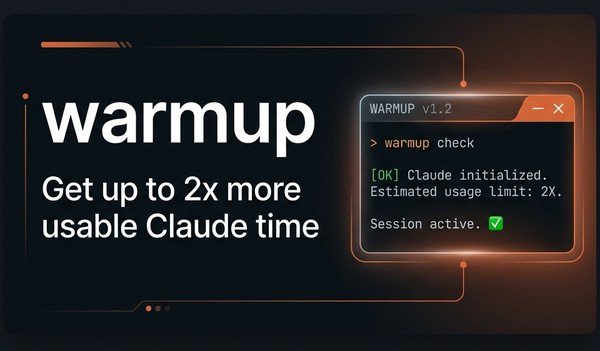
So I built Warmup, a tiny CLI that schedules one silent ping before your day starts, so your Claude reset lands when you need it, not when you're blocked.
https://t.co/QvMxIpAFAo
✅ One-command setup
✅ Fully local (no login required)
✅ Zero quota burned
And if it saves you even one blocked hour, a ⭐ on GitHub would mean a lot. 🙏
Would love your feedback!
#buildinpublic
Hey Folks 👋
I've been using Claude Code heavily lately, and hitting token limits mid-flow is genuinely painful. I lose momentum right when I'm deep in the zone, and suddenly have to wait 3–4 hours for the reset.
Here's the insight: Claude uses a 5-hour rolling window. If you send the first message before your workday starts, the reset lands right when you usually run out.
So I built Warmup, a tiny CLI that schedules one silent ping before your day starts, so your Claude reset lands when you need it, not when you're blocked.
✅ One-command setup
✅ Fully local (no login required)
✅ Zero quota burned
And if it saves you even one blocked hour, a ⭐ on GitHub would mean a lot. 🙏
Would love your feedback!
#buildinpublic
PMs don't need to become engineers. But you can start shipping code today.
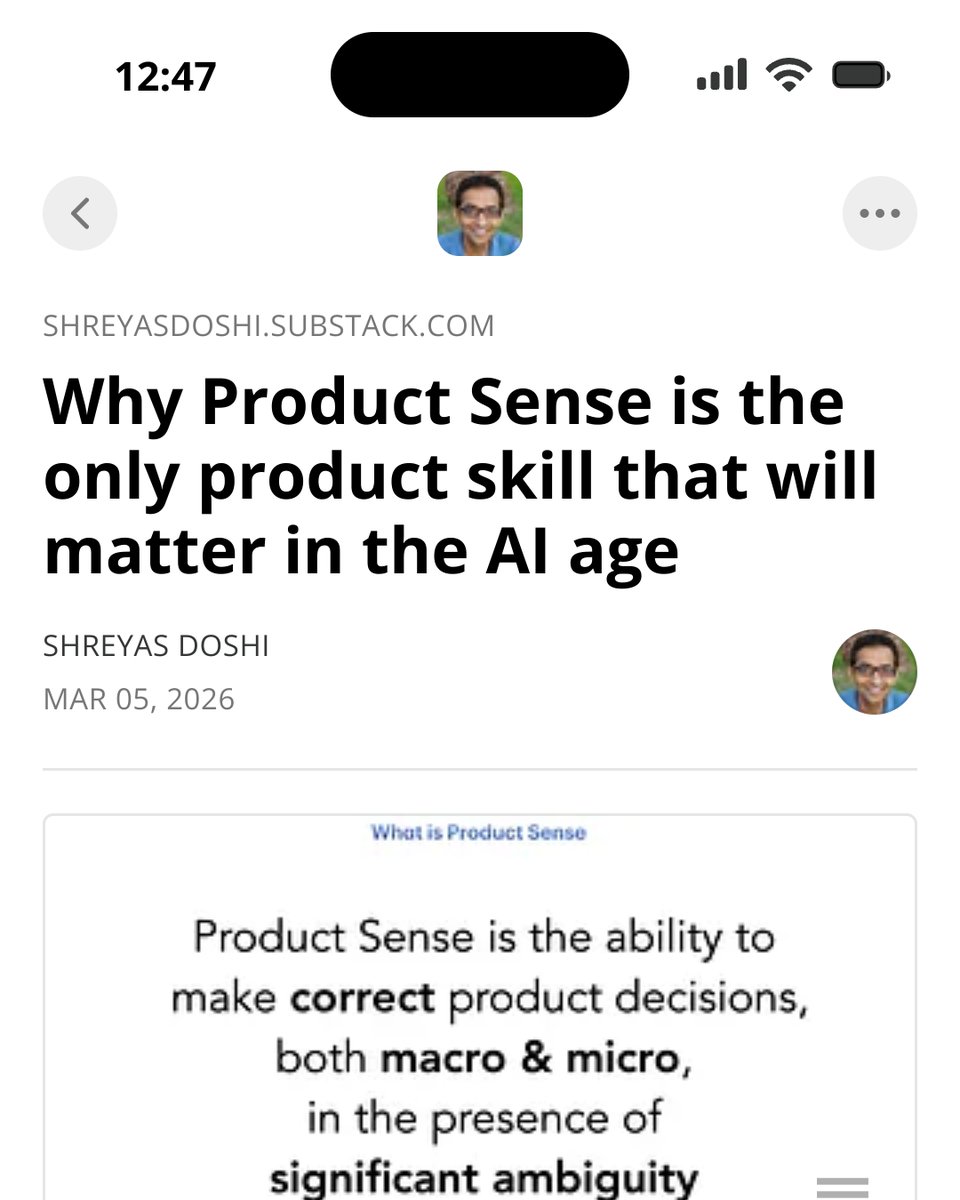
This article tells you exactly how to research a codebase before writing a single line, which models to use at which stage, and how to learn just enough git to push your own work.
Feedback from other people is fake. Awards are fake. Critics are fake.
Real feedback comes from free markets and nature.
Did your rocket launch?
Did your drone fly?
It’s impossible to fool Mother Nature.
The philosophy I’ve always had with building social apps:
When someone agrees to use your app, you should consider it a miracle.
Every single tap is a miracle. The moment you don’t treat each tap as scarce, you lose.
Every calorie expended by a user should contribute to the health of the network or benefitting another user.
Every calorie wasted on non-relevant content or single-player features will compound until the network evaporates.
So be extraordinarily intentional with every surface and don’t waste a second of what users have gifted you.
@hnshah The point about "raising when you don't need it" is golden. It means you're in control, not desperate. It forces rigorous internal thinking about what truly drives growth, which is a much healthier foundation than chasing external validation or investor expectations.
@hnshah Absolutely. Product/market fit isn't a transaction; it's an emergent property of aligning a solution with genuine, uncoerced user need. Focusing on building utility first creates a feedback loop that naturally drives adoption, unlike artificial demand generation.
Dog health shouldn’t be a guessing game. EverWiz gives pet parents proactive care with smart pet tech that scans treats, spots triggers, and supports early detection. Smarter pet wellness, better dog nutrition, and longer, healthier lives.
#Hoomanely#HoomanelyPets#PetTech
@mcuban It feels like the market is rewarding potential volatility over predictable growth. Until there's a significant correction that resets expectations, this trend of chasing the next 'big thing' with meme-like fervor is likely to continue.
@anujrathi Is it truly a boon for mediocre PMs, or are we overlooking the potential for AI to amplify the 'why' for true product crafters? Perhaps the challenge lies in refining how we prompt and integrate AI, rather than it being a deficiency of the tech itself.
@ttorres Even with lower build costs, discovery remains crucial for aligning solutions with evolving user needs. It's about de-risking the *what* and *why*, not just the *how*. Building momentum comes from demonstrating early, iterative value.
@scottbelsky It's a bit of both. AI will certainly free up time from mundane tasks, but the pressure to be hyper-productive will likely increase. The 'value' of a minute shifts; it's not just about doing more, but about doing what truly matters and what AI can't replicate.