@RBI , @TRAI - the whole point of 1600 series calls was for service calls only. However, banks have started abusing this and the same calls that they were doing earlier, cross-sell calls disguised as service calls, are being made using 1600 numbers.
@ICICIBank
A Cold Storage of Hope
The Indian fridge is not an appliance but an ecosystem. A living, breathing archive of culinary optimism, forgetfulness and occasional bravery. Every once in a while it begins with great hope. Fresh vegetables are placed neatly, milk packets stand upright with purpose, leftovers are carefully stored in steel dabbas, and someone confidently declares, “We will be organised going forward”. Just a matter of time, however, the fridge begins to resemble an archaeological dig where every shelf represents different eras of cooking.
Let us begin with the curd, which perhaps has the most fascinating life cycle inside the Indian refrigerator. Day one curd is fresh, creamy and optimistic. It sits proudly waiting to meet rice, maybe even a little salt and pickle. Day-two curd becomes slightly sour but still respectable. This is the stage where someone nods wisely and says, “Perfect for curd rice.” Day-three curd begins to develop character. Someone opens the lid, sniffs cautiously, tilts the head slightly and asks the eternal household question: “Still okay no?” , “Yes,Maybe we can use it for rave idli or majjige huli on the weekend“ . The teenager rolls his eyes. By day four the curd has crossed into what can only be described as weaponised dairy. Even the fridge light seems reluctant to illuminate it fully. But no one throws it away immediately. It remains there for a few more days.
Then come the vegetables, which enter the fridge like enthusiastic new employees and slowly lose motivation. The curry leaves are the first to suffer. On day one they are green and fragrant. By day five they resemble the wrinkled skin of an eighty yearold grandfather, folded and questioning their life choices. The carrots, once crisp and proud, now lie limp and philosophical. Not even a stick could motivate them again. Even the most determined cook looks at them, sighs softly and closes the vegetable drawer.
Somewhere in one corner sits the brinjal. Nobody remembers buying it. Nobody admits responsibility. Yet it sits there quietly, slowly transforming into something that looks suspiciously like a small dead rat wearing purple clothes. Each time the tray opens someone notices it and says, “We should use this tomorrow,” which of course means it will remain there for another four days. The coriander looks like stiff dry curly hair. It turns from lush green to dark, the humour is on us.
The teenagers, on the other hand, treats the fridge like a hunting ground. Around 11:30 pm the door opens slowly. A thoughtful stare follows, as if expecting the fridge to magically produce pizza. The teenager surveys the shelves: leftover dishes, curd of uncertain age, three philosophical lemons and the brinjal that now clearly resembles wildlife. Nothing seems appealing. The door closes. Two minutes later it opens again, just in case something improved during that time. The chocolate that was there last night has been consumed by the “sweet bitter” parents.
And then there is the ice tray that came with the fridge. It has lived there for years without meaningful employment. Occasionally someone fills it halfway with water, forgets about it, and later discovers cubes shaped like small glaciers.
The greatest mystery of the Indian fridge, however, is space. It does not matter whether the fridge is small, large or one of those giant double-door models or something of industrial scale that look like they belong in a hotel buffet. Within days there is absolutely no room left. Certainly not for noble things like cold beer or good 85 percent dark chocolate. Instead the shelves are packed with bowls of unfinished palya, mysterious dabbas from unknown days and people, curd in multiple stages of danger, vegetables in emotional decline, a brinjal approaching rodent status, and fingerprints from the teenagers visits.
Yet every evening someone opens this packed fridge, stares inside for a full thirty seconds and announces with total conviction:
“There is nothing to eat in this house.”
Just pack the fridge with dark chocolate and beer . The world will be a better place ..
@ShivamVahia If it makes you feel any better, I went through the same process. I reset my UTS password and it still doesn't let me login on RailOne. Also, I have some money loaded in my UTS app. No word on what happens to that. Maybe that's one more drop in the ocean of unclaimed deposits.
@joybhattacharj Reminded me of ABV's famous speech in Parliament, which in many ways is also fundamental to why India is a progressing, functioning state, irrespective of the politics that gets played out:
https://t.co/36ThAYIcQc
@RahulChels@VishalBhargava5@zoru75 Actually, similar cabling work is happening on Saki Vihar Road. They've done a reasonably good job of filling up the dug up portions and filling it up with tar, levelling it etc. It's not Singapore quality work but it's far better than what I have seen in some other parts.
A 1 crore earning techie's life has no value in Bengaluru.
And if you're not earning that much? Your life has even less.
My sister and her friend were driving home in my car. They stopped at a red light - the logical thing anyone does. A drunk driver in a mini-truck didn't feel the need to stop. He slammed into them instead.
I know he was drunk. She knows it. The highway police knows it. The truck owner knows it.
No arrest was made.
The truck driver never showed up at the station. The owner never showed up. Nobody cared. My sister and her friend - both injured, both terrified - kept going back to the station, back to the accident site, explaining what happened over and over, just trying to get a report filed.
I was in the US. All I could do was talk to them on calls, helpless.
Here's what the police told them:
"If nobody died, an FIR doesn't make sense."
"Just claim first party insurance."
"Third party insurance doesn't pay much anyway."
And then, quietly, one officer pulled them aside and told the truth: "These truck mafia bribe us. Nothing will happen."
Nothing happened.
The truck was KA04 AE6550. The police themselves said if they'd been on a two-wheeler, both would be dead.
We had 100% insurance from Reliance. Claim rejected. Reason? "Misrepresentation of facts." These two, even while injured, kept showing up to represent the facts. Reliance still found a way to deny them.
The law says if someone hits you from behind, the person behind is at fault. It was a red light. How does a truck driver not see that?
Trust me, this isn't about money. I'll manage the repairs and the medical bills. I have savings. And I have a decent credit score; I'll take a personal loan if I have to. That's not the point.
The point is this: my sister is afraid now. Afraid that anything can happen to her at any moment and there's no one - no system, no law, no institution - that will protect her.
But how do I tell her the world is supposed to be fair? How do I tell her to trust the system? How do I explain that the drunk driver walks free, the truck owner was never questioned, and the police pocketed their bribe and closed the file?
I can't say to any official, "What if this was your daughter? Your sister?" Because their daughters travel in cars with security escorts. They will never know what it feels like to be ordinary and unprotected.
So I'm saying it to you, an ordinary reader.
You're on the road. You stop at a red light. A drunk driver in a truck rear-ends your car. Your loved one is inside, terrified.
And then you learn: there is no recourse. None.
The truck owner pays off the cops. The insurance company rejects your claim. The system shrugs.
This is Bengaluru in 2025. This is India in 2025. This is what your life is worth here.
One more thing. The friend in the car? He's one of the smartest people I know. close to top 100 rank in IIT-JEE. AI engineer and one of the biggest data companies. At 23, he is valuable to be paid more annually than the cost of five such trucks, that too, in India. He's patriotic. He pays his taxes. He stays in India even though he constantly gets offers to move to the US.
This is the confidence our system gives to someone who is clearly an asset to this country. All this unfairness - for a drunk truck driver.
@blrcitytraffic@BlrCityPolice - tell me. I've always avoided raising fingers publicly. But what else can I do?
@joybhattacharj I assumed the reference was to Trump being the Penguin, as in Oswald Cobblepot.
I was wondering who will be the Dark Knight in this version.
@shiv_cybersurg Read this behind a Truck once:
सौ में असी बेईमान
फिर भी मेरा भारत महान
This made complete sense after spending a couple of years working abroad.
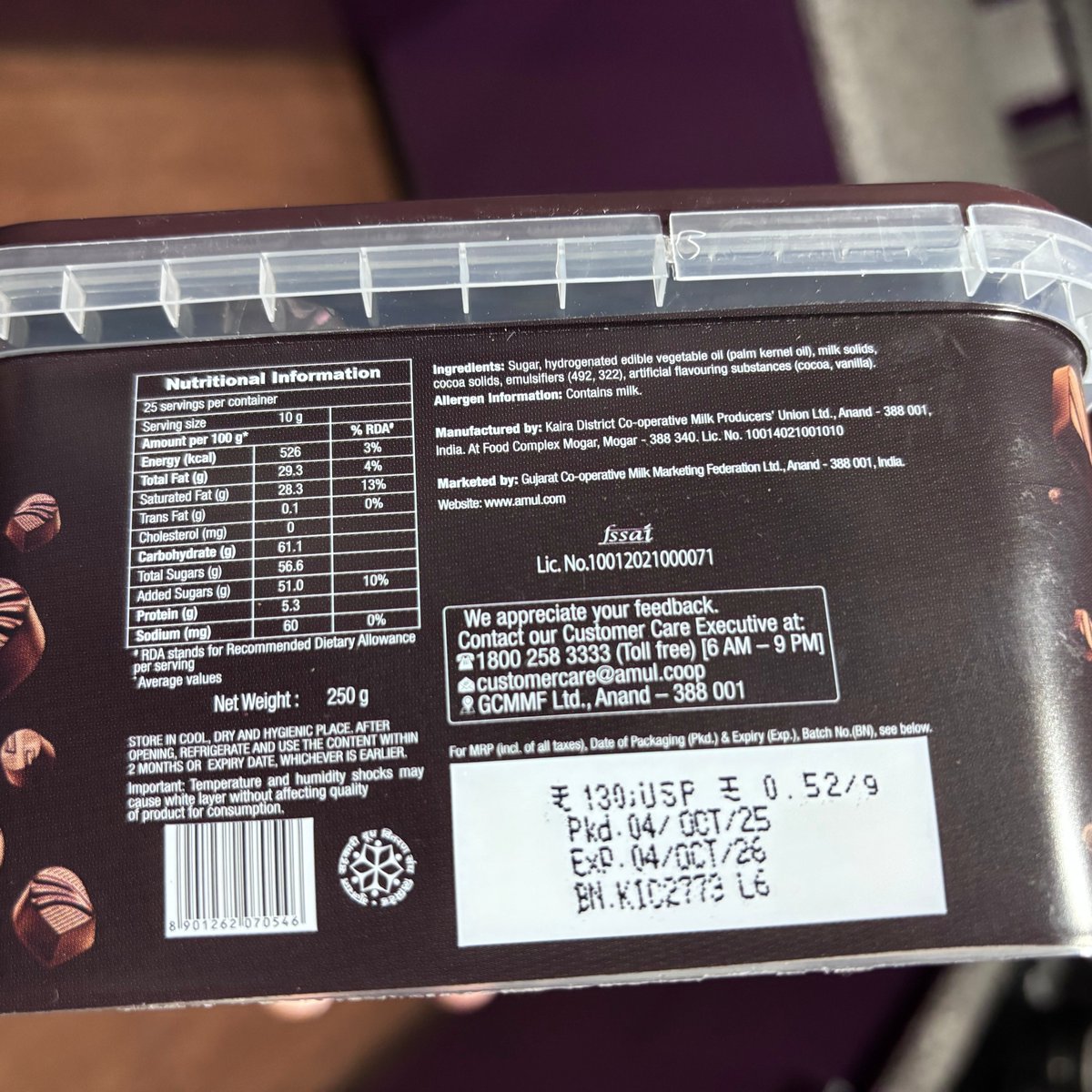
For a brand like Amul that had waged war against the use of vegetable oil in Kwality Wall's ice cream with highly publicized advertising campaigns in the mid-2010s, to see an Amul Chocolate (Chocominis) product list "Edible hydrogenated vegetable oil" as the Number 2 ingredient (indicating its importance in the making) is adequately shocking!
There's a misconception that bus systems take off a lot of density off the road, and so it reduces congestion. The truth is far more nuanced.
1. BRTS superior demands on demand density. In dense corridors with high peak loads, metros and rails actually outperform BRTS.
2. BRTS makes sense where ridership is high enough to justify dedicated lanes, but not so high that buses saturate.
3. It only works if lanes are truly exclusive. If right-of-way can't be protected, BRT becomes a failure.
Before I put in the math, let's understand what bus bunching is and what headway spacing is.
Bus bunching up happens when small delays cause buses that were evenly spaced to clump up at the same bus stop together.
Headway space is the gap between vehicles. If there's less headway space, then probability of buses bunching up increases. And that's inefficient.
Based on practical experience, regular buses require 2-5 minutes of headway. That reduces to 60 seconds for BRTS. And that's why people think it is more efficient. You cannot push this below one minute.
Transit math:
Capacity = vehicles/hr × passengers/vehicle
BRTS tops out ~15k pphpd before bunching. Bus capacity cannot be more than 200. And you can have at most 60 buses an hour. That gives you a max capacity of 12k passengers an hour.
Metro does 40–70k+. For example, Mumbai Metro 1 can transport 65k passengers at peak hours.
BRTS works, but really in very niche use cases. In most cases, in India, we're better off building metros.
I think the difference between a developed country and an undeveloped country is not income inequality.
It is power asymmetry.
In undeveloped countries, people in government, be it politicians, civil servants or judiciary, have an extraordinary right to trample on citizens and their rights.
That's the problem in India today.
Call it VIP culture. Call it unaccountability. Call it arrogance. In fact, call it toll exemptions, security clearance, whatever.
It all stems from a core belief that people in power are somewhat superior. So, they can get away with doing anything to people who don't have power.
The recent police videos and the SDM video are all examples of that.
It's only because of social media that these things even come to light - probably less than 0.001% of the daily sapping, brutal exercise of power.
So, if we want "Viksit Bharat", we need to do two things.
The first is, of course, financial growth, infrastructure, and all that.
But that still won't be enough.
We have to get rid of the power asymmetry. That will truly make a difference.
Less discretionary power, less perks, less privileges, less "exceptions". And more transparency thru social media.
We become a superpower when 1.4 billion people have power.
The Tale of Two Bridges
Bridges are an important part of many cities. You build them well; they are a lifesaver. Build them badly, and you curse them for years.
Whether you like it or not, bridges are very critical in the complicated maze that is the urban commute system.
Bridges are like Salt, Nobody notices them when they are present. But when they are absent. They cause havoc.
Today, I am going to be talking about two bridges, 5000 kms apart from each other in terms of distance and 10 years in terms of time.
One is a tale of incredible engineering achievement. The other however, is a case of bureaucratic apathy and systemic disorder. And the tale of these two bridges also is somewhere a metaphor for the progress made by the two countries.
The first bridge I am talking about is a Chinese bridge called Sanyuan Bridge.
Built in 1984, this 350 mtr bridge connects the Beijing Airport expressway and some other important places in Beijing. So important is this bridge, that it is used by over 2 lakh vehicles every day, 48 bus routes and carries more than 7 lakh people. That is 25% of the population of New Zealand to put it in perspective.
By 2010, the bridge had begun to show its age. Cement had started falling off, steel was visible, cracks were observed and the bridge was deteriorating faster than the storylines of a Salman Khan movie.
By 2015, the Beijing authorities decided that the Bridge no longer was safe for people and had to be replaced. They estimated that, if they rebuilt the bridge using traditional methods, would take 90 days.
But considering this was in an important intersection, a shut down of 90 days would be catastrophic. Traffic jams giving Silk board an inferiority complex would occur, countless hours will be wasted, and people’s lives would become hell.
So, what did they do?
First, they did a complete study of the old bridge, its construction technique, the size of its girders, beams, spans and all the other civil engineering stuff, down to the last mm.
Then they prefabricated the entire new bridge off site.
Post that, using lasers and satellite navigation, they planned to bring the constructed bridge to the actual site.
Once everything was planned and ready, at 23:00 on November 13 - 2015, the Sanyuan Bridge replacement project commenced.
First the old bridge was the cut into 27 pieces for removal, each weighing anywhere between 75 to 139 tonnes. 2490 cranes worked in tandem to remove these parts, one by one.
The entire thing was done in 7-8 hours.
Then using a custom-made girder carrier, which was 50 mtrs long, had 96 tyres and a capacity of 216 tonnes, they rolled the new prefabricated bridge in place. To put this in perspective, the world’s biggest airplane, the Antonov AN-225, has 24 tyres. This had 3 times that number.
They manoeuvred it slowly, because they had an error margin of 9mm.
After 18 hours, the new bridged was dropped and snapped into place.
And by 11:30 AM on Nov 15th, 2015, the new bridge was thrown open to traffic.
The entire operation was finished in 43 hours.
In 43 hours, they had replaced a critical Beijing bridge, while causing least inconvenience to the people of Beijing and hardly causing any stoppage.
Now we come to another bridge, this time in the city of Mumbai, called the Sion Bridge.
This 400 mtr bridge is one of the few that connects the central and western suburbs of Mumbai.
Built in 1912, like Rahul Dravid, it carried the bulk of Mumbai traffic for a very long time.
Then in 2024, the BMC had a sudden realization. They realized after 112 years, that the bridge was 112 years old and they had to replace it. Otherwise it would lead to a disaster.
So In Aug 2024, they shut it down.
They said it will be done in 2 years. Six months to demolish it. One and half years to build a new one.
Then the problems started
Post shutting traffic, they realized that there was a public toilet on the bridge and an illegal squatter above that toilet. And there were electric transmission cables which ran thru the bridge. Mind you, this is a 112 year old bridge.
It took them seven months to collect the NoCs for that.
Then they realized, forget vehicles, lakhs of people, including school students, used that bridge to cross over from one side to the other. Demolishing the bridge would deprive them of a major foot over bridge.
So, they had to build a new walkway for pedestrians before they could demolish the bridge.
The walkway is still under construction, nearly 1.5 years after the closure of the bridge.
As of Nov 2025, the old Sion bridge is not yet fully demolished. So, the construction of a new one is out of the question.
There are cranes on that bridge, but I have never seen them operate. It is like the entire project has stalled.
BMC says it will open the new bridge by 2026. But looking at how it is going, I wouldn’t be surprised if it isn’t done 2036.
And even after taking 10 years, the final bridge won’t be aligned with the road beneath it, which will push the construction by another 5 years.
Today’ thanks to Sion Bridge closure, there are traffic snarls, which are infinitely worse than the ones in Saki Naka.
What used to take 9 minutes, now takes anywhere between 40 to 1 and half hours. The life of Sion/Matunga/Wadala people now starts and ends in that traffic jam.
Two bridges, same dimensions, same criticalities and same challenges.
One country replaced it in 43 hours, ten years ago.
One hasn’t started construction for 15 months.
Don’t give me democracy, dictatorship, communism and capitalism in this.
This is sheer execution. And we suck at it.
Chinese have the resolve the size of the aforementioned girder carrier to solve infrastructural problems.
Our’s smaller than one of those 96 tyres.
Completely agree. To compare, Delhi went through a similar upgrade between 2000-2010. At this time, Mumbai got nothing. But with @Dev_Fadnavis coming in, there has been a real transformation. More power to you Sir!
“Mumbai is Upgrading”
If you have travelled around Mumbai over the last 5 years, you’ve definitely seen this board somewhere.
It was a sign that either the road is dug up, or traffic has been diverted.
And it felt like ‘roz ka traffic hai’, ‘kitna saal construction chalega’, ‘dhul-mitti udti hai’, ‘daily ka kitkit’.
But in the background, at breathtaking speed, Mumbai was indeed upgrading.
I stay two mins from Akurli Metro station.
When the first pillars were put here, my family would joke that ‘mere bache travel karenge ye metro mein’.
Because that is the speed of construction we were used to in Mumbai.
Within 5 years, I was myself travelling in that metro. And it’s been 3 years since I’ve been taking that metro to office everyday.
But it’s not only the Metro.
Look around.
Big towers and projects are coming up everywhere - even in residential areas.
The Goregaon skyline looks different than it used to 5-7 years back. The Borivali skyline looks different. The Lower Parel skyline looks different.
South Mumbai looks different with the Coastal Road. The Haji Ali junction feels different. The promenade has given a new look to the city. The Atal Setu presents a new skyline of the city. Drone shots of Mumbai look vastly different than they did merely a few years ago.
The cement road upgrades in my area are better than previous shoddy road work. The local trains didn’t stop much in spite of extraordinary rains this year - signalling that people got things right in the backdrop. More AC trains are visible on local train networks - plans are in place to upgrade all old coaches with ones that have doors.
Of course, everything isn’t perfect. There is a lot to do - in sanitation, traffic, roadways. These things don’t change overnight - but the trajectory has been set in the right direction.
Multiple metro lines, a coastal road, a sea bridge, a new airport, local train upgrades - these are staggering changes in a span of 7-10 years.
You may not realize that if you live and move around this city on a daily basis. But ask someone who was here 15-20 years back, and they’ll tell you how different things are.
Mumbai is indeed upgrading.
And the energy to do more is infectious - Mumbai 3, the Vadhavan port, more airport terminals, multiple metro lines already in progress, underground tunnels connecting different parts.
There is no poverty of ambition.
And that is fitting for a city like Mumbai - it is the mayanagri after all.
I can’t talk about all this and not mention the architect of this transformation of Mumbai - @Dev_Fadnavis !
Yes, there is a team and lakhs of people who have contributed at various levels, but leadership matters.
To move files. To energize teams. To execute at scale and speed. To monitor and review.
Mumbai is going to look and feel radically different within the next 15 years. It is on its way to become a truly world class city.
And I am a proud Mumbaikar witnessing this transformation of Aamchi Mumbai first hand.