Grok confirms that @LeaderJohnThune can fire parliamentarian Elizabeth MacDonough. Please REPOST to send this message to Thune.
https://t.co/q5PjfSK9HF
At 17, Dawn Loggins came home from a summer program and discovered her family was gone.
No note.
No warning.
No home.
Months later, she received an acceptance letter from Harvard.
This is her story.
Dawn grew up in rural North Carolina in a house without electricity or running water.
When the family needed water, she and her brother walked to a public park and filled jugs from the bathroom faucets.
Showers were rare.
Classmates called her dirty.
She kept showing up to school.
Her parents moved constantly.
Eviction after eviction.
New town.
New school.
By age 17, Dawn had attended four different high schools and missed nearly an entire year of education.
Most students would have fallen behind.
Dawn excelled.
When she arrived at Burns High School in 2010, guidance counselor Robyn Putnam immediately saw something special.
Dawn enrolled in makeup courses.
Studied before sunset because there were no lights at home.
Took AP classes.
Earned straight A's.
Joined clubs.
Then led them.
Photography Club.
Rock Climbing Club.
Spanish Club.
President of all three.
That summer she earned a place at the prestigious Governor's School of North Carolina.
Teachers helped buy her clothes.
Putnam drove her 200 miles to the program.
Nobody knew where Dawn would be living when it ended.
The concern turned out to be justified.
Near the end of the program, Dawn tried calling home.
The number was disconnected.
When she returned, the house was empty.
Her parents had moved away.
She was 17 years old.
Homeless.
Alone.
Most people would have stopped there.
Dawn didn't.
She couch-surfed.
Carried toiletries in her backpack because she never knew where her next shower would come from.
And every morning at 6 a.m., she went to work.
As a school custodian.
She swept hallways.
Cleaned classrooms.
Scrubbed desks.
Then sat down and earned straight A's.
By graduation year, she had:
• Straight A grades
• AP courses
• Leadership roles in three clubs
• A part-time job before school every morning
Then a teacher made one suggestion:
Apply to Harvard.
Dawn laughed.
Then thought:
"Why not?"
She became the first student in Burns High School history to apply.
Months later, an envelope arrived.
Harvard College.
Accepted.
Full tuition.
Full room and board.
Everything covered.
On graduation day in 2012, when her name was announced, the entire gymnasium stood and applauded.
Teachers cried.
Students cheered.
The girl who cleaned their hallways before sunrise was heading to Harvard.
When asked about her parents, Dawn didn't speak with anger.
She simply said:
"I love my parents. I disagree with the choices they've made."
Then she added something even more powerful:
"If I had not had those experiences, I wouldn't be such a strong-willed or determined person."
Burns High School had over 1,000 students.
Dawn Loggins became the first ever accepted to Harvard.
Proof that the circumstances you're born into are not the same thing as the future you're capable of building.
On the morning of June 6, 1944, Lt. Dick Winters had already survived one disaster before the sun came up.
His C-47 roared over Normandy through a wall of flak, flying too fast and too low. He jumped anyway. The prop blast ripped his leg bag clean off, taking his rifle, his ammo, and most of his gear. He hit the ground in occupied France armed with a knife in his boot.
Most men in that situation hide. Winters started walking toward the sound of the war.
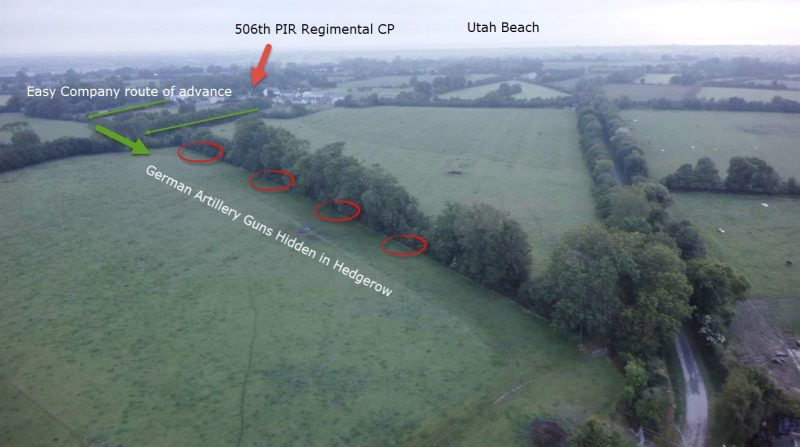
By dawn he had scavenged a rifle, collected a handful of scattered paratroopers, and learned that his company commander's plane had gone down with everyone aboard. Just like that, a quiet lieutenant from Pennsylvania who didn't drink, didn't curse, and wrote letters home about wanting to find a peaceful farm someday was in command of Easy Company.
A few hours later a battalion officer gave him one of the great understated orders in military history. German fire was coming from a farm called Brecourt Manor, hammering the troops coming off Utah Beach. The order was basically: there's fire along that hedgerow, take care of it.
What was actually there: four 105mm howitzers dug into a hedgerow network, connected by zigzag trenches, covered by machine guns, and defended by roughly 60 German troops. The guns were dropping shells directly on causeway exit 2, where thousands of Americans were trying to get off the beach. Every minute those guns fired, men died in the sand.
Winters had 12.
He did not charge. He crawled forward alone to study the position, then briefed his men like he had all the time in the world. Machine guns here to pin the defenders. Compton, Guarnere, and Malarkey crawling along the flank. Hit the first gun with grenades and speed from a direction the Germans never expected.
It worked almost exactly as drawn. The first gun fell in minutes. Then his men used the German trenches as a highway, rolling up the battery one gun at a time, beating back counterattacks, and dropping blocks of TNT down the barrels to destroy them for good.
In the middle of the firefight, Don Malarkey spotted what he thought was a Luger on a dead German and sprinted into open ground to grab it. The German machine gunners held their fire, apparently deciding that anyone that reckless had to be a medic. He made it back alive. It wasn't even a Luger.
At the second gun, Winters found something better than a pistol: a German map showing every artillery and machine gun position covering Utah Beach. He sent it up the chain immediately. On the most important morning of the war, a 26-year-old lieutenant had just handed the Allies the enemy's entire defensive layout for the sector.
When reinforcements under Lt. Ronald Speirs arrived, they stormed the fourth and final gun. About three hours after it started, the battery was silent and the exits off Utah Beach were open for thousands of men who will never know his name.
The cost: one American killed, a few wounded. The Germans lost around 15 dead and a dozen captured. Winters received the Distinguished Service Cross and later said the best decoration he ever got was a sergeant telling him years later that his men trusted him with their lives.
The assault on Brecourt Manor is still studied at West Point as a textbook example of a small unit destroying a fixed position.
Around 60 defenders. Four guns. Twelve paratroopers and a lieutenant who started D-Day with nothing but a knife.
If it sounds familiar, it should. This is the same Easy Company from Band of Brothers. The difference is that none of it was fiction.
And when Winters was asked decades later if he was a hero, he gave the answer that still gets quoted at his statue in Normandy: "No. But I served in a company of heroes."
Lock her up and never let her see daylight again.
A 1-year-old named Jacob starved to death eating roaches and ants while his mother left 6 kids — ages 1 to 10 — alone for 12+ hours in a filthy, foodless home.
Her attorney’s defense? “We are here because my client is poor.”
She looked well-fed. Poverty is not an excuse for evil.
Where is the outrage? Black community? Media crickets. Again.
Today, we remember the heroes of D-Day - June 6, 1944.
Through extraordinary courage and sacrifice, American troops stormed the beaches of Normandy, defeated tyranny, and helped secure freedom for generations to come.
Their legacy lives on. America remains forever grateful. 🇺🇸
Hawaii state officials stole around $12M from you. The money was supposed to be used to prosecute fraudsters, but they didn’t indict a single person in 4 years. The Trump Administration will not sit back and do nothing when states waste your tax-dollars. Other states should take note. More coming soon.