Before you cut steel on your first injection mold, send me the print. I'll tell you free what will fight you in the mold: draft, walls, gates, sink, undercuts that add slides. I'm a journeyman toolmaker managing mold builds in China for US teams. DMs open.
@getpeid Making something people already wear smart is mostly an enclosure problem. The electronics need a sealed shell that stays as thin and light as the original, and thin plastic walls get hard to fill the farther they run from the gate.
Ask to see the ejector pin layout at mold design review. Every pin leaves a round witness mark, and pins go where the part needs a push, not where your customer won't look. Mark the faces that can't take a pin on your print before steel is cut. Where can pins push on yours?
@Onshape Same here. Settle the parting line and pull direction first, and draft, shutoffs and slides all follow from it. Leave it for last and the part gets reworked to fit the steel.
@Slant3D For some parts it already is. Molding still wins where one multi cavity tool fills several parts every cycle, the cosmetic surface has to come straight off the steel, or the resin is one a printer can't run. Where have you seen the crossover move most?
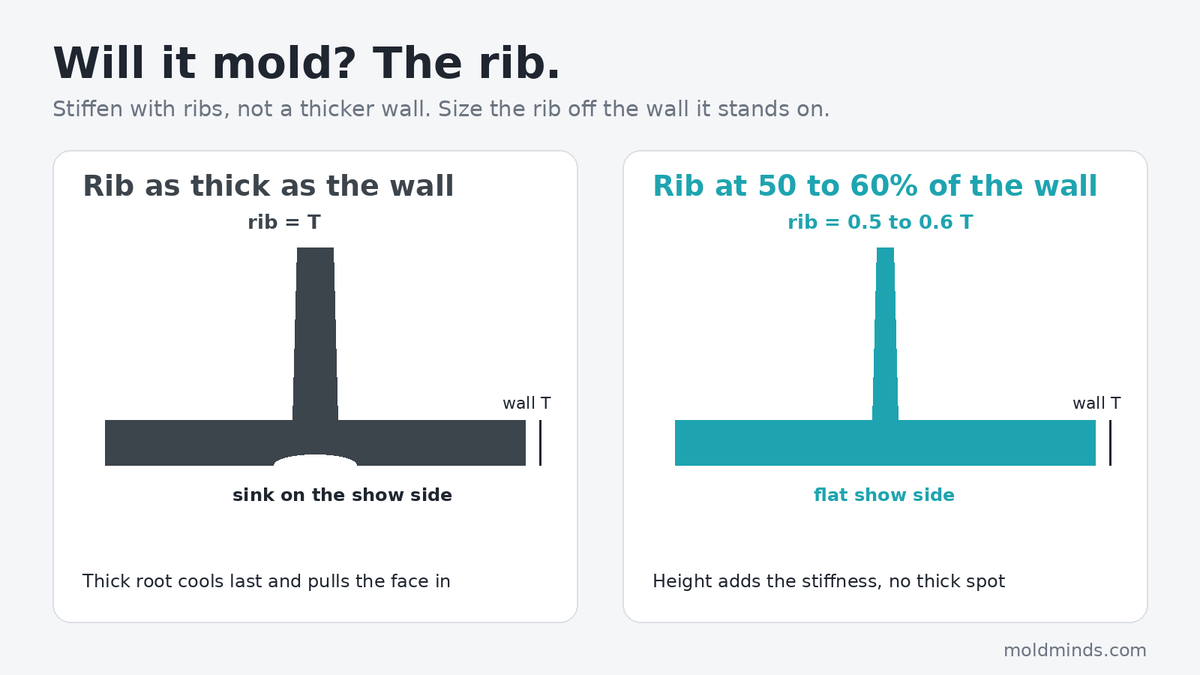
Will it mold? The rib. Need a stiffer part? Add ribs, don't thicken the wall. Keep each rib 50 to 60% of the wall it stands on. A rib as thick as the wall leaves a sink line on the show side right behind it, and packing harder rarely fixes it. How thick are your ribs?
@Stratasys@SMEMediaNews Production printing changes the make or mold call. No tool to pay for and no draft to design in, but the piece price stays flat. A mold front loads the cost, so your volume sets the crossover point.
@plasticsnews Floods hit the molds as hard as the presses. Rust on a polished cavity and silt in the water lines show up later as blemished parts and hot spots, so tools need a full teardown before they run again.
@FreightWaves Battery plants pull in a lot of molded parts: cell frames, covers, connector housings. Many run in flame rated grades that are less forgiving in the mold, so local molders with that experience get busy fast.
@Slant3D For low volume and parts that keep changing, agreed. The math turns at volume: a mold shoots every cavity in one cycle, so once the steel is paid off the piece price keeps falling while a printed part's stays flat.
@SOLIDWORKS Reynolds number is the one to watch. Water that flows too slowly in a cooling line goes laminar and pulls far less heat, so one slow circuit leaves a hot spot that shows up as warp or a longer cycle.
Agree on what a good part looks like before T1, in writing: a cosmetic spec naming each surface and the flaws it can carry, plus boundary samples both sides sign. Without it, acceptable is whatever the shop says the day parts ship. Who signs off cosmetics on your part?
@Onshape Smooth G3 blends are worth it on molded consumer parts, as long as the parting line has a clean place to land. Decide where the mold splits before blending everything, or the steel ends up with a thin shutoff that wears and flashes.
@FreightWaves Delivery assurance at a car plant often comes down to molds. Many molded parts come from a single tool, so one mold down for repair can starve the line. Ask suppliers which parts have a spare tool or insert on the shelf.
@Ryan__Dunwoody Shenzhen speed is real for prints, boards and soft tooling. The production mold is still the long pole, and most of the time saved there comes from settling draft, walls and gate location before the steel is cut.
@arduino Electronics on a race boat live in spray and vibration. If a build like that ever gets a molded housing, design the gasket groove and the screw bosses together so the lid clamps evenly instead of bowing between screws.
@BambulabGlobal Printed fixes are a cheap way to prove a part works before anyone cuts steel. If one turns into a product, the print shows fit and function, but the molded version still needs draft, even walls and a place for the gate.
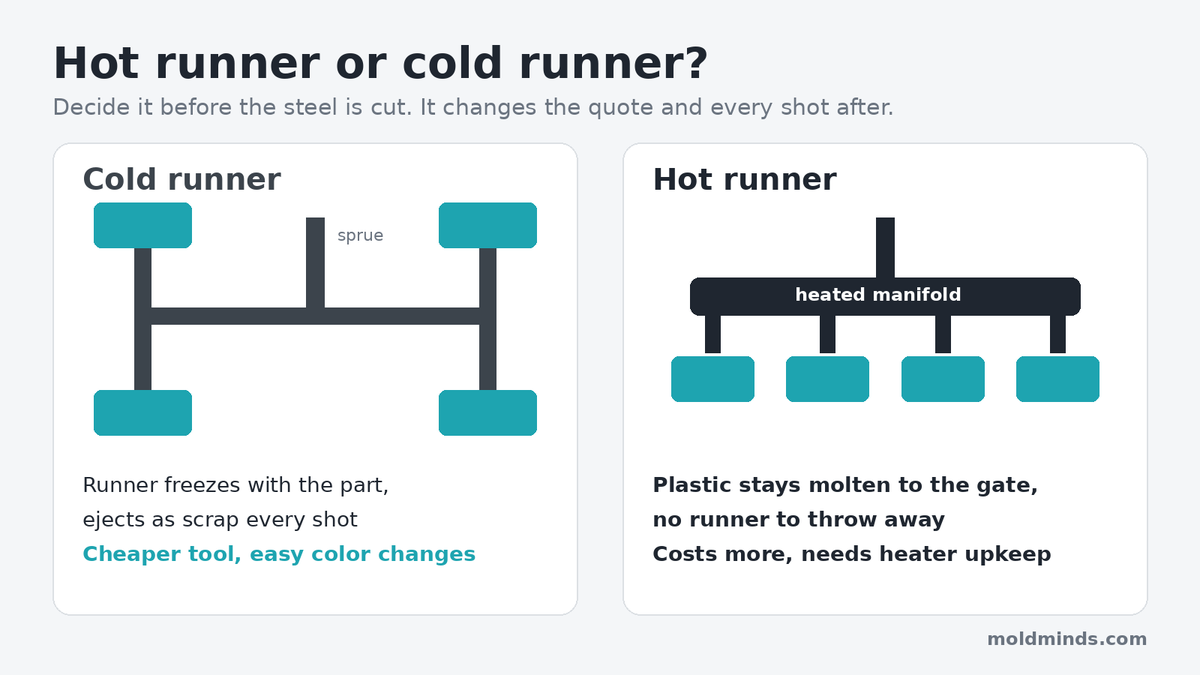
Hot runner or cold runner is a buying decision, not a shop detail. A cold runner ejects a scrap skeleton every shot, and that thick runner often sets the cycle. A hot runner costs more up front and needs upkeep. Volume and color changes decide it. Which is on your quote?
@plasticsnews If soft pricing tempts a switch to PCR, treat it like a new resin. Shrink and color can shift, so run fresh samples and check dimensions first. Dark colors hide lot to lot variation far better than whites.