@Arm Nvidia N1X ARM based-SoC (System-on-Chip) with customized Windows 11 laptops.
> CPU: 20 core based on ARM v9.2 cores.
> GPU: Blackwell architecture with 6,144 CUDA cores
> Unified LPDDR5X memory architecture
> Those are coordinates for Taipei, Taiwan
> Computex 2026 next week
Rosenblatt InP lasers checks:
According to our checks, NVIDIA, which is the driving force behind scale up CPO, asked the supply chain to increase InP laser capacity by ~20x from 2025-2030. The vendors appear to have taken a more conservative stance, agreeing to an ~12x increase ( $AAOI / $LITE etc)
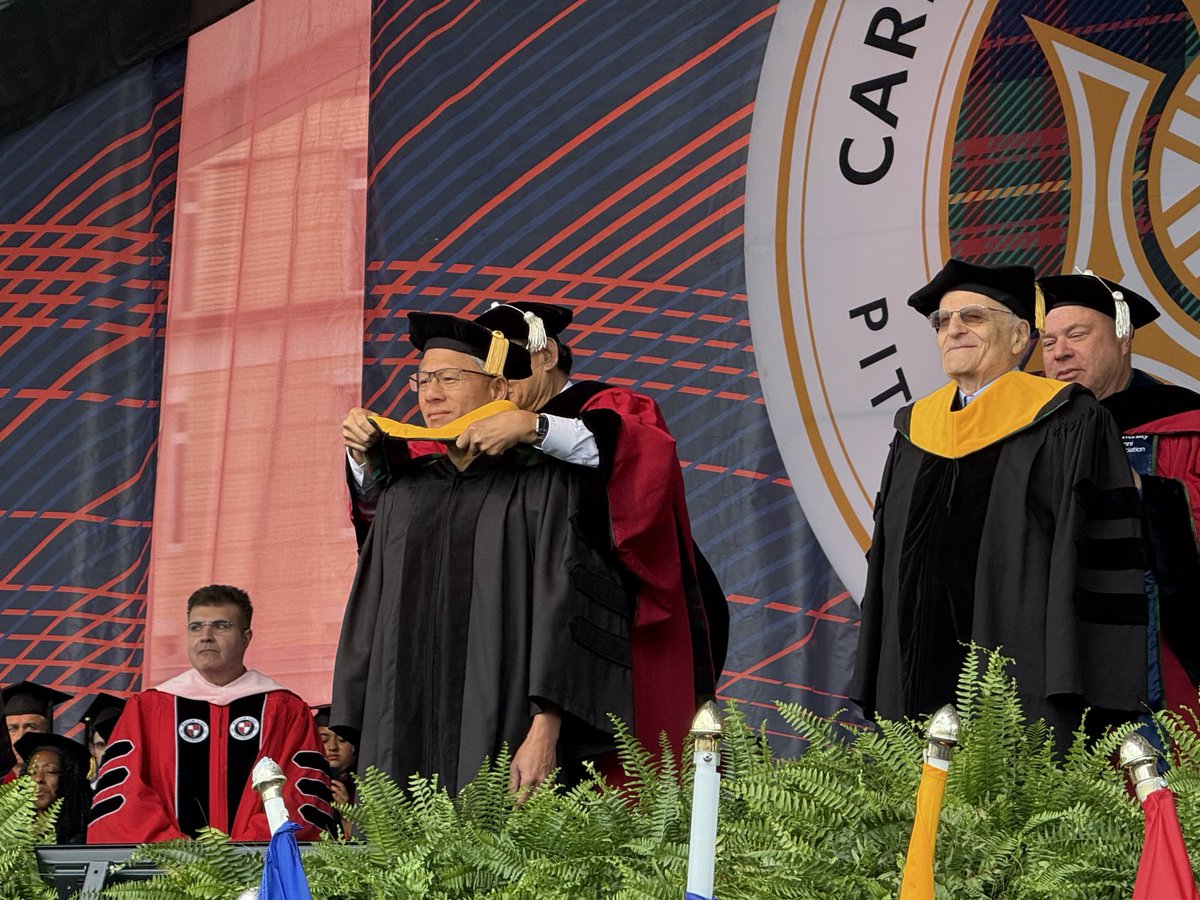
Congratulations to my good friend Jensen Huang on being awarded an Honorary Doctorate in Science and Technology from @CarnegieMellon University for his outstanding contributions to accelerated computing and Artificial Intelligence. It was my honor to place upon him his doctoral hood this morning. @intel and @nvidia are collaborating to develop exciting new products!
# 3D Packaging & **Onto Innovation (ONTO TP $397) Note
* **Outlook:** 2026 revenue guided at **$1.3bn**; capacity supports **$2bn** by 2027.
### **3D Packaging Trend** We expect the shift to 3D for Nvidia Feynman, AWS Trainium, and Google V9 (Broadcom).
* **Capacity Surge:** We forecast TSMC SoIC capacity to be 15KPM and 35KPM by end of 2026 and 2027.
* **Tools:** **G5/3Di** tool shipments expected to jump from ~30 units in 2026 to >100 units in 2027.
#ONTO
CPO (Co-Packaged Optics) testing is critical because the cost of failure is enormous. Once an optical engine is attached to the switch package, a defect can jeopardize the entire assembly rather than a replaceable module. The CPO test flow follows four sequential phases, each with distinct technical challenges, equipment requirements, and vendor ecosystems. (1/5)
We've just created this infographic visualizing 10-year EPS CAGRs among Food, Beverage, and Tobacco companies.
Here are the eight most impressive names:
$MGPI +49%
$CELH +34%
$COKE 32%
$PODR +28%
$DOLE +27%
$POST +26%
$AGRO +24%
$MOWI +22%
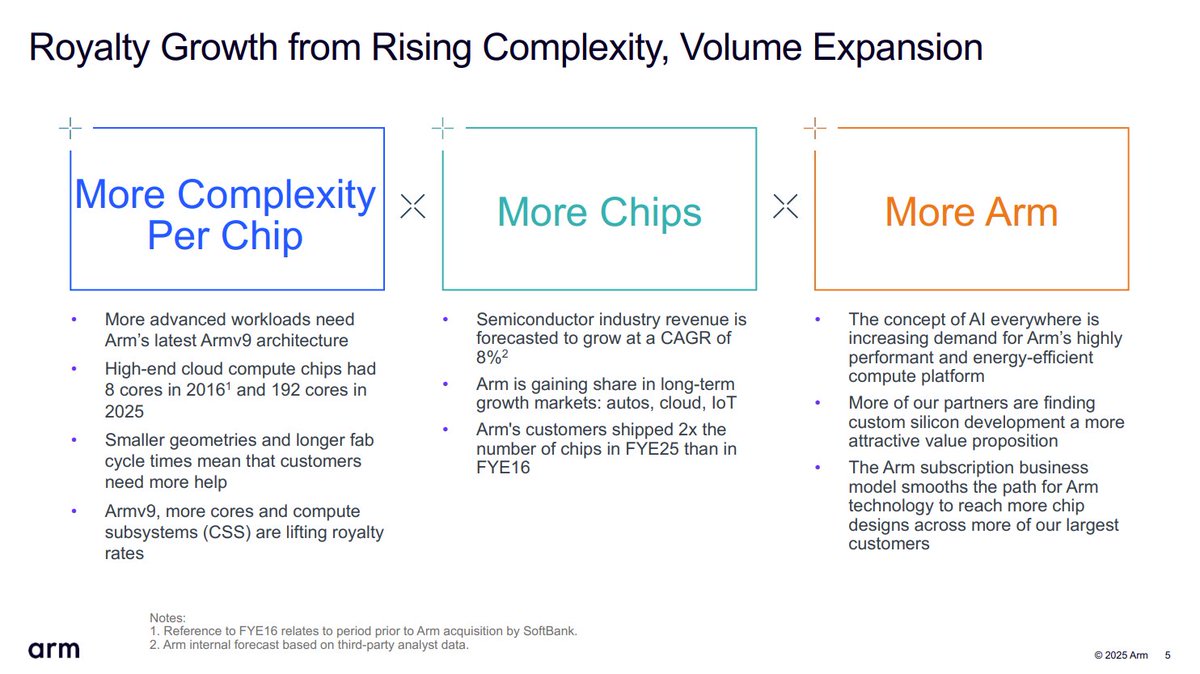
Arm just put up one of those earnings quarters where nearly every metric points the same direction: up and to the right.
I had a chance to speak directly with Jason Child, @Arm CFO, after the print, and the confidence level matched the numbers. Q3 revenue came in at $1.242B (up 26% YoY) with royalties at $737M (up 27% YoY) and license and other at $505M (up 25% YoY), plus non-GAAP operating margin at 40.7%.
Arm also raised Q4 guidance to $1.470B and raised non-GAAP EPS guidance to $0.58, even while much of the industry is talking about memory-driven constraints.
A few takeaways from my conversation that felt especially important:
1⃣ The market may be choppy, but Arm exposure is broad enough to keep compounding.
Jason framed Arm strength as “general exposure” across client, handsets, cloud AI, edge, and automotive. That diversity matters when one segment is noisy. It also shows up in the royalty line, which is being pulled by multiple end markets at once.
2⃣ Smartphones are still the largest business, but the mix is the story.
He acknowledged unit headwinds, with the expectation that OEMs protect the high-end and constrain the low-end. Net result, he sees only a modest impact to Arm smartphone revenue for the full year and an even smaller impact when blended into the whole company.
3⃣ Cloud AI is accelerating fast, and it is not subtle.
Arm calls out data center royalty revenue growth of 100% YoY, and positions the shift toward agent-based inference as a structural tailwind because it increases the need for power-efficient CPU cores.
Jason echoed that point in a memorable way: as inference and agentic workloads scale, more of the workload lands on the CPU, and in his view, Arm is the CPU for AI.
4⃣ Watch the hyperscalers, and possible “value capture” shift.
Beyond the usual names (Graviton, Cobalt, NVIDIA), Jason called out the Google TPU path as particularly interesting, paired with Google Axion CPUs.
And on the handset side, he pointed to something I had not considered: if phone vendors move from a Qualcomm core to Arm CSS-based designs, Arm can make materially more per design. Arm itself highlights CSS momentum with 21 CSS licenses across 12 companies, with multiple customers already shipping CSS-based chips.
My bottom line: Arm is executing like a platform company that is getting pulled forward by AI, not pushed around by cycles. Record quarter, raised guide, and a CFO message that the compute foundation is shifting in Arm's direction across cloud, edge, and physical AI.
If you are watching the AI stack, it is getting harder to treat Arm as anything but a clear leader. The next few quarters should be fun.
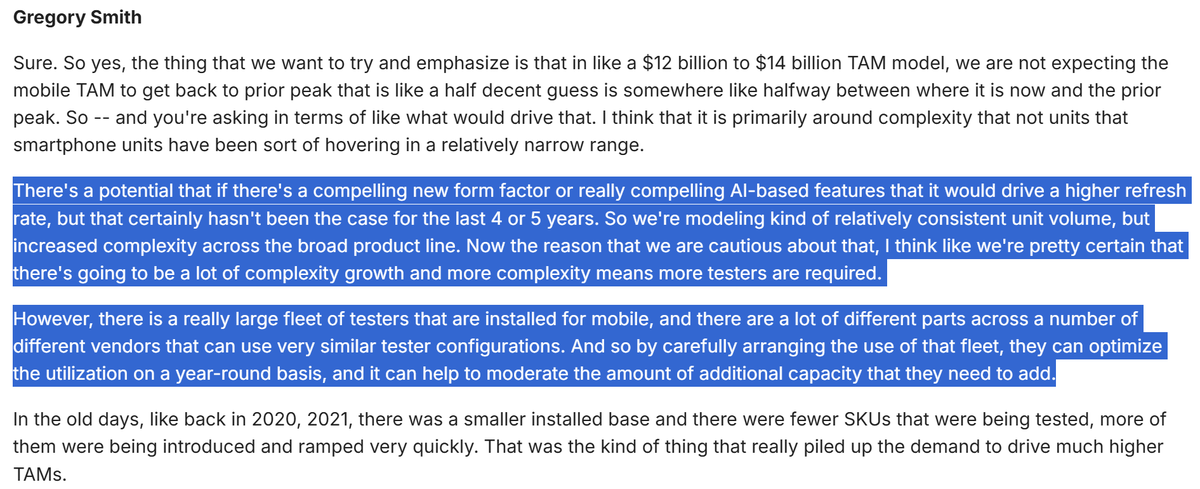
Teradyne sees mobile not recovering to previous peak despite 2nm/WMCM. Huge installed base in mobile limits incremental growth. Merchant DC GPU qual in process and revenue likely from 2H.
This year, whether from keynote talks by Micron, Marvell, Advantest, Teradyne, MPI and other leading companies, or from technical discussions throughout the forum, one theme was consistent: testing is now essential for high-speed SerDes, KGD validation, multi-stacked memory, system-level reliability, and thermal integrity. As AI/HPC chips increase in package size and push signaling frequency ever higher, test strategies must evolve beyond traditional wafer sort toward a new electrical × optical × thermal tri-domain framework. This shift is gradually turning testing into a critical engineering platform—one that will shape the next decade of semiconductor processes and advanced packaging architectures.
#SemiVision #Semiconductor #SiPh #SiliconPhotonics #CPO #Photonics #AI #Insight #Technology
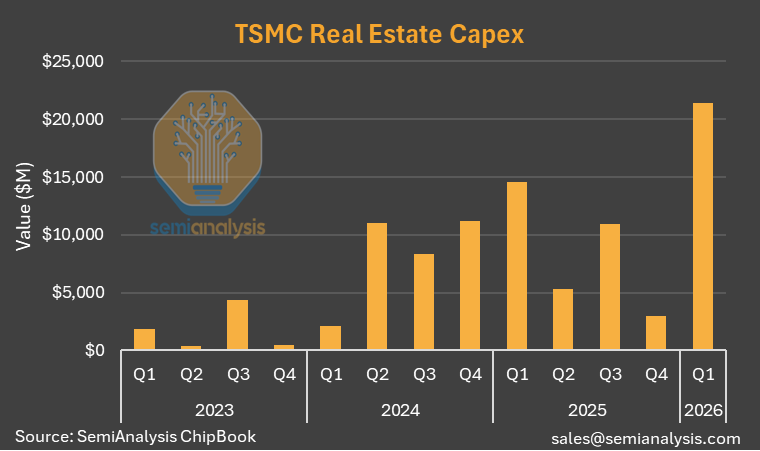
TSMC's huge capex trend is proven by KYEC's capex plan. Teradyne is a big upcoming player in GPU & ASIC testing; Advantest won't be the only beneficiary. This AI testing cake is big enough for everybody. $TER
Nvidia’s main chip testing supplier, Taiwan’s KYEC, will spend a record high NT$39.4 billion (US$1.3 billion) on capex next year to meet strong customer demand, media report, as KYEC’s board voted to approve the plan. KYEC has also signed an NT$35 billion 5-year syndicated loan with a consortium of Taiwan banks led by Mega International. $NVDA $TSM $TER #KYEC #Advantest #Semiconductors https://t.co/LommBFKFTg