Our vision is to empower rural India by transforming villages into vibrant centres of growth and opportunity. Addressing the Grameen Bharat Mahotsav in Delhi. https://t.co/XZ20St4QX9
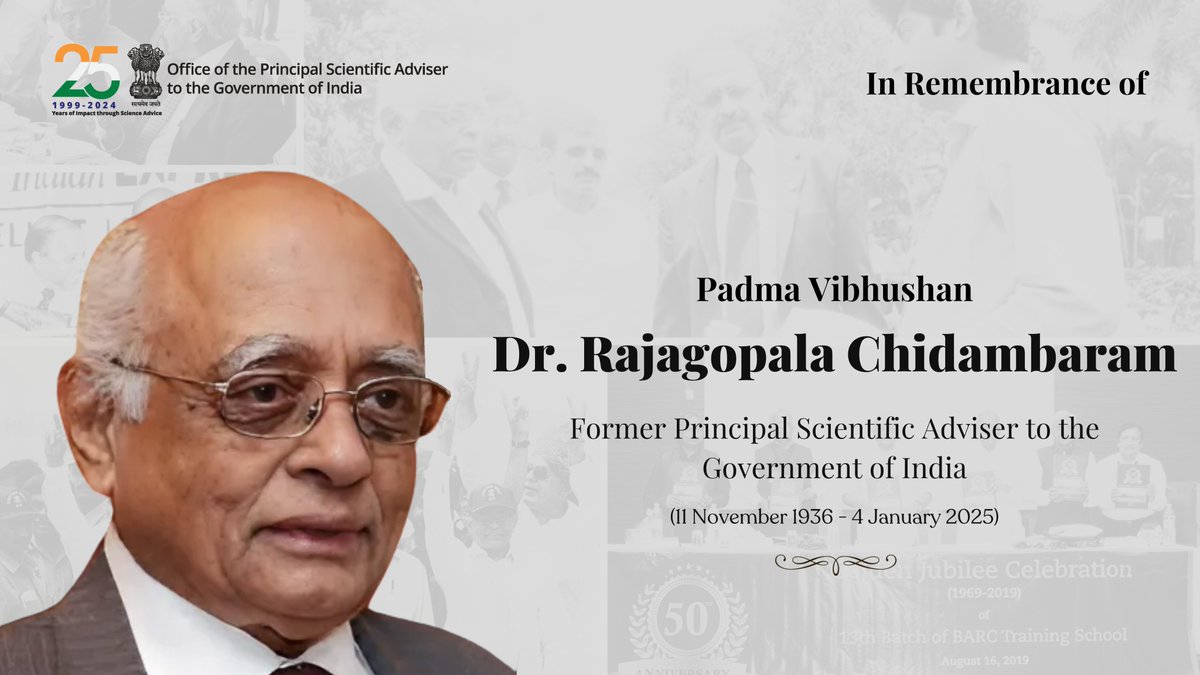
We deeply mourn the passing of Dr. R. Chidambaram, Former Principal Scientific Adviser to the Government of India and one of the nation��s most distinguished scientists.
Dr. Chidambaram was a visionary leader and architect of India’s scientific and technological progress. He played a pivotal role in India’s nuclear program, including the Pokhran-II nuclear tests in 1998, which established India’s scientific and strategic capabilities on the global stage. Dr. Chidambaram’s contributions to nuclear science, strategic technologies, and scientific policymaking have left an indelible mark on the nation.
A recipient of the Padma Shri (1975) and Padma Vibushan (1999), Dr. Chidambaram’s groundbreaking work in condensed matter physics, nuclear energy, and strategic technologies remains an enduring legacy. As Chair of the Scientific Advisory Committee to the Cabinet, he championed advancements in energy security, materials science, supercomputing, and nanotechnology.
His tenure as Principal Scientific Adviser saw the launch of initiatives such as Rural Technology Action Group (RuTAG), which empowered rural communities through innovative technologies, Society for Electronic Transactions and Security (SETS), to contribute towards advancing India’s cybersecurity and hardware security infrastructure, and National Knowledge Network (NKN) to connect educational and research institutions across the country addressing issues with ‘Access to Knowledge”.
His visionary leadership in strengthening scientific excellence, research and innovation ecosystems, and promoting Indian science diplomacy through multilateral and bilateral institutional mechanisms, continues to inspire generations of scientists and policymakers.
We extend our heartfelt condolences to his family, colleagues, and the scientific community. His contributions will remain a cornerstone of India’s progress in science and technology. We honour his legacy. India has lost a true scientific pioneer.
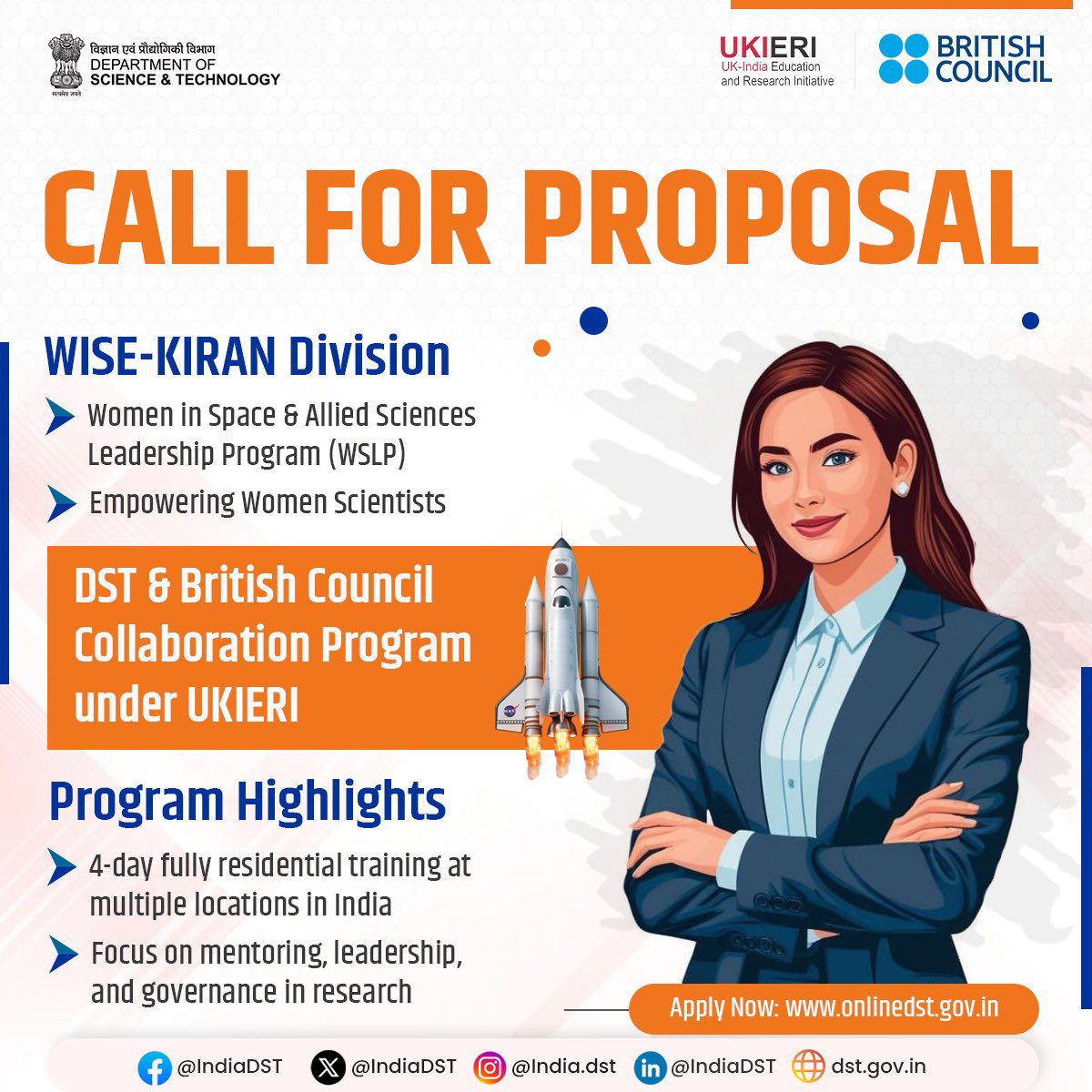
Empowering women scientists!🚀
The Women in Space & allied sciences Leadership Program (WiSLP) brings opportunities to build leadership skills & to advance your career in research📝
#WomenInStem
📢 Apply now!
https://t.co/77coGg13Wz
The Kodaikanal Solar Observatory is the oldest astronomical observatory in India. It is one of few solar observatories of the world which provides an opportunity to study long-term variations in the Sun's activity over a century scale. Established in the year 1899 it is managed by @IIABengaluru@IndiaDST. Ro know more see:
https://t.co/dhbAJA6bzv
https://t.co/rgVLkPY6EU
National-Level Entrance Exams for applicants considering a PhD in physics in India
Many universities and institutes in India require qualifying scores in national-level exams. Common ones include:
CSIR-UGC NET (JRF): Essential for research fellowships and admissions in
entrance exams, e.g.:
IITs
IISc Bangalore
TIFR (Tata Institute of Fundamental Research)
IISERs
Direct Admission:Exceptional candidates with an MSc in Physics and strong academic credentials may qualify for direct interviews at certain institutes.
#sharingtostayconnected
"I remember once going to see him when he was ill at Putney. I had ridden in taxi cab number 1729 and remarked that the number seemed to me rather a dull one, and that I hoped it was not an unfavorable omen. “No,” Ramanujan replied"
https://t.co/j51Fz7nPJN