Your kids will love this video!
Grok Imagine prompt:
The kittens with mittens start dancing and singing “we’re kittens with mittens” with joyful, energetic movements and playful expressions.
From physical wellness to inner peace, yoga enriches every aspect of life. Delighted to join this year’s celebrations in Kolkata. https://t.co/75UZECw8JR
Diagnostics. Research. Monitoring. Records.
The instruments of medicine have always existed in pieces.
The next step isn't creating more tools.
It's bringing them together into a connected health infrastructure.
NO DONATIONS FOR FIVE DAYS!!
NO DONATIONS FOR FIVE DAYS!!
NO DONATIONS FOR FIVE DAYS!!
NO DONATIONS FOR FIVE DAYS!!
NO DONATIONS FOR FIVE DAYS!!
NO DONATIONS FOR FIVE DAYS!!
NO DONATIONS FOR FIVE DAYS!!
NO DONATIONS FOR FIVE DAYS!!
https://t.co/gEECCiiXCi
A drug spends years in trials, then decades in the real world.
The real world generates far more evidence about how it actually performs than any trial.
That evidence rarely goes anywhere.
Which patients respond. What side effects emerge. How it behaves across populations the trial never tested.
The most valuable evidence in the entire lifecycle — and it almost never flows back into what gets discovered or trialed next.
Every new program starts from the same incomplete picture as the last.
AI can generate more candidates than ever. But a pipeline that can’t learn from its own history won’t produce a different outcome.
The missing infrastructure isn’t discovery. It’s the loop back.
@LifeNetwork_AI Exactly
Faster tools in a broken sequential system still leave us waiting
The real leap will come from rethinking the entire parallel, integrated structure of drug development
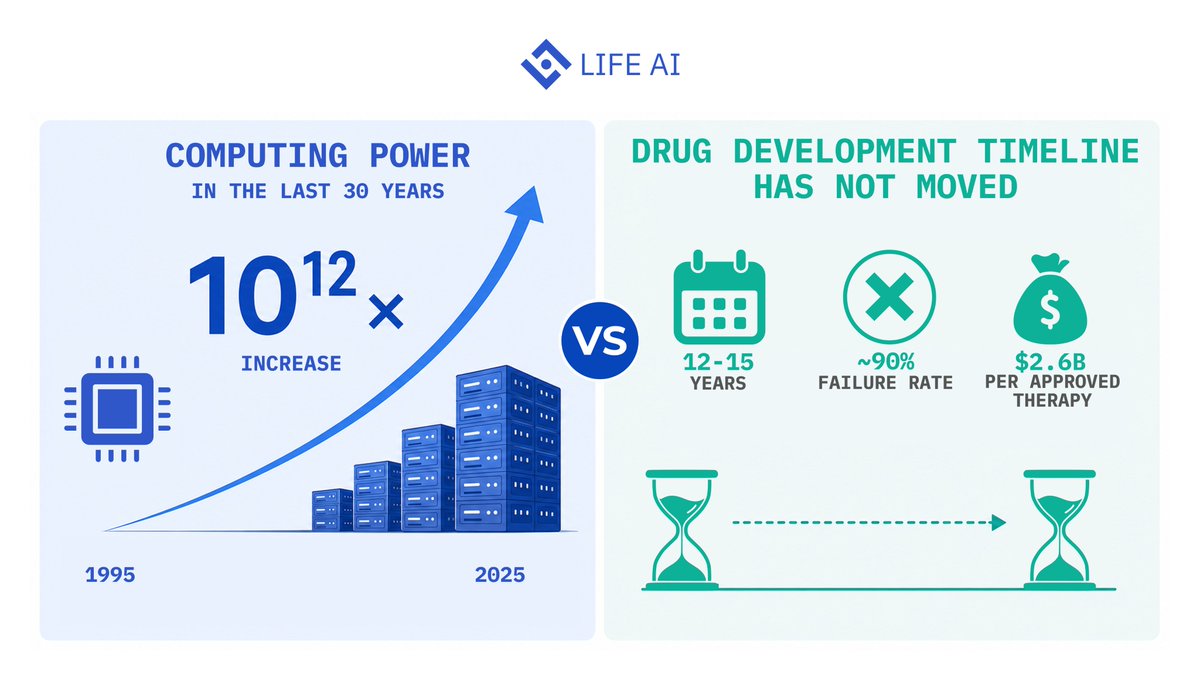
In the last 30 years, computing power has increased by a factor of a trillion.
Yet developing a new therapy remains one of the slowest, most expensive, and most failure-prone processes in modern science.
This is the paradox worth understanding.
AI has accelerated target identification. Gene sequencing has collapsed from years to days. Computational modeling can simulate molecular interactions at a scale that was unimaginable a decade ago.
Yet the pipeline moves at the same pace.
The reason is that technology has made individual stages of the process faster. What it has not changed is the structure of the process itself.
Drug development is still sequential. Each stage waits for the one before it. Each program still assembles its own evidence infrastructure from scratch. The handoff between controlled validation and real-world performance still happens after approval.
Better tools applied to a fragmented, sequential process produce better science at the same speed.
What compresses the timeline is not faster tools inside the existing structure. It is a different structure entirely.