Why I’m bullish on #Bitcoin and #Crypto right now…a little thread 🧵
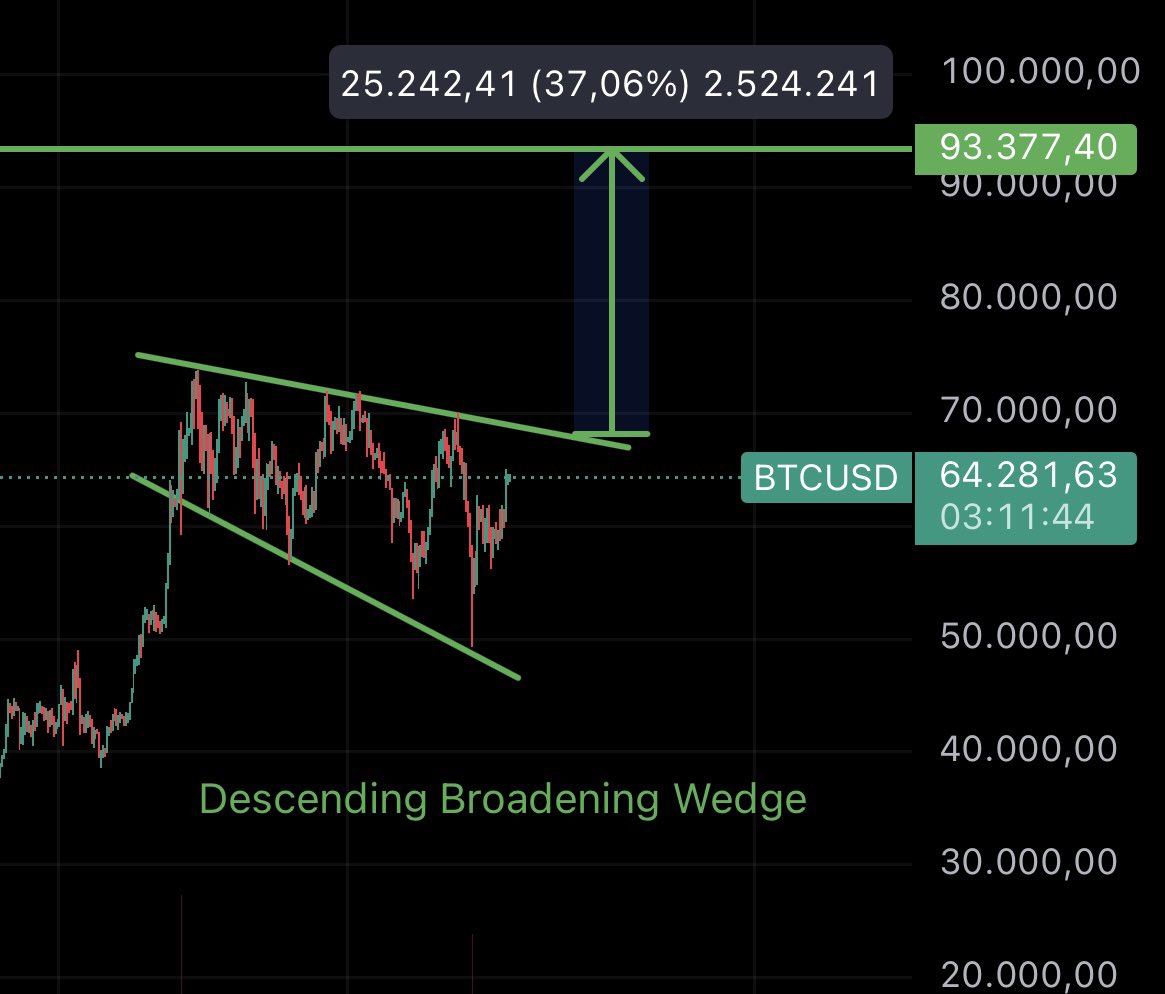
1. #BTC is currently forming a descending broadening wedge with a breakout target of round about $93.000…still waiting for a breakout and backtest though.
#VeChain isn’t chasing the next hype cycle. It’s building the rails Europe is about to require.
EU Digital Product Passports are going mandatory. VeChain is already running production-scale traceability with AMRC and Rekord, on top of real enterprise use from enterprises such as Walmart China, Lululemon, and DNV.
Add a 2026 push into AI agents and real-world assets, and the setup is simple: compliance demand meets a chain built for it.
Huge runway. Still early.
$VET
How does staking work on VeChainThor?
The simple version:
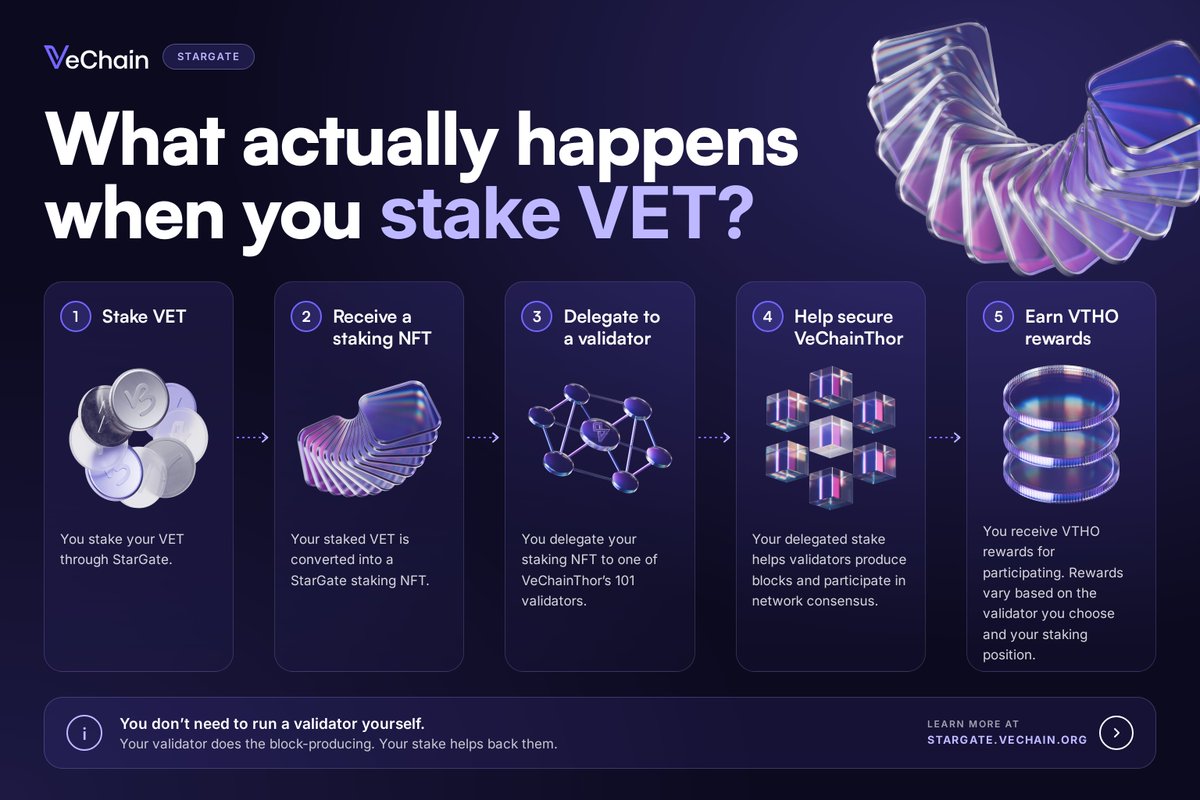
Stake VET → receive a StarGate staking NFT → delegate it to a validator → help secure VeChainThor → earn VTHO rewards
You don’t need to run a validator yourself. Your staking NFT represents your position, and delegation lets you participate through one of 101 validators.
One thing worth knowing: the validator you choose matters. Rewards can vary based on validator performance and your staking position.
If you’ve only recently started paying attention to VeChain, good timing.
Here’s the short version of what we’ve been working on:
Protocol: VeChainThor has been live since 2018. Interstellar just moved it closer to the modern EVM environment, with better tooling and stronger native cryptography. For builders: less friction.
People: VeBetter is now ~40 live apps, with 3 joining this month. Everyday actions, verified on-chain and rewarded — with an increasing focus on app quality, user experience and new ideas.
Agents: People like you have already built 440+ AI agents on VeWorld․ai. 440 is nice. What we really want to see is how many become genuinely useful to others.
Protocol. People. Agents.
More ways to put VeChain to work. Same goal since day one: make blockchain useful where it matters
15.5B VET is locked through StarGate today.
And if you check who’s helping secure VeChainThor, you might recognize a few names:
Crypto․com, Binance, Bitvavo, BitGo, Cointelegraph — plus a few familiar VeFam addresses and a growing validator community.
Not a bad crew to have keeping the lights on.
JUST IN: Spain confirms self-custody crypto holdings are exempt from foreign asset disclosures.
+ Assets bought and fully sold on foreign exchanges within the same year require no filing.
Kippt die @cducsubt in Bezug auf die Haltefrist bei Bitcoin nun doch? 🧐
Aktuelle Aussagen deuten Spielraum im Koalitionsvertrag und bei den eigenen bisherigen Standpunkten an.
⬇️⬇️⬇️
https://t.co/GNGMGF52M7
Most people still think vechain:native is the same supply-chain coin from the 2021 cycle.
It isn't.
While attention moved elsewhere, VeChain changed its consensus mechanism, redesigned its tokenomics, introduced staking and fee burning, grew its ecosystem to millions of users — and is pushing deeper into RWAs, payments and real-world adoption.
Yet VET is still trading at a fraction of its previous valuation.
That disconnect is what caught my attention.
So I took a deeper look at VeChain — and the VET thesis today looks very different from what most people remember.
VeChain has spent a decade building around real-world utility and enterprise adoption.
But underneath the surface, the network has gone through one of the biggest transformations in its history.
Galactica is LIVE.
It introduced an EIP-1559-style fee market with 100% of the VTHO base fee burned.
Hayabusa is LIVE.
VeChainThor moved from Proof of Authority to Delegated Proof of Stake, opening the network to validators and delegators.
The economics changed too.
VTHO production was reduced roughly 50%, while rewards shifted away from passive VET generation toward VET actively staked to secure the network.
And staking has grown fast.
According to VeChain, StarGate went from roughly 2.5B VET staked to 13B VET.
That's around 15% of circulating VET participating in network security.
Then there's adoption.
According to VeChain:
→ 5.3M VeBetter users
→ 50+ live VeBetter applications
→ 50M+ verified sustainable actions
→ 14M+ on-chain addresses
→ 530M+ transactions since 2017
→ 100% network uptime
VeChain has also launched 100+ enterprise applications historically and has worked with or built relationships involving names such as:
Walmart
Lululemon China
BitGo
Keyrock
Franklin Templeton
And VeChain is no longer simply the old "supply-chain blockchain" narrative.
It's expanding across:
→ Sustainability
→ RWAs
→ Digital Product Passports
→ DeFi
→ Payments
→ AI-agent infrastructure
Then there's Interstellar, the third phase of the VeChain Renaissance.
Interstellar has passed governance approval and is bringing VeChainThor closer to the broader Ethereum ecosystem through deeper EVM compatibility, JSON-RPC support, easier use of Ethereum tooling and stronger interoperability.
So the VET thesis today looks very different:
DPoS: LIVE
Staking: LIVE
100% VTHO base-fee burn: LIVE
Reduced VTHO issuance: LIVE
~13B VET staked: REPORTED
Interstellar: APPROVED / ROLLING OUT
None of this guarantees price appreciation.
VeChain still needs more developers, liquidity, economic activity and, perhaps most importantly, market attention.
But that's where the valuation gets interesting.
With roughly 86B VET circulating:
$0.10 VET ≈ $8.6B market cap
$0.25 ≈ $21.5B
$0.50 ≈ $43B
$1.00 ≈ $86B
Now compare that with $XRP.
A $1 VET would put VeChain at roughly an $86B market cap — around the valuation territory XRP has already demonstrated.
XRP has a massive head start in institutional adoption, liquidity, payments infrastructure and market recognition.
So VET reaching that level would require an enormous expansion in adoption, demand and capital.
But here's the part I find more interesting:
VET doesn't need to reach $1 for the thesis to get interesting.
A $5B–$20B VeChain would already represent a completely different valuation from where it sits today.
5.3M users.
50M+ verified actions.
530M+ transactions.
13B VET staked.
New tokenomics.
DPoS live.
Interstellar rolling out.
The technology changed.
The tokenomics changed.
The network changed.
The market's perception hasn't necessarily changed with it.
Now the question is:
Will attention and capital eventually catch up?
vechain:native 👀
Gerade gemeldet: Strategy, BlackRock, Fidelity und Coinbase zahlen jetzt gemeinsam für die Sicherheit von Bitcoin.
Heute wurde das Bitcoin Security Consortium angekündigt: 9 der größten Finanzinstitute und Bitcoin-Firmen, darunter auch Strategy, Ark Invest und Block, bündeln ihre Kräfte für die langfristige Sicherheit des Netzwerks. 15 Millionen Dollar fließen über die nächsten drei Jahre in die globale Bitcoin-Security-Community.
Die Sicherheitsforschung wurde bisher von einer Handvoll Entwickler und Spenden getragen.
Wenn der größte Vermögensverwalter der Welt anfängt, dafür zu zahlen, behandelt er Bitcoin wie kritische Infrastruktur. 👀
Weekly Recap
1) 🇺🇸 President Trump officially signs executive order opening the $12.5 trillion 401(k) retirement market to crypto investments.
2) SEC and Ripple $XRP officially end legal battle following joint dismissal of appeals.
3) President Trump officially signs executive order to stop banking discrimination against crypto, religion, and politics.
4) Canada loses 40,800 jobs in July, largest monthly decline since the COVID pandemic.
5) Harvard buys $116,666,260 worth of BlackRock's spot Bitcoin ETF.
6) Crypto Czar David Sacks says the executive orders President Trump signed this week will give 90 million Americans access to crypto.
7) 82% of S&P 500 companies beat quarterly earnings estimates, despite President Trump's tariffs.
8) SEC declares crypto liquid staking activities are not considered securities.
9) Dubai officially approves first crypto options license.
10) $ETH surpasses $4,300 for the first time since 2021.
Crypto markets—and the millions of Americans who participate in them—deserve long-overdue clarity.
Under President @realDonaldTrump's leadership, we are well on our way.
My latest in @CoinDesk with SEC Commissioners @HesterPeirce and Mark Uyeda ⬇️ https://t.co/KghSqh1PXZ