Ja Didi, het achterliggende verhaal is vooral waar veel mensen inspiratie uit kunnen halen. Omdat rijkdom relatief is zit het succes niet zo zeer in je keuze voor Bitcoin maar het waarderen van Tijd als schaarste goed. Bitcoin was de weg naar dat doel voor meer vrijheid en tijd met je familie🗽
De psychologische reset
Box 3 heeft iets kapotgemaakt dat moeilijker te repareren is dan wetgeving: vertrouwen.
Eerst werden we belast over rendement dat we niet haalden. Toen de rechter dat afkeurde, kwam er een herstelwet — die opnieuw werd afgekeurd. Toen een overbruggingswet. Toen een tegenbewijsregeling. Toen een formulier. En nu een wetsvoorstel dat het kabinet zelf al bestempelt als tussenstap naar weer iets anders.
Ondertussen draait de Belastingdienst op software uit 1987. Is de IT-modernisering meer dan een jaar vertraagd. Heeft de Raad van State het wetsvoorstel teruggestuurd. Heeft de Hoge Raad driemaal geoordeeld dat het stelsel discrimineert. En waarschuwt de NOB dat geen enkel westers land doet wat Nederland nu voorstelt.
Dit is geen belastingstelsel meer. Dit is een permanente herstelmachine.
De actieve investeerder, de ondernemer, de spaarzame Nederlander voelt zich geen drager van de economie meer. Hij voelt zich doelwit. Dat is gif — niet alleen voor het vestigingsklimaat, maar voor de belastingmoraal zelf.
De oplossing is niet nóg een reparatie. De oplossing is een psychologische reset. Hef Box 3 op. Niet omdat vermogen onbelast moet blijven. Maar omdat een stelsel dat zijn vertrouwen heeft verspeeld, niet meer te repareren is.
Soms is afscheid nemen de sterkste hervorming.
@VVD@D66@Minister_FIN@eelcoheinen@Stas_Financien@eelcoeerenberg@50PLUS@BBB
Erik Voorhees: A new kind of inequality is coming, and it has nothing to do with money.
"If you really understand how to use agents and models, you become kind of like a demigod."
Erik's prediction:
A stratification of society based on capability, not wealth.
Those far up the AI curve advance faster and faster.
FT @RaoulGMI@ErikVoorhees@RealVision.
USD putting in its first higher low and high on the Weekly Cycle in a very long time. Possible major bottom.
Would suggest more pressure for precious metals and bitcoin into end of year. Stocks don't care, for now,
If you're struggling in life, do this:
> final food 4 hours before sleep
> screens off 60 before bed
> read a book 10 min before sleep
> light in eyes when waking
> exercise daily
Do it for 7 days straight.
It works. I promise.
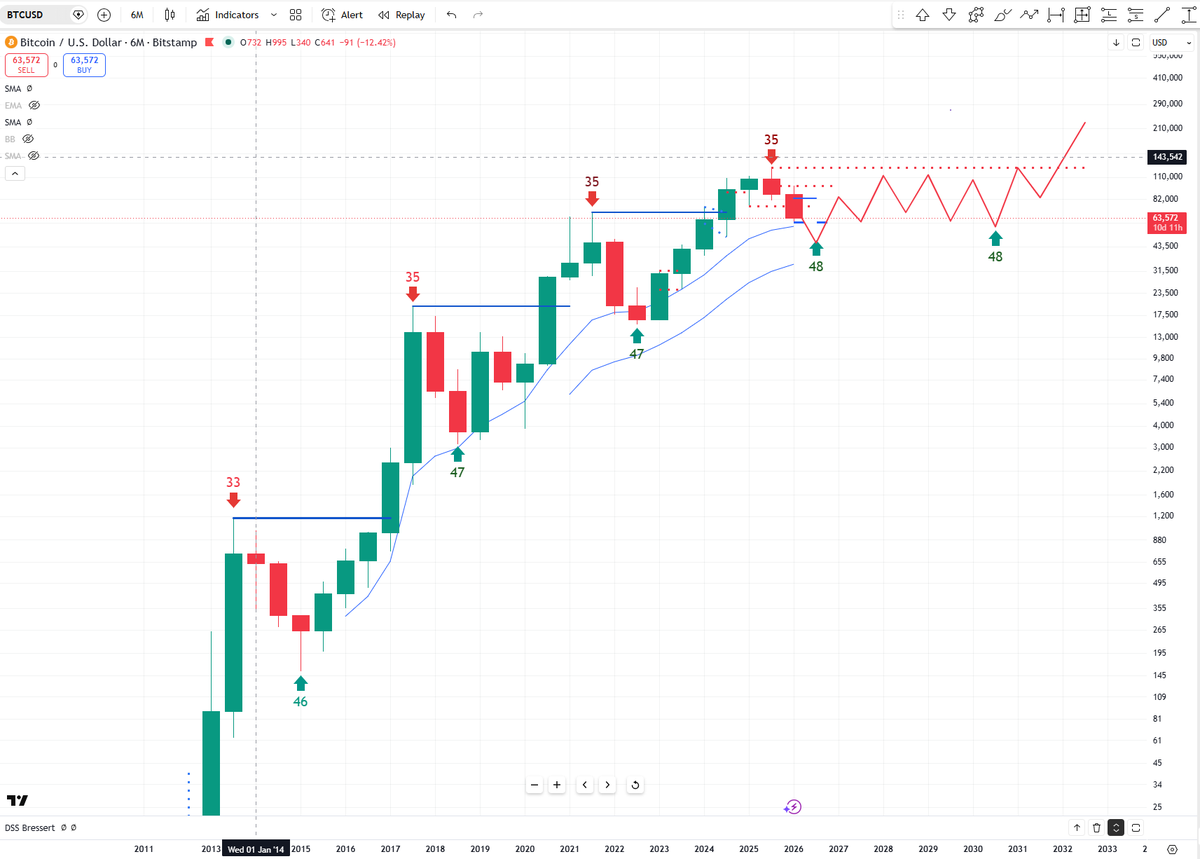
If the Bitcoin thesis is purely a SOV play, then in a world of AI capturing all the attention/capital, coupled with quantum fear, an outcome similar to this for the next 4 yr cycle would not be a big surprise, to me.
Would also align with a secular crypto bull market having peaked (as seen in alt's and bitcoin poor performance).
$BTCUSD So far the rebound on weekly scale looks weak. In one week price fell from 74K to 60K. It's been 2 weeks we are at 62K. Counter moves are weak. Still a downtrend with an important support at 60K.
Dinsdag 30 juni vindt het debat plaats over de gevreesde box 3-wet en het gaat serieus spannend worden.
Nu coalitiepartij CDA zich tegen de wet heeft gekeerd, ligt de sleutel in handen van de VVD. Durven de liberalen de wet weg te stemmen?
https://t.co/IMF3KlIgHj
Most $TAO holders staking right now are trusting the wrong validators.
Not because they are careless.
Because nobody explained what the numbers on the Validators page actually mean.
There is a tool inside Taostats that shows you exactly which validators are genuinely working and which ones are collecting your emissions without contributing anything to the network.
It is free. It is live. And almost nobody is using it correctly.
Here is exactly how to read it.
Step 1: Understand what Dominance actually measures.
Dominance is not popularity.
It is not a ranking of which validator is best.
It describes a validator's Stake Weight as a percentage of all validator stake weights combined across the network.
Stake Weight is calculated as: root stake multiplied by 0.18, plus all alpha staked across subnets converted into TAO.
Root stake is deliberately discounted at 18 percent of its face value.
Alpha stake carries the full weight.
This means a validator with deep subnet-level staking is structurally more powerful than one sitting purely on root, even if their raw TAO numbers look similar on the surface.
When you see a validator with rising Dominance over time, it is not just getting more popular.
It is getting more alpha stake directed toward it across active subnets.
That is a meaningful signal about where serious capital is moving inside the network.
Step 2: Check the Take percentage before you delegate anything.
Take is the percentage of emissions the validator keeps for itself.
Everything above that number flows to you as a nominator.
A validator with a 18 percent Take keeps 18 percent of the emissions their position generates and distributes the remainder to stakeholders.
A validator with a 50 percent Take is keeping half of what your stake earns.
Most people never look at this number before delegating.
It is the first number you should check.
A high Take is not automatically a red flag if the validator is genuinely performing well and contributing to the network.
But a high Take combined with low VTrust in their subnet performance page is the exact combination that should make you move your stake immediately.
Step 3: Open the Validator Performance page and find the VTrust score.
This is the number most holders never see.
VTrust measures how closely a validator's weight assignments align with the honest stake-weighted majority across the network inside each subnet they operate in.
Validators are responsible for evaluating miner output and assigning scores.
Those scores go into Yuma Consensus and determine which miners earn emissions.
A validator doing genuine evaluation work will have weights that align closely with the honest consensus.
High VTrust. Consistent emissions. Reliable nominator returns.
A validator that is weight copying, meaning they are simply copying the Yuma consensus scores back onto themselves rather than doing real evaluation, will show a flagged return on Taostats.
Their nom/24hr/1k TAO score appears in red.
This is Taostats telling you directly: this validator is extracting value from the network without contributing to it.
When you stake to a weight copying validator, you are funding a free rider.
Step 4: Watch the 24hr Nominator Change column.
This number moves fast and it tells you something before any other signal does.
A validator losing nominators over consecutive days is a validator that informed stakers are quietly leaving.
A validator gaining nominators rapidly while their VTrust is healthy is a validator attracting attention for the right reasons.
The 24hr column is the on-chain version of sentiment before sentiment becomes a narrative on social media.
Step 5: Check Active subnets alongside Total Weight.
Active tells you the number of subnets where the validator has a parent or child hotkey running.
A validator with high Total Weight but low Active subnets is concentrated.
They are running a specific strategy in specific markets.
A validator with broad Active coverage across many subnets is building a wider surface area for emissions and is more exposed to the overall network performance rather than any single subnet cycle.
Neither is inherently better.
But knowing which type of validator you are delegating to tells you what you are actually betting on when you stake.
Step 6: Check the Weight Change column over time.
Total Weight is a snapshot.
Weight Change is momentum.
A validator with stable or growing Total Weight over consecutive days is attracting net new stake consistently.
A validator with declining Weight Change is losing stake faster than it is gaining it.
Most people look at the current number.
The people positioning correctly are watching which direction the number is moving and how fast.
The difference between a good validator and a dangerous one is not obvious from the outside.
It is not the name.
It is not the size.
It is the VTrust score, the Take percentage, the nominator trend, and whether Taostats is showing their return in red or not.
Every one of those signals is sitting on the Validators page right now.
Free. Live. Updated every block.
The investors who read the data layer before the narrative layer will not need to explain their staking decisions later.
Open Taostats tonight.
You will want to find this post when you do.
The Trump & Co grift (and all those who followed) in crypto this cycle just marked the peak of a Major Cycle in my book.
There will be some success stories and bitcoin certainly will be back, but on the whole, grift, theft, degen etc hitting peak levels is significant. Few suckers left to fleece.
El multimillonario Tony Robbins explica por qué la mayoría de las personas nunca construyen una verdadera riqueza, incluso viviendo en un sistema lleno de oportunidades.
«El iPhone ha existido durante unos 18 o 19 años. Si te hubieras comprado un iPhone cada vez, habrías gastado unos $22,000 y algo de cambio a precio de venta al público».
«Pero si hubieras comprado acciones de Apple, invirtiendo esa misma cantidad de dinero en la bolsa, tendrías una ganancia de $326,000 en lugar de haber perdido $22,000».
«Si vas a usar un teléfono de Apple, al menos sé dueño de la empresa».
«¿Cuál es el error que están cometiendo? Son consumidores, no dueños. Somos una sociedad de consumo y entrenamos a nuestros hijos para ser consumidores también».
Elon Musk:”You get taxed on what you earn, you get taxed on what you buy, and you get taxed on what you own. And what does it get spent on? A bunch of stuff you don’t even agree with.
That’s why we need to reduce the size of government, spend less money and let the people keep a lot more of their hard-earned money.”