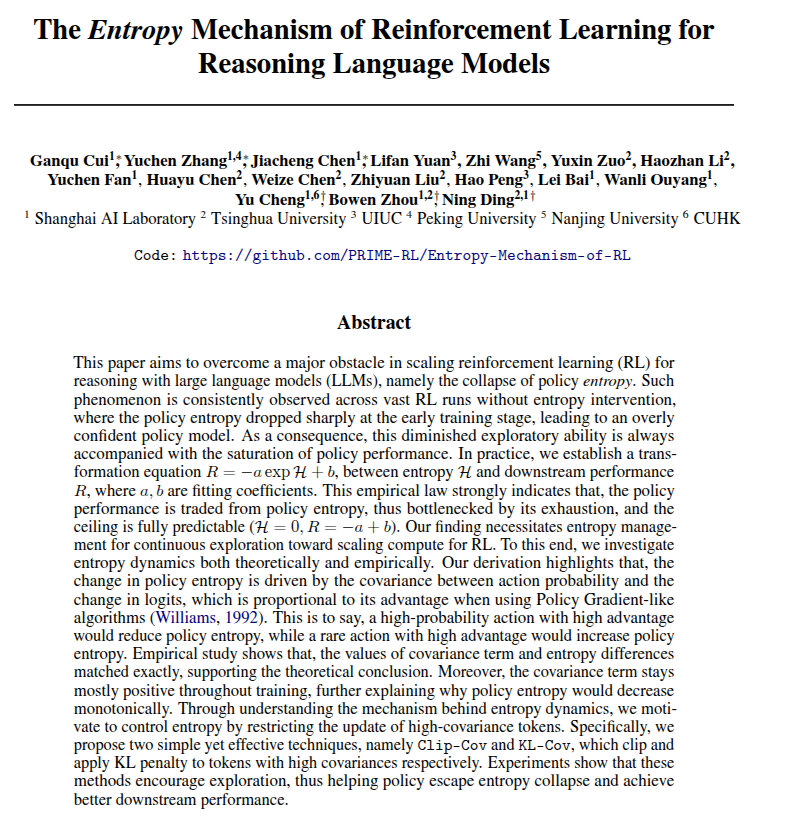
LLMs running reinforcement learning shed their randomness almost at once, then their scores stall.
This paper shows that randomness drop is predictable and fixable, so bigger gains are still on the table.
The authors fit an exponential link between entropy and reward.
Two simple edits keep key tokens from killing entropy, which lets the model keep exploring and solve harder math.
⚙️ The Entropy Crash
Standard RL tunes the model until its action probabilities almost hit 0 or 1.
Entropy, the numeric measure of uncertainty, falls by about 95 % in the first 200 gradient steps, and it keeps drifting toward zero after that.
Once entropy flattens, validation accuracy stops rising, so later training steps waste compute.
This paper introduces two techniques, Clip-Cov and KL-Cov, to prevent policy entropy collapse and encourage better exploration.
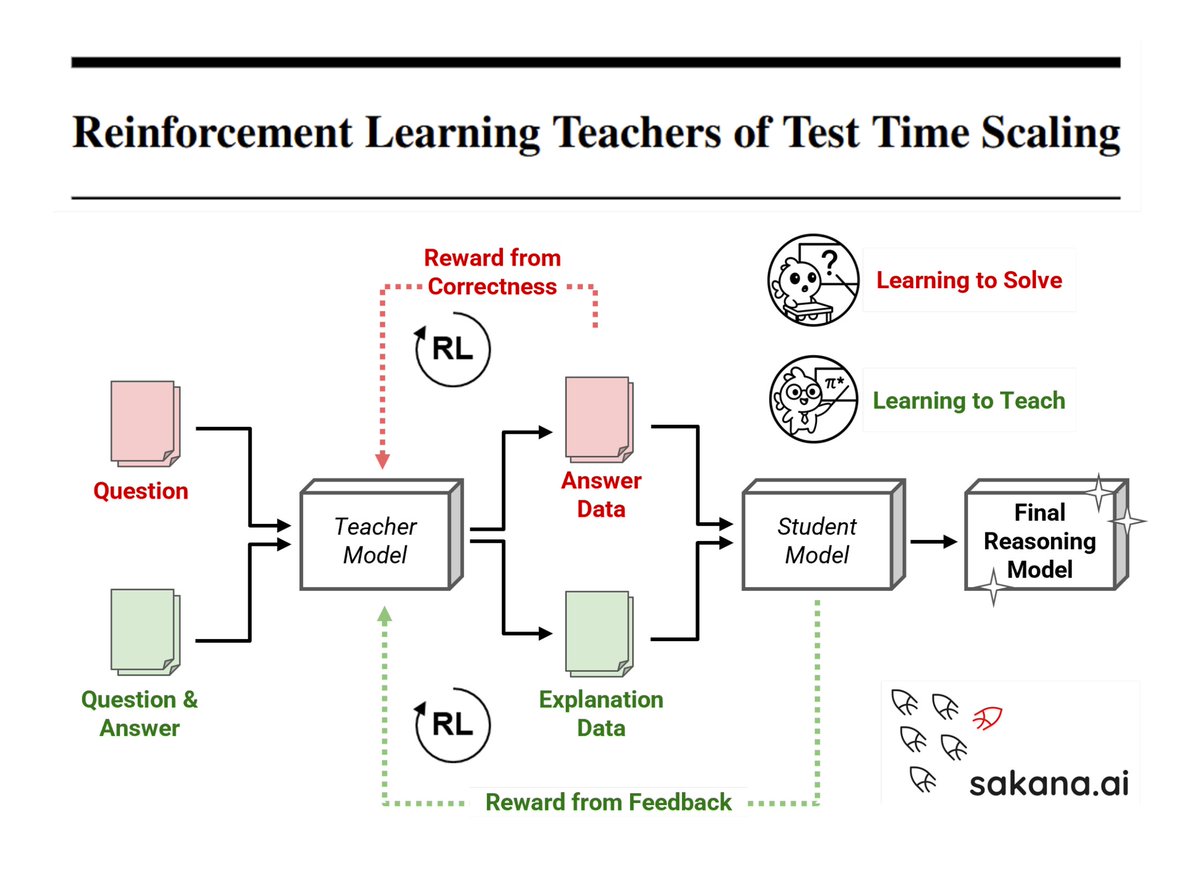
Reinforcement Learning Teachers of Test Time Scaling
In this new paper, we introduce a new way to teach LLMs how to reason by learning to teach, not solve!
The core idea: A teacher model is trained via RL to generate explanations from question-answer pairs, optimized to improve a student model’s understanding. Rather than solving problems from scratch, the teacher is rewarded based on how effectively its explanations help the student recover correct solutions.
Many advanced reasoning models, like DeepSeek R1, follow a two-stage learning process: first, a teacher model is trained, and then its outputs are used to train a student model, which becomes the final product. These teacher models are usually trained using expensive reinforcement learning (RL), where the model must “learn to solve” complex problems from scratch and is rewarded only when it gets the right answer. This process is slow, costly, and often narrowly focused, requiring carefully filtered outputs from the teacher to ensure the student learns effectively.
In contrast, our method tackles precisely these challenges. Instead of teaching by solving, our new reinforcement-learned teachers (RLTs) “learn to teach”, tasking them to output clear step-by-step explanations based on known solutions, just like great human instructors. Crucially, together with the questions, we also provide the correct answers to our teachers during training, which are now rewarded not for solving problems themselves, but for how helpful their explanations are to the student. This feedback loop aligns teacher training with its true purpose (being helpful to students), making it far more effective. It also allows us to use small, efficient models that wouldn’t otherwise be able to solve problems on their own.
The result is surprising: Our compact teachers with only 7B parameters are better at teaching reasoning skills than orders-of-magnitude larger LLMs, making advanced AI more affordable and much faster to train. This holds not only for students of the same size (26% on our set of tasks vs 19% when using DeepSeek R1, which has 671B parameters) but also 32B students, much larger than the teacher itself (38% vs 34% using R1).
Mastering All Design Patterns In C
We’ll get into the assembly-level implications of these patterns, offering a holistic view from high-level design to low-level execution.
Libgen, Sci-Hub, and Z-library had millions of pirated academic books and papers.
So, they were shut down. We shouldn't use them anyway.
We should help billion-dollar academic publishers get richer.
Anyway, here's how to access these libraries:
Don't do this!
"can you do the same thing for football?" - I got this question 100x today
yep, I actually did this last year
- player detection and tracking
- team clustering
- perspective transformation
end-to-end YT tutorial: https://t.co/d09LtEKz2C
Thirty-three days ago, we released Clair Obscur: Expedition 33.
Since then, we’ve sold 3.3 million copies.
Seriously. As of today.
We couldn’t make that up.
Another entry on the long list of surreal moments that your support has made real. Thank you ALL.
Tomorrow comes.🤝
Strong recommend for this book and the JAX/TPU docs, even if you are using Torch / GPUs. Clean notation and mental model for some challenging ideas.
https://t.co/ypg3jjbWRx
https://t.co/HKBSctquKq
https://t.co/k7XXc9Eesg
We’ve been moved by the love you’ve shown for the music of Expedition 33. 🎶
Thank you so much for listening, sharing, and feeling every emotion with us.
Here’s a small update on the soundtrack and what’s coming next... 🧵
Clues to architecture of viral Dia-1.6B model 🧵
While we await the technical report for this great model, here is what we know about the early work it is based on:
Parakeet:
----------
This model was announced by Jordan Darefsky et. all in May 2024.
The autoregressive architecture is simple as you can see from the below diagram. The magic is data. The text has all the "events": laughter, hesitations etc marked, rather than plain transcript.
Obtaining such transcripts is hard. The authors of this paper solved the problem using a custom Whisper model.
They fine-tuned a Whisper model to provide speaker/event annotated transcriptions and then back-translated the entirety of the Spotify Podcast audio using this model.
They train an autoregressive transformer to predict audio tokens (specifically, DAC codes), conditioned on raw transcription text.
They develop a modified classifier-free guidance (CFG) technique, which they call CFG-filter, to improve quality.
Rather than predicting raw audio directly, they instead predict latent audio codes / tokens, using the pre-trained Descript-Audio-Codec (DAC) as their autoencoder. Next tweet.