IITian, Googler, Hopeless Idealist | Live and Let Live | Zeitgeist Movement and Techno-Utopia Believer 💥 | RTs are not endorsements | Views are Personal
An Indian engineer in Bengaluru got tired of potholes destroying his car.
So he built an app with Codex that detects them, finds who is responsible, and files a complaint.
Here is how it works. He installed a dashcam with GPS and an accelerometer. The app records everything while he drives.
A vision model classifies every pothole by size. Small, medium, large.
But here is the clever part. Most Indian roads are under warranty.
The contractor who built them is legally responsible for fixing potholes for free.
His app searches through 2,900 government contracts, finds the exact tender number, identifies the officer responsible, attaches the photo and geolocation, and generates a ready-to-file complaint.
One drive to work. 12 potholes detected. 12 complaints ready.
--
vc: @gkcs_
@vepsi__ Oh yeah, we get that question a lot. While other products like Search and Gmail use Gemini models, the 1B here refers to people choosing the Gemini app across Web (https://t.co/osG9AOtWf5), Android, iOS, and Gemini in Chrome.
@JeffDean End of an era at Google... Always in awe of what you have built and your tech-talks.. always inspiring, truly a legend !! .. all the best for your new journey Jeff ...
@bekhayalime What Saif has said in this dialogue is only related to being poor and nothing specific to caste in current India.. reservation based on economic status makes sense, reservation based on caste no longer does in current India..
People replace their phones every ~4 yrs. This means there are hundreds of millions of old phones discarded each year that are still perfectly usable as computing devices. @Google in collabration with @UCSD is exploring how to turn these old phones into cloud-computing “phone clusters”. Putting phones back in service in this way can directly reduce the environmental footprint of computing by avoiding the need for further raw material extraction, and taking advantage of the embodied carbon already incurred from manufacturing these devices, and modern phones actually are already quite powerful computers. Read more in the blog below ⬇️
My wife (Ria) went to AIIMS. I went to IIT Delhi.
We watched 'Hello Bachhon' on Netflix this weekend. One kid in the show breaks down walls in his village to sell bricks so he can afford coaching fees. A girl hides her textbooks because her parents want her married off.
Throughout the show, Ria and I realized that we never had to fight for any of that.
We had access to coaching. Good coaching. Neither of us ever worried about whether we'd get to prepare.
The IIT-AIIMS crowd loves talking about the grind. # of hours of self-study per day, the pressure, and sleepless nights. I've done it too. But that grind starts after you already have access. Most of us skipped the actual hard part and don't even know it because the people who are capable but can't afford access are invisible. They're not in your coaching batch. They're not in your college. You never compete against them because they never got the chance to show up.
We credit hard work more than it deserves. Sometimes the biggest advantage was just being born in the right city to the right family.
'Hello Bachhon' made this truth hard to ignore. Great watch.
Introducing Cinematic Video Overviews, the next evolution of the NotebookLM Studio. Unlike standard templates, these are powered by a novel combination of our most advanced models to create bespoke, immersive videos from your sources.
Rolling out now for Ultra users in English!
@_amitbehere Nope 👎.. you are delusional ... while I like your posts in general, India ain’t that bad that a middle class in US is better than top 0.1% or even top 1%.. get yourself checked…
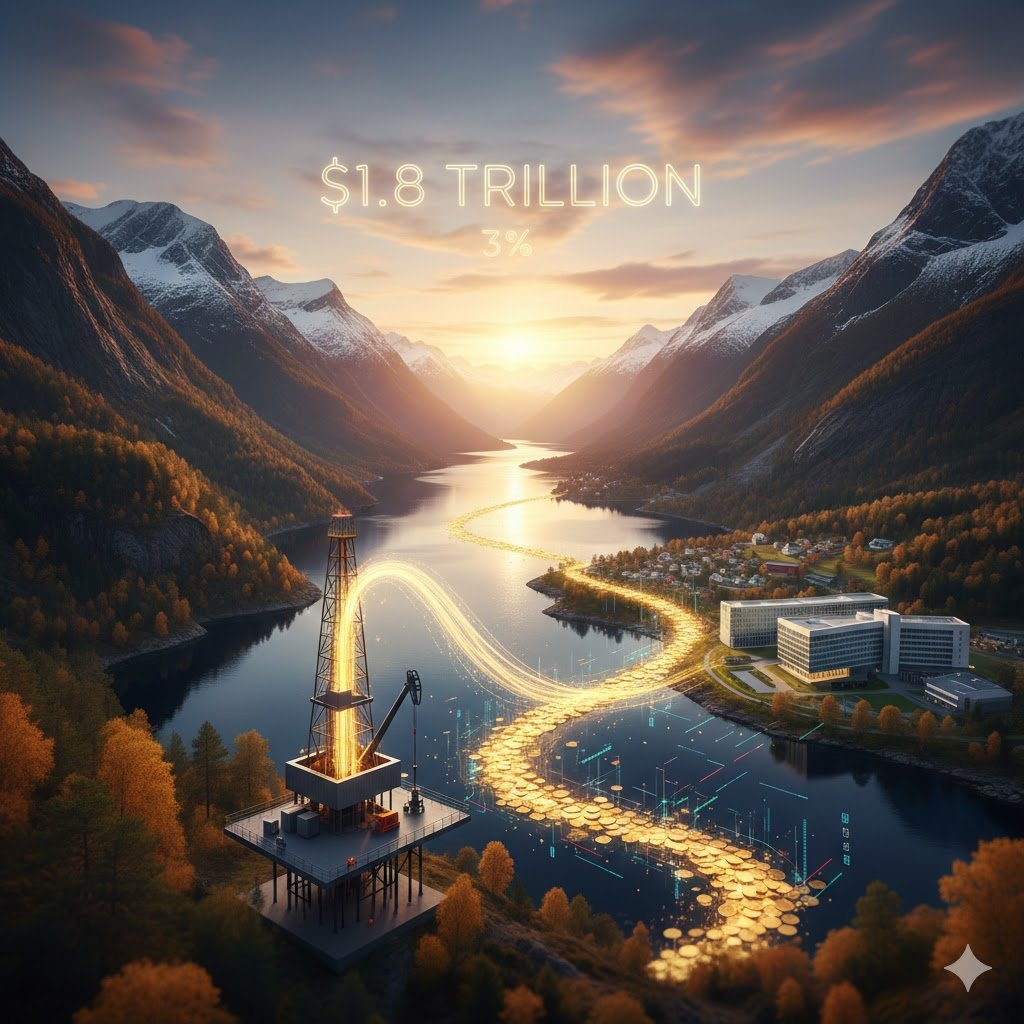
Imagine Bharat🇮🇳 wins the lottery. $1.7 Trillion. What’s the first thing our politicians do? Spend it, right?
In 1969, Norway found massive oil reserves. They were suddenly rich. But instead of a spending spree, they chose "Radical Patience."
In 1990, the Norwegian Parliament created the "Government Pension Fund Global"
The mission: Transform "black gold" into a permanent financial legacy.
In 1996, they deposited the first payment: $150 million.
Then they did something even more remarkable.
They stuck to the plan. Year after year, oil revenues flowed into the fund. Year after year, the fund invested in global markets—stocks, bonds, real estate across 70 countries. Year after year, politicians resisted the overwhelming temptation to raid the fund for short-term political wins (something our politicians should emulate from it).
Every election cycle brought promises to spend more. Every economic downturn brought demands to tap the fund. Every crisis brought calls to break the rules "just this once." Norway said no. Every single time.
The fund's managers didn't try to beat the market or gamble on hot stocks. They simply bought small stakes in thousands of companies worldwide—around 9,000 today—and held them. They played the longest game imaginable. By 2000, the fund was worth $50 billion. By 2010, it had grown to $500 billion. By 2017, it crossed $1 trillion. Today, it has surpassed $2 trillion.
Every time we buy an iPhone, a coffee at Starbucks, or a subscription to Netflix, a tiny fraction of that money flows back to Norway. Why? Because their fund owns a piece of almost 9,000 companies worldwide.😃
Now, the investment returns are higher than the oil revenue. Even when the oil runs out, the schools, hospitals, and pensions stay funded.
For a country of just 5.6 million people, that works out to roughly $340,000 per citizen.
This👇👇
The 3% withdrawal rule ensures the fund will last indefinitely. That 3% provides roughly a quarter of Norway's national budget—funding education, healthcare, infrastructure, and pensions without ever depleting the principal.
Norway's oil will eventually run out. Maybe in 30 years, maybe 50. It doesn't matter anymore.
By the time the last barrel is pumped, Norway will have a multi-trillion-dollar fund generating returns forever.
Norwegian children will attend free universities, elderly Norwegians will retire with security, and the entire nation will thrive—all funded by oil that stopped flowing decades earlier.
Because in 1990, Norway made a choice that most countries never make.
The genius wasn't finding the oil. It was having the humility to admit that people who haven't been born yet deserve a seat at the table. 🇳🇴
Idiots, the lot of them. Can’t stop at a red light, can’t drive in the designated lanes, don’t want to signal. Just don’t want to follow the law or have any civic sense, but they blame the government rather than look in the mirror. 🥴
10-minute delivery in India isn't magic. It's really good engineering.
@albinder and @letsblinkit built tech that most people never see.
We went deep on how it works.
Russia was India’s oldest trusted ally.
Russia consistently supported India at critical moments.
Although the Modi government and his friends did not transfer any real benefit from cheap Russian oil to the people but stopping the purchase of cheap Russian oil under pressure from the United States goes against Nehru’s long-standing non alignment policy.
The people of India did not receive any benefit from cheap Russian oil, but they will now have to pay the price for costly U.S. oil.
The loss is yours. The profit belongs to Modi’s friends. We backstabbed our old ally in their tough time.
China continue to buy cheap Russian oil even after US tariffs & western sanctions to fuel its economy.
I don’t know where we are heading as a nation under this regime.
🇮🇳 Good morning India! A lot of you asked for full-length mock JEE Main tests in @GeminiApp at no cost - done! Good luck on your prep!
Last week, SAT. This week, JEE.
What other global exams would be most helpful?
‘India should worry about Tariffs later and start worrying about Pollution first , it has far greater impact on India than any tariff’ : Gita Gopinathan, IMF
Kalli Purie of India Today had no answer, She didn’t know how to defend Modi.
Must Watch.
https://t.co/GC2P2r7Fmr