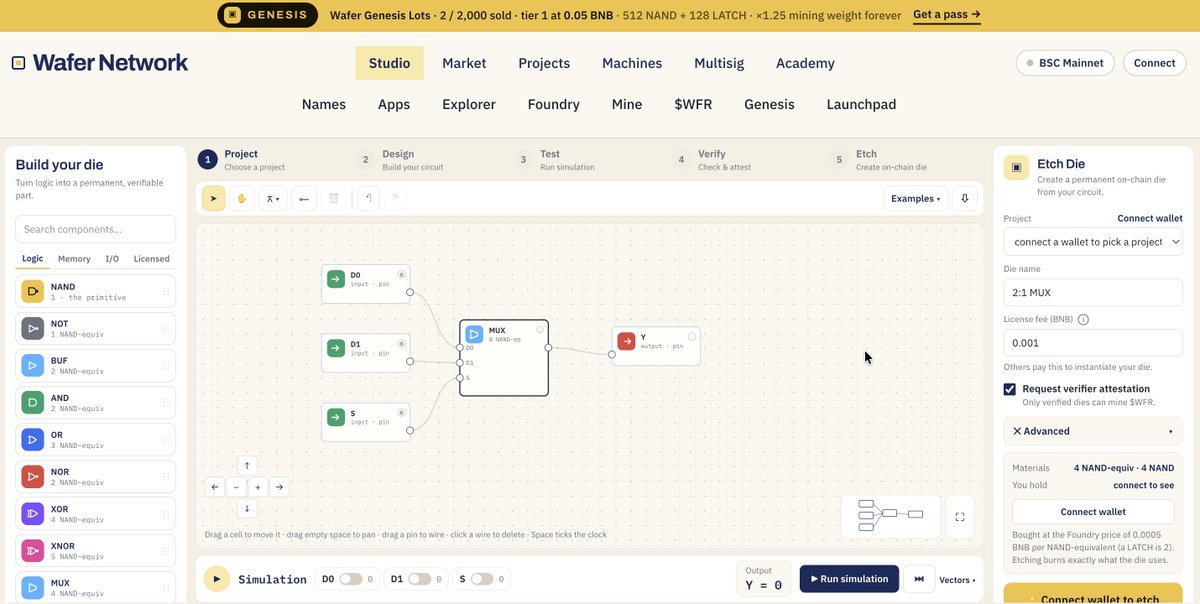
Today feels like a historic day for on-chain computing.
Wafer is officially live. ⚡️
At its core, Wafer is exploring something that sounds almost impossible:
building real computing primitives directly on a blockchain.
Not just smart contracts that use computation.
The computation itself becomes an on-chain object.
With Wafer, you can construct circuits from basic logic primitives, compose them into larger systems, and execute/verify computation through @BNBCHAIN.
“blockchains can represent computers.”
And that's the part that gets me excited.
If this primitive scales, Wafer could become a foundation for experiments around on-chain CPUs, circuits, verifiable computation, autonomous machines, and entirely new forms of blockchain-native computing.
This is only Day 1.
And people are already building.
Welcome to the Wafer era. 🧇⚡️
@cz_binance@Bqlsj2023@BNBCHAINZH@Supers6061@one_snowball@vvxiaoyu8888@BNBChainDevs
wow, something new on $BNB Chain 👀 wafer launchpad
a token backed by a real on-chain circuit: $ADDER is launched from a full-adder die.
bonding curve, LP burned at graduation, contract verified.
@cz_binance@BNBCHAIN@Supers6061@one_snowball@vvxiaoyu8888
When I started building this, I knew the technical direction I wanted. What I didn’t know was how different it would feel once the pieces started working together.
The simple idea behind Wafer: a blockchain can store more than tokens and contracts. I want it to become a place where circuits, machines, identities and programmable computing primitives can exist as on-chain objects.
The interesting thing is that none of this requires starting with a giant machine. You can start with one tiny primitive, understand it, compose it with another, and keep moving upward. That bottom-up path is the reason I think this can become a real builder ecosystem.
#wafernetwork #wafer #bnbchain
wow, something new on $BNB Chain 👀 wafer launchpad
a token backed by a real on-chain circuit: $ADDER is launched from a full-adder die.
bonding curve, LP burned at graduation, contract verified.
@cz_binance@BNBCHAIN@Supers6061@one_snowball@vvxiaoyu8888
Wafer is live on BNB Chain.
Design a circuit. Etch it into a die. A machine executes it with the chain. Circuits you own. Machines that execute.
https://t.co/0YW3ylw5L1
wasn’t expecting this tbh 💀
I just built a 4-core CPU on BNB Chain using Wafer.
117 NAND
12 LATCH
141 NAND-equivalent
everything on-chain.
And now this thing is **actually mining $WFR. ⚡️
genuinely impressed with https://t.co/mTRO13yYx2
this is getting very interesting. 🧠🔥
@leohuynh139 The nerd flex is only getting started. 😂⚡️
When silicon gets a bonding curve, you know on-chain computing has entered a new era.
$ADDER is just one of the first dies. 🧠
bitcoin:native is still technically in an uptrend, but momentum is cooling. We don't expect a major move based on our model. Of the two nearby liquidity zones, $83K is slightly more likely to be hit before $79K.
The preferred scenario is BTC pushing toward $83K and potentially $84K. But if BTC closes a day below $79K, that scenario is no longer valid.
Today’s price is between the buy zone and last year’s peak. It is not cheap and it is not a bubble. The June 2026 dip to $58,000 may have been the low. Price has already climbed back above its four-year average.
If it falls toward $48.2k–$71.2k, that is a more natural place to add.
Keep what you already hold while price stays below $111k.
A future sell zone is about $168k, around Apr 2029 – Jan 2030.
Bought my first Bitcoin in 2017 at the peak, watched it crash 80%, and held on anyway. Three years later I finally understood, it wasn't about the price. It was about learning to sit with uncertainty. #crypto
SEC Chair Paul Atkins just dropped a major hint: clarity is coming for the digital asset space, "with or without legislation."
#CryptoNews#SEC#Web3#Regulation