Generative Media TLV #2 meetup is live! 🚀
In collaboration with @nebiusai, we’re bringing together the Israeli generative media research community once again!
Featuring - talks will be recorded:
Decart Optimization Stack
Orian Leitersdorf | Chief Scientist & Co-Founder @DecartAI
BADAS-2.0 - Nexar Driving World Model
@ronigoldshmidt | Senior AI researcher @getnexar
Beyond Text: Continuous Control in Generative Models
@OPatashnik | Assistant Professor @TelAvivUni
Multimodal Generative Agents At Scale
Aviad Dahan | AI Researcher @ ZyG
🗓️ June 15
📍Nebius offices Tel Aviv
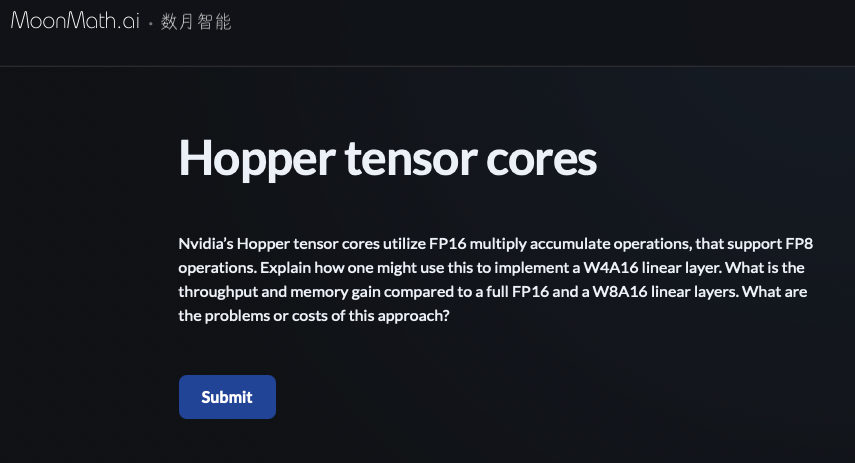
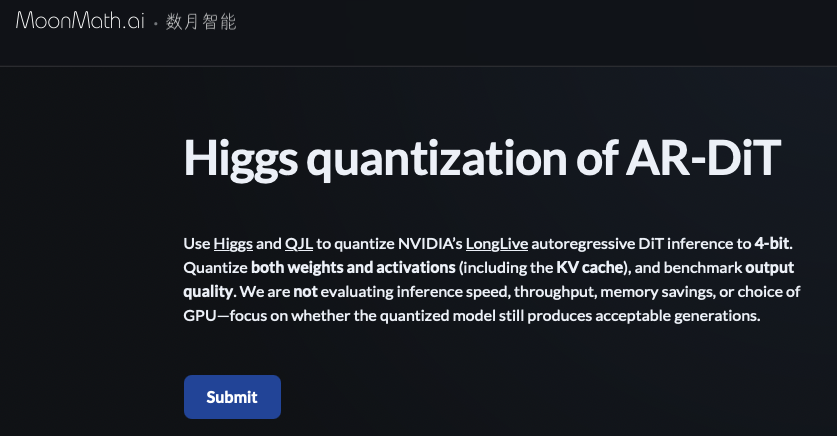
Our most popular section on the website is Challenges.
It's how we hire:
Solve a challenge → get a job offer 💪
A few examples below. More coming soon.
Claude won’t help..
I just published new research on Video Evals 🤓
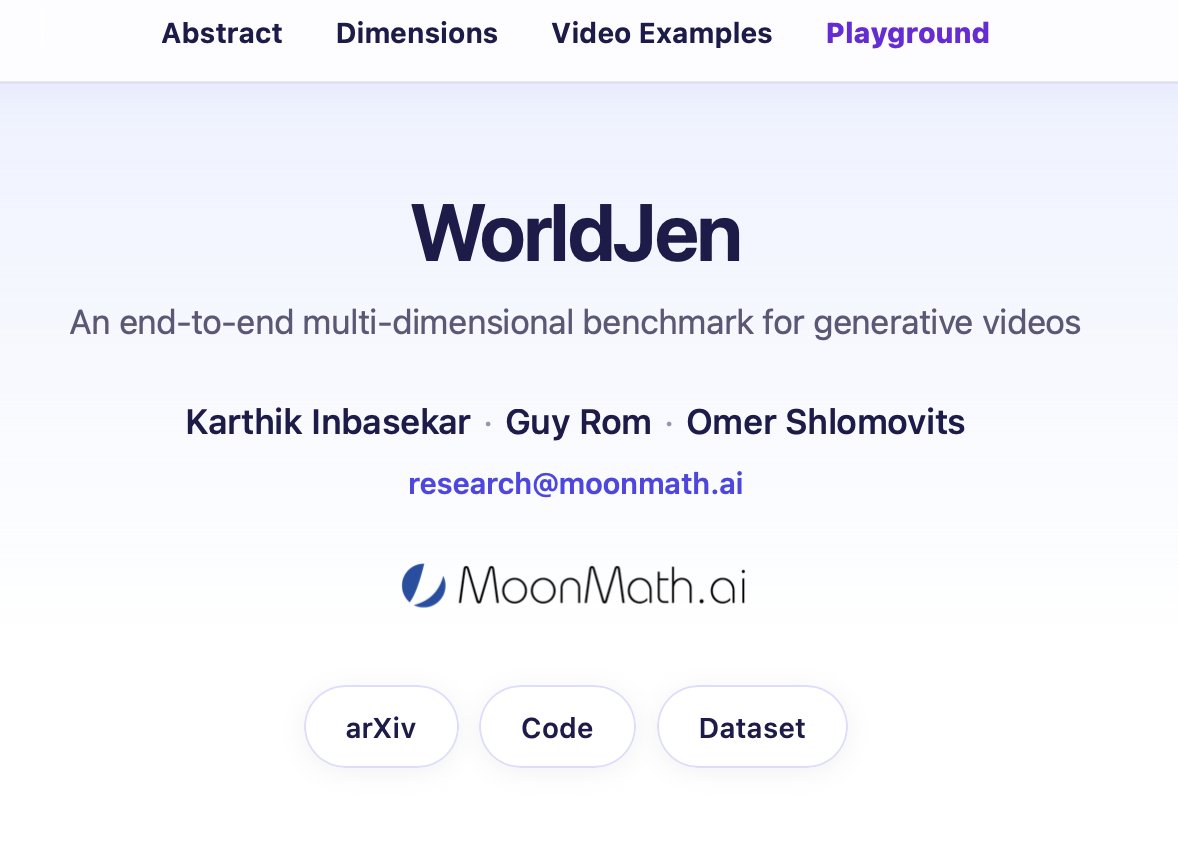
We introduce a new scoring system called WorldJen.
This work came from a practical need: when we optimize kernels for video models, we may affect output quality. But video quality loss is hard to quantify. How do we measure degradation or prove an optimization is lossless?
We couldn’t find an existing method we were satisfied with. Human evals are expensive and slow. Current benchmarks are saturated, limited in dimensions, and often miss the specific quality regressions we care about.
Then we spoke with friends at generative media labs and learned they share the same pain. While inference, training, and RL get massive engineering investment, evals are still left behind. So we set out to fix this.
You can skip the paper and just ask your favorite coding agent to install WorldJen and start evaluating videos or models, free. But I strongly recommend checking out the project page: you can score any video in the playground across 11 dimensions, see our kernel-optimization use case in action, and explore examples and insights from the study. We open sourced everything so you can reproduce.
Please share feedback and most importantly, help us find the edge cases where the system breaks. Thank you 🙏
🚨 New Paper 🚨
Why Self-Supervised Encoders Want to Be Normal:
Understanding Joint Embedding Predictive Architecture: Soft Clustering on the Predictive Manifold
abstract: Self-supervised learning has achieved remarkable empirical success in learning robust representations without explicit labels, most recently demonstrated within the framework of Joint-Embedding Predictive Architectures (JEPA).
However, a fundamental question remains: what analytical principles drive these encoders toward specific distributional states? In this paper, we demonstrate that the preference for normal distributions in self-supervised encoders is a direct consequence of the Information Bottleneck (IB) principle. By recasting the IB objective as a rate-distortion problem over the predictive manifold, we provide a theoretical basis for why optimal, target-neutral, latent representations should tend towards isotropic Gaussian states.
Under this framework, we show that latent representations correspond to soft clustering of inputs sharing similar predictive distributions, organized within a natural simplex structure. This perspective unifies a wide range of existing supervised and less-supervised objectives and provides a principled explanation for commonly used regularization schemes. Furthermore, we derive practical loss objectives that approximate this structure and demonstrate their effectiveness on standard benchmarks. Ultimately, our framework offers a geometric lens to understanding representation collapse and it establishes a mathematical system for regularization strategies to be used to ensure high-entropy, informative embeddings in modern self-supervised models.
cc: @ylecun
Video AI benchmarks are broken.
VBench requires 6,230 videos per model eval. Scores cluster near the ceiling.
Yes-bias makes every model look good. Rankings don't match what humans prefer.
We built WorldJen to fix this. 🧵
We have a problem with video/world models. Let me explain what's wrong, and how does it provides a context to Fal new WMA:
First, the state of open source video diffusion models (VDMs):
The best open source video model is currently LTX-2 and it's ranked ~#40 according to AA. There are in general very few open source models outside of academia.
While with LLMs the gap between open and close has mostly collapsed, with VDMs we are talking, IMHO, at least 1y gap. We need DeepSeek for video to come and save us - because almost no frontier lab is open sourcing their models.
Why this gap between LLMs and genreative media? could be multiple reasons - Data availability (much hard to get internet scale high quality video), training cost (order of magnitude more expensive), HW (give me Vera Rubin), model arch stability, Evals maturity etc..
What does it have to do with Fal? Given these conditions, Fal became a pipe to serve Google Veo3 and other closed source model. This is nice on paper and good for traffic, but Google can also just serve directly. There are not enough open source models for Fal to optimize and run on their GPUs (much higher margin) so they created this product, hopefully this will motivate AI labs to give part of the infrastructure to infra experts like Fal
Some time ago, I had the idea to port NVIDIA Physical AI stack to AMD. The motivation was to improve hardware diversity and enable world models and VLAs to run beyond a single ecosystem.
We started with NVIDIA Cosmos Predict 2.5-2B. Porting wasn’t trivial: these models are deeply optimized for NVIDIA’s stack. We used this as an opportunity to apply our ROCm kernels.
The results were surprising:
Both encode and diffusion run faster on AMD Instinct MI300X vs. NVIDIA H200 (FA3) and we still saw significant headroom for further optimization.
Quality is unchanged across modalities (validated with WorldJen)
To be clear, this is no luck. We have deep experience with diffusion models and AMD GPUs. But this just gives us a good opportunity to get closer to a true hardware-to-hardware comparison, as we work with less software abstractions than usual. Just to give an example, on AMD, memory instructions are async with a hardware queue of ordered pending instructions, enabling concurrent load/store with compute without warp specialization. Bottom line: there are real architectural advantages on AMD, if you take the time to work with the hardware.
Note, we did tradeoff ~20% higher memory usage,
That being said, AMD has more to give to begin with :)
in the coming weeks:
AMD versions of Cosmos Transfer and GR00T, an even faster version of Cosmos Predict, and open-sourcing an attention kernel faster than AITER v3 (which is closed-source for some reason? cc: @AnushElangovan )
The community invested enormous efforts in optimizing attention, but the large `nn.Linear` layers that surround attention? Largely untouched!
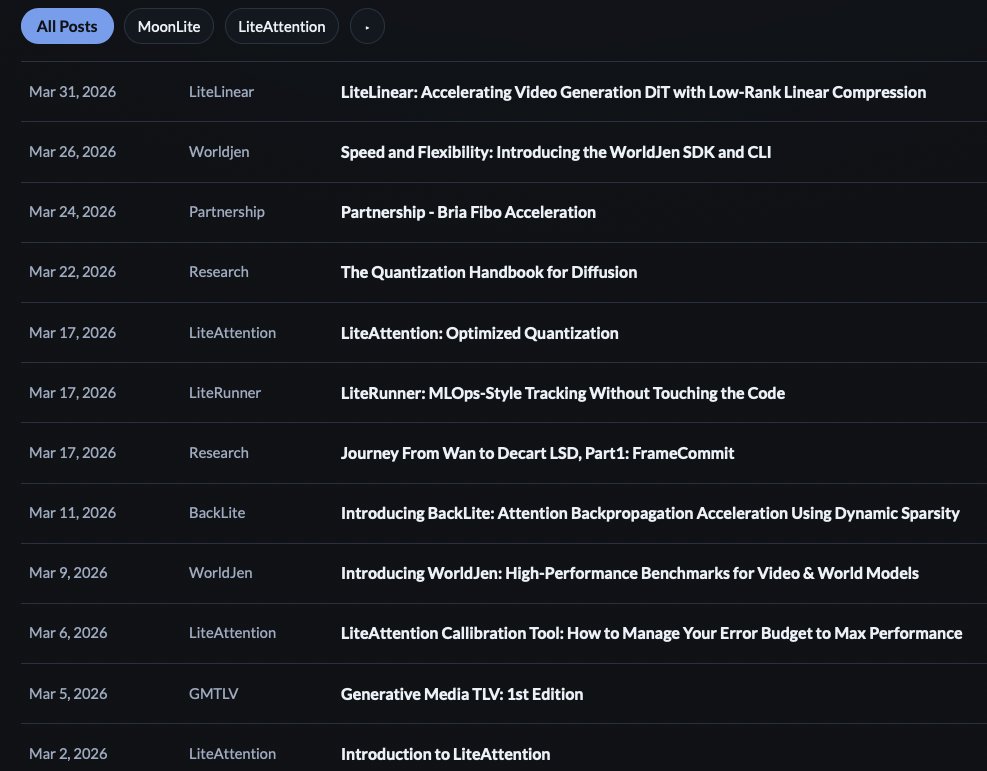
Introducing LiteLinear: a drop-in video DiT acceleration that compress nn.Linear layers via calibration-aware low-rank decomposition + quantization. Targets both FFN and attention projection linears (Q/K/V/O) without retraining
We are releasing LiteLinear support for both @nvidia Hopper and @AMD Instinct, together with a proof of concept on @Lightricks LTX-2 FFN:
22.5% faster transformer compute
11.5% peak memory reduction
7.6% faster end-to-end inference
Blog: https://t.co/qOKRJVH97L
Code: https://t.co/NiD8TEp3Ht
The community invested enormous efforts in optimizing attention, but the large `nn.Linear` layers that surround attention? Largely untouched!
Introducing LiteLinear: a drop-in video DiT acceleration that compress nn.Linear layers via calibration-aware low-rank decomposition + quantization. Targets both FFN and attention projection linears (Q/K/V/O) without retraining
We are releasing LiteLinear support for both @nvidia Hopper and @AMD Instinct, together with a proof of concept on @Lightricks LTX-2 FFN:
22.5% faster transformer compute
11.5% peak memory reduction
7.6% faster end-to-end inference
Blog: https://t.co/qOKRJVH97L
Code: https://t.co/NiD8TEp3Ht
WorldJen is a high-performance benchmarking stack for video models
Today we’re releasing the WJ SDK + CLI 🚀
Run fast, reproducible evals to compare checkpoints and rank against other models
Get started:
PyPI: https://t.co/r2FhcOx6aZ
Blog: https://t.co/xm70DPWnrr
Evaluate LTX2 on your Mac: https://t.co/T8QcCQYe1g
Making models run fast at inference requires optimizing the entire AI stack.
It was great partnering with MoonMath to take @bria_ai_ 's Fibo to the next level of speed. Unlike standard models, Fibo consists of a Reasoner (VLM) and a Renderer (Flow Matching), requiring both to be optimized at the algorithm, deployment, and kernel levels.
And most importantly it was great to work with @moonmathai
Read more in the new blog post