Laboratory of Systems Physiology at @ETH_BSSE, aka SyPhy lab! Spatial transcriptomics, niche interactions, RNA localization. Tweets are from lab members ✌️
How are cell-cell interactions governing successful metastatic colonization in the liver? Have a look at our new paper in @nature that introduces an in vivo proximity screen to functionally test cellular interactions in a high-throughput manner. https://t.co/oWFn3Hfj8M 🧵
Researchers at ETH Zurich have uncovered how #Colorectal#CancerCell's colonise the liver. Their findings could open up new ways to suppress this process in the future. https://t.co/C7HPcQ2l1N @ETH_BSSE
My PhD work in the @moorlab is out 🥳🤩🤪 Five year after that lunch break discussion with @AndreasMoor! Thanks Andreas for believing in our crazy outside-in screen and to ALL the people that helped along the way!
Clonal expansions can remodel entire tissues even when they appear normal, but what mechanisms drive this? And how do these processes differ from tumorigenesis? Out @Nature, we identify distinct TNF programs during tumor evolution. 🧵
https://t.co/S3w9Zl1NE2
Stop stressing about losing granulocytes in your single-cell RNA seq experiment and check out our new protocol online now at @NatureProtocols 🧘♂️ with @AlessandraGurt1@lab_arnold@moorlab
https://t.co/MUN0qDCvSD
Well, this is what happens when two scientists become best friends (@cocoborrelli) and go on a relaxing retreat to a beautiful island in gulf of Naples with delicious mozzarella and wine... They make science!
https://t.co/5FbDzvBuyx
ISCHIA uses the inherent proximity of #spatialtranscriptomics spot data to reconstruct co-occurring cell-type networks. Application to ulcerative colitis patient data reveals #inflammation-induced cellular networks ➡️ https://t.co/ErqOyIYF6S @AndreasMoor@moorlab@ETH_BSSE
ISCHIA is online at @MolSystBiol! So much fun to work with the one and only @Ati_lz! Takeaway message from this project: lab retreats are fun and inspirational, even if no scientific activity is planned! Keep it up @moorlab!
https://t.co/ujdgMOO2EV
Excited to give a talk about our recent work from the sendoel-lab at #KSSingleCell23@KeystoneSymp tomorrow.
"Tissue-wide Single-cell CRISPR Uncovers Distinct TNFa Modes in Clonal Expansion and Transformation in the Skin".
In collaboration with @moorlab and @s__ellis
Soooo happy to share the results of my PhD project in the @moorlab! The seed and soil hypothesis postulates that metastases will only grow in favorable environments. Here we forget about the seed and focus on the soil. Which factors in the liver promote or suppress seeding? 🧵👇
Super excited about this new preprint of the lab 🚀🚀. Congrats to @cocoborrelli and all coauthors. Our research delves into the world of tumor-hepatocyte interactions, spotlighting #PlexinB2 as a key player in regulating liver metastasis.
@BaCell3D@ETH_BSSE Thanks @AshleyMaynard10 and organizers for the invitation! Such an inspiring day so far, loving this conference , the people and the venue.
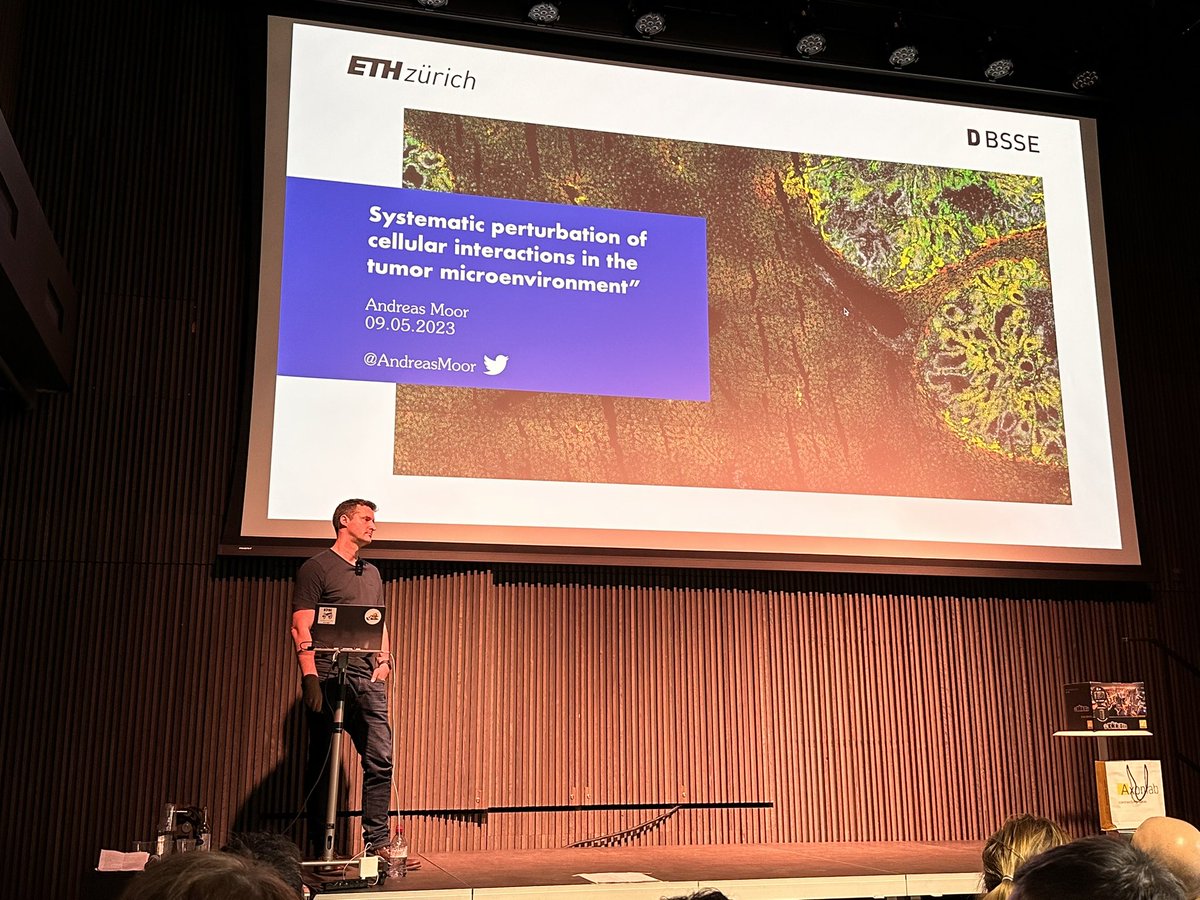
Next up is @AndreasMoor talking about cancer organoids and drug development. They are profiling cancer heterogeneity driven aberrant signaling and interactions in primary cancer tissue and colon cancer #organoids using spatial transcriptomics @ETH_BSSE
[6] Finally, by tracking individual B cell clones using B cell receptor sequencing, we reveal that previously fated Bm cell clones could redifferentiate into other Bm cell subsets, demonstrating that single Bmcell clones can adopt functionally different trajectories!
New research from our collaboration with the Boyman lab at @UZH_ch now published in @NatImmunol: https://t.co/nSkmwNVMEx! Check it out to learn about memory B cell plasticity, longitudinal tracking of B cell clones and much more performed by @ZurbuchenY and @JanMichler! Digest:🧵
[5] Using our scRNAseq data, we characterized the transcriptional makeup of different S+Bm cell subsets in great detail. Main result: CD21–CD27–S+ Bm cells carried a distinct transcriptional profile, similar to ‘atypical’ B cells found in chronic infection and autoimmune disease.


![moorlab's tweet photo. [6] Finally, by tracking individual B cell clones using B cell receptor sequencing, we reveal that previously fated Bm cell clones could redifferentiate into other Bm cell subsets, demonstrating that single Bmcell clones can adopt functionally different trajectories! https://t.co/Sz1DQ7tzXF](https://pbs.twimg.com/media/FvIGZ3HXgAAQrxF.jpg)
![moorlab's tweet photo. [5] Using our scRNAseq data, we characterized the transcriptional makeup of different S+Bm cell subsets in great detail. Main result: CD21–CD27–S+ Bm cells carried a distinct transcriptional profile, similar to ‘atypical’ B cells found in chronic infection and autoimmune disease. https://t.co/2UssEkx9k4](https://pbs.twimg.com/media/FvIGUlzXwAAU2WX.jpg)





