Thank you @MichaelDell. Last night, I was telling my son about your generous gift and your journey. He will definitely read your book: Play nice but win and be inspired to chart his one course of entrepreneurship.
Have been finding opportunities to extract deterministic workflows out of Agentic workflows and hard coding them. Finding much efficiency increased accuracy and improved quality
When using agents, ensure that everything that can be deterministic, is done with a deterministic tool. Don't try to get the poor agents to follow a deterministic process.
If there is one constant in management as you get older it is that the companies at peak interest (by any measure) are the ones where no matter what they are doing it is a best practice and that is the source of endless fawning.
Later in a corporate arc, these same companies will do the inverse and if successful that becomes the "pivot" playbook of the day. And when not doing well whatever they were doing becomes the third rail of management.
If what you're doing works then it works. It isn't always best or the "right" answer. Context is everything. Also blindly pivoting to the other thing almost never works. You can tell from the reorg or announcement mail since it leads with the implementation and not the problem being solved (eg first, here's our new "functional" org chart, or first, here's our new "pizza team" org chart.)
General take, exceptions ignored:
This is a trap because low margin businesses cannot invest in technology. Their financial model doesn’t support it. Their investors have programmed in steady state returns. They cannot re-invest their low margin profits. This is where new entrants without the financial constraints, providing steady state returns to investors, can disrupt their businesses. You can see VCs shifting their attention to vertical AI companies that are disrupting low margin businesses for this reason. The other path is PE taking over these businesses and using debt to reinvest, reshape and repackage the business.
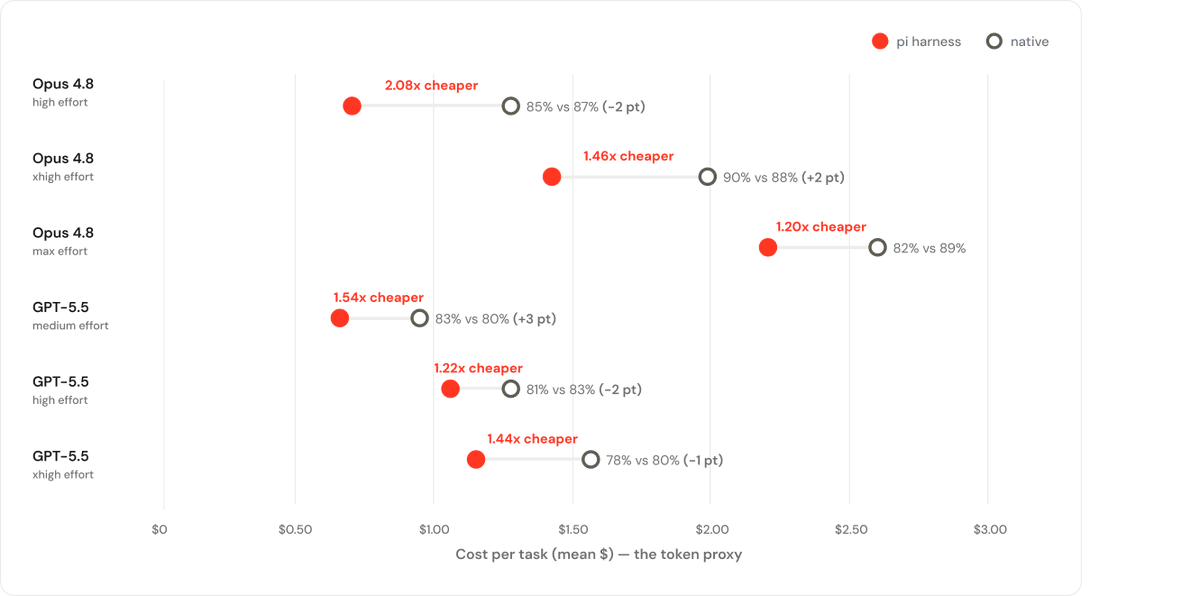
3) Harnesses make a huge difference in cost-performance. The very simple Pi harness (@badlogicgames) got the same success rate as harnesses from the LLM vendors with Opus and GPT 5.5, but at 2x less cost! Seems to be mainly due to smaller inputs to the LLM.
Bullish on harness engineering as the product interface, for enterprise use cases the question remains general purpose or domain specific harness wins out.
new post on harness engineering for AI self-improvement: https://t.co/ZYvGfVs61k
It is hard to forecast how much the future of RSI will rely on harnesses. Likely harness engineering will evolve in the direction of self-improvement and enable auto-research, and, in turn, smarter models keeps harnesses simple.
Even when many harness improvement get eventually internalized into core model, the need to specify goals and context will not disappear.
Since Quick launched in July 2025, we’ve collectively built more than 50,000 sites. Over 50% of employees have at least one Quick site.
When you remove the barriers to build & share, it’s incredible what happens.
More examples of how we’re using Quick :
https://t.co/y0bgxemDXG
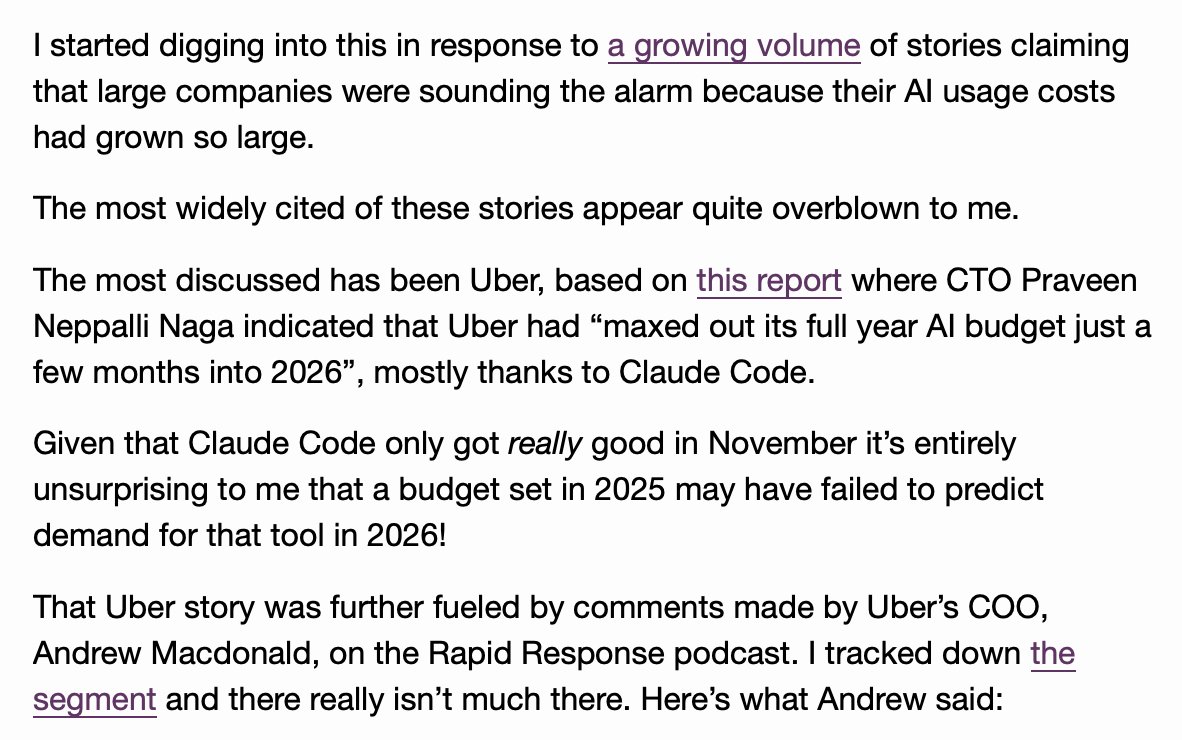
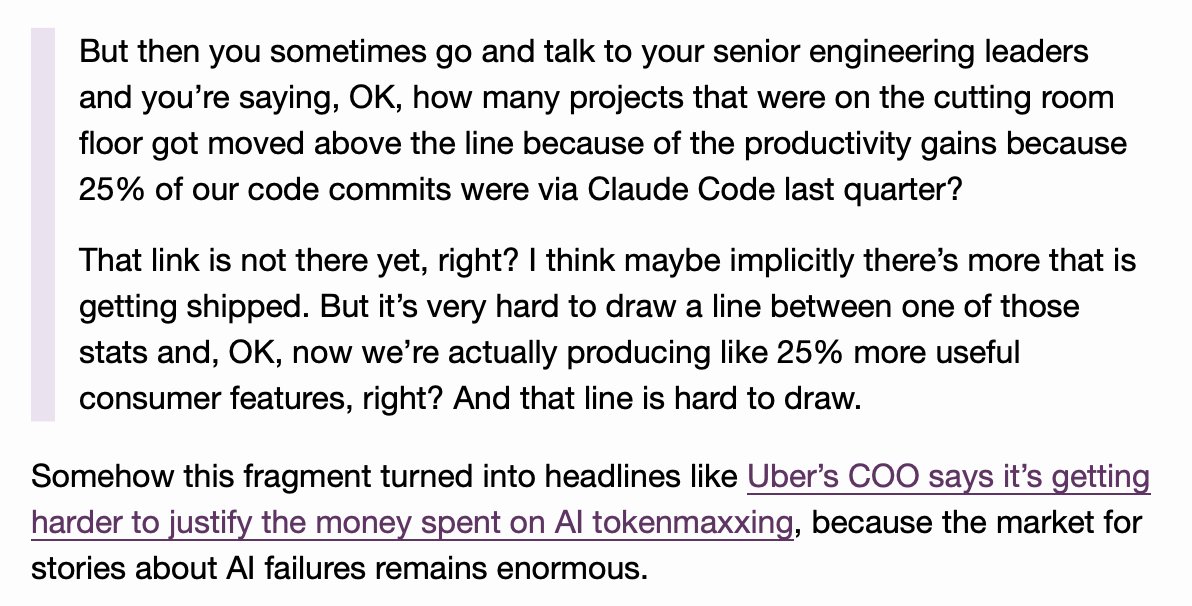
I'm suspicious of that that whole story about Uber blowing their AI budget and being disappointed in the results - I dug into it and it appears to have been built on very shaky foundations
We have seen in tech cycles where value accrues. Database companies have had the hardest time getting the combined valuations of the applications built on top of their product. As models become plug and play commodity with an optimizer sitting between the harness and model layer, value will move further up the stack.
i'm strongly against model companies focusing too much on harness, but i would love to hear if anyone has a strong argument for it
my reason against it:
if openai didn't build GPT 5.5, no one else can. this is their core competence
if openai didn't build codex cli and app, we have opencode and t3code. building harness is NOT their core competence
this is not saying products like claude code, codex aren't good - i genuinely think these are top tier products built by really talented people
my point is - the world might be a better place if model companies focus more on their core capability and give us better, faster, safer and cheaper models, rather than competing with the ecosystem in the application layer
what do you think?