@TedLeddy@realBobbyHealy Sadly, that clarity will take a very long time and your R&D and know-how will leach away from Ireland, no doubt creating a great Texas business
Wondering if the hearts of those frustrated by small acts of petty symbolism, by the feeling that smashed windows and graffiti on bakeries are simply not enough, are cheered by the upgrade to burning ambulances this morning.
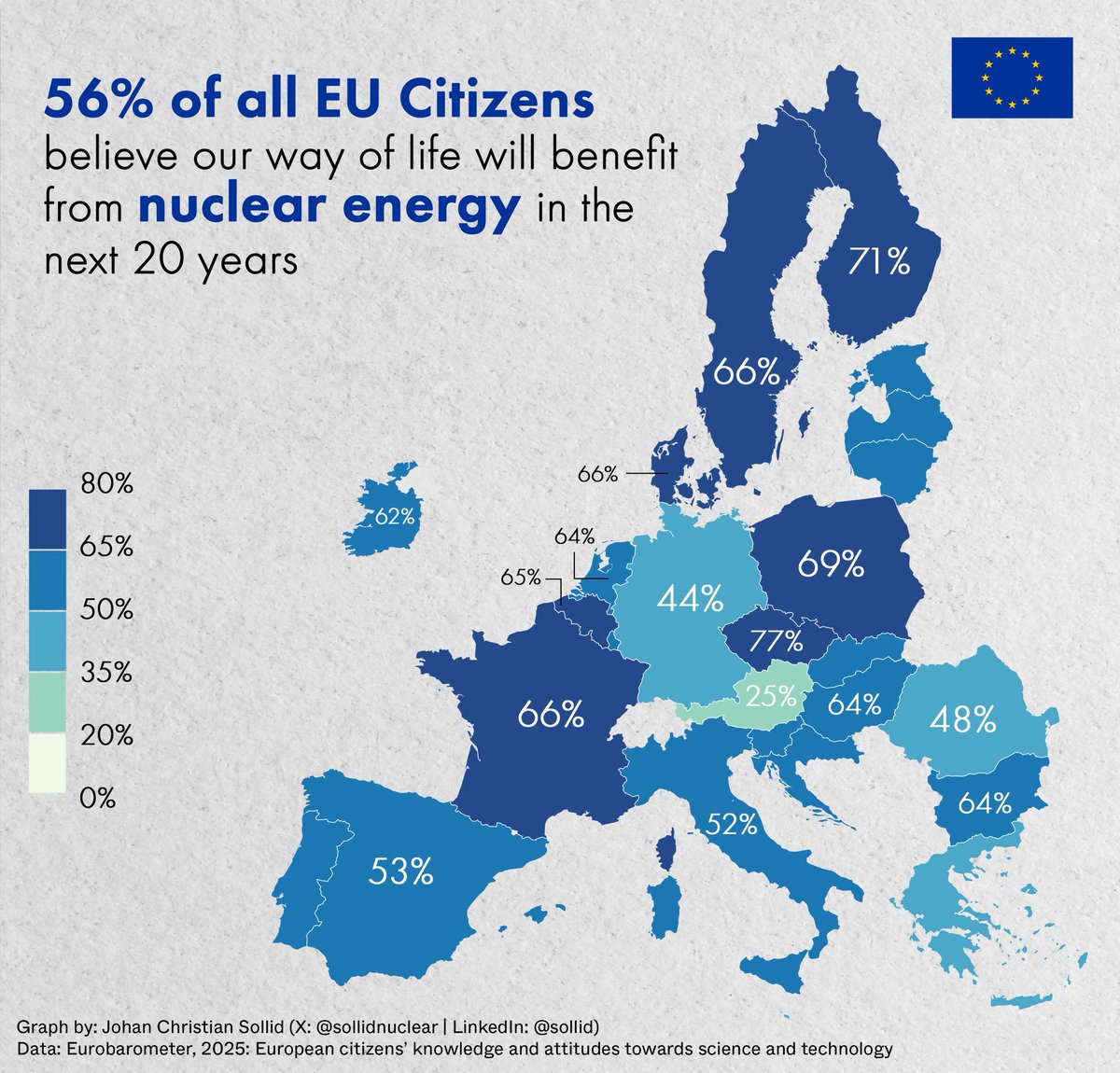
A Majority of EU Citizens Support Nuclear Energy 💙
The top 5 most pro-nuclear countries:
1️⃣ Czechia (77%)
2️⃣ Finland (71%)
3️⃣ Poland (69%)
4️⃣ Denmark (66%)
5️⃣ France (66%)
These numbers come from a European Commission survey (Special Eurobarometer 557) asking Europeans:
“Do you think nuclear energy will have a positive, negative, or no effect on our way of life in the next 20 years?”
Compared with the same survey four years earlier, positive attitudes toward nuclear increased by 10 percentage points.
The country that saw the biggest increase is surprisingly Denmark. Positive attitudes among Danes rose by 44 percentage points, from 22% to 66%. This enormous shift places Denmark in the top 5 most pro-nuclear countries in the EU.
This is a country that banned nuclear energy for electricity production in 1999 and kept it out of national energy planning since 1985.
One thing is clear: EU citizens increasingly support nuclear energy, and the trend is only growing
@ConorHogarty Accurate, and to a committed European like me a somewhat sad position; on economic model for individuals we are increasingly high tax and high benefits
The Islamic Republic of Iran was founded on February 11, 1979, on a single principle above all others: the overthrow of hereditary rule. The Shah’s dynasty was the enemy. The monarchy was the sin. The revolution that swept Ruhollah Khomeini to power drew its legitimacy from the promise that Iran would never again be governed by a son who inherited power from his father.
On March 8, 2026, the Assembly of Experts appointed Mojtaba Khamenei to succeed his father Ali Khamenei as Supreme Leader of the Islamic Republic.
The revolution lasted forty-seven years before it became the thing it was created to destroy.
Mojtaba is 56 years old. He holds the clerical rank of Hojatoleslam, a mid-level position two tiers below the Ayatollah status that the constitution implicitly requires of the Supreme Leader. He has never held elected office. He has never published jurisprudential scholarship. He has never submitted himself to public vote. His primary qualification is his surname and his decades of proximity to his father’s inner circle, where he served as gatekeeper, enforcer, and the IRGC’s preferred interlocutor.
The Assembly of Experts met under what Iran International described as “heavy pressure” from the IRGC, with commanders making “repeated contacts” demanding support for Mojtaba. Some members opposed the appointment as hereditary succession. They were overruled. The IRGC, the armed forces, and the foreign minister pledged allegiance within hours.
Trump responded by calling Mojtaba “unacceptable” and warning that without Washington’s approval, whoever is chosen “is not going to last long.” The IDF posted a statement in Persian warning it would “not hesitate to target” any successor.
Consider the sequence. The United States killed Iran’s supreme leader. Iran replaced him with his son. The United States rejected the replacement and claimed veto authority over who governs a sovereign nation of 88 million people. The son now leads a country under the most intensive bombardment since 2003, with theological legitimacy his own clergy questions, an external death threat from the coalition that killed his father, and thirty-one autonomous military commands whose obedience is pledged but untested.
The IRGC chose Mojtaba not because he is qualified but because he is controllable. A leader who owes his position entirely to the Revolutionary Guard is a leader who cannot constrain the Revolutionary Guard. The institution that was supposed to serve the Supreme Leader has installed a Supreme Leader who will serve the institution. The theological office that once commanded the IRGC now exists at the IRGC’s pleasure.
This is the structural inversion that matters more than any personality analysis. The Islamic Republic’s centre of gravity has shifted permanently from the clerical establishment to the military. Mojtaba is not the new Khamenei. He is the IRGC’s civilian face. The Guards do not need his permission to continue the war, escalate toward nuclear capability, or reject negotiation. They need his signature.
The father built the system. The son inherits the title. The Guards own the state. And the revolution that was fought to end the reign of a dynasty has produced one.
Forty-seven years. That is how long it took.
https://t.co/ULBgEzZ3A8
🥀March 8: Remember the Women of Iran
Elnaz Rekabi is a professional competition climber and rock climber from Iran, born on August 20, 1989, in Zanjan, Iran. She has been a member of Iran’s national climbing team and achieved notable successes in Asian and international competitions, including becoming the first Iranian woman to win a bronze medal in the combined event at the IFSC Climbing World Championships in 2021.
In October 2022, amid the nationwide protests in Iran following the death of Mahsa Amini in morality police custody, Elnaz Rekabi competed at the IFSC Climbing Asian Championships in Seoul, South Korea. During one of her final climbs, she appeared on the wall without the mandatory hijab, wearing only a black headband instead. This act quickly went viral on social media and international media, widely interpreted as a courageous protest against Iran’s compulsory hijab law and a symbol of solidarity with the “Woman, Life, Freedom” movement.
Upon returning to Iran, she faced immediate and severe repercussions. Reports emerged of her temporary disappearance, passport and phone confiscation, and intense pressure from security and judicial authorities. She was forced to appear in state media interviews and post statements claiming the hijab removal was unintentional and due to poor timing. Many observers, including human rights groups, described these as forced confessions under duress. Although Iran’s National Olympic Committee initially claimed she would face no punishment, she endured prolonged restrictions: temporary house arrest, ongoing security harassment, a ban on foreign travel for a period, professional and sporting limitations, and even the demolition of her family’s villa in Zanjan by state authorities.
These injustices stemmed directly from the Islamic Republic’s laws, particularly the compulsory hijab regulations enshrined since the 1979 revolution and codified in various articles of the Islamic Penal Code (such as provisions on “promoting immorality,” “public indecency,” or “propaganda against the state”). Violating hijab rules can lead to charges of “disrupting public order,” “anti-regime propaganda,” or other security-related offenses, often resulting in judicial harassment, travel bans, asset seizures, or worse.
After years of pressure, threats, and restrictions, Elnaz Rekabi was ultimately forced to leave Iran. She now lives in exile and has remained vocal in support of political prisoners and against executions.
Her action became an enduring symbol of women’s resistance against systemic discrimination in Iran, but the heavy cost highlights the depth of repression under the Islamic Republic’s laws. Today, she continues as an athlete and advocate from abroad. #InternationalWomensDay
#IranWar2026
@mehdirhasan@rayofoghlu The author refers to Orwell but is clearly no student.
Iran under the Ayatollahs is Animal Farm, sadly brought to reality. Let’s hope Napolean’s dogs are brought to heel
@KilkennyOf Seeing Ireland’s response hurts. I’m an Irish Iranian. Both countries are my home. It’s painful to watch my fellow Irish refusing to listen to Iranians and understand their pain. Talking over us, silencing our voices, erasing our Iranian history all in favor of a rotten ideology
On January 27, 1945, warriors of the 1st Ukrainian Front liberated the prisoners of Auschwitz, revealing to the world the truth about the machinery of extermination that claimed the lives of six million Jews, including one and a half million of our compatriots.
Today, we honor the memory of the victims of the Holocaust, but at the same time we must acknowledge a bitter truth: passive remembrance has not become a safeguard against new genocides. The proof of this is Russia’s aggression against Ukraine.
The world has no right to be blind or caught off guard. Preventing new tragedies is impossible without a resolute readiness to act preemptively and the inevitability of punishment for war criminals. It is only just retribution for crimes that can ensure that the slogan “Never Again” finally becomes a reality.
@CarrollJennifer studied Economics at TCD and has a PhD in public policy. She was on the PAC and was Minister of State at the Department of Finance with responsibility for Financial Services, Credit Unions and Insurance.
So why didn't she get the Finance Minister job? 1/2...