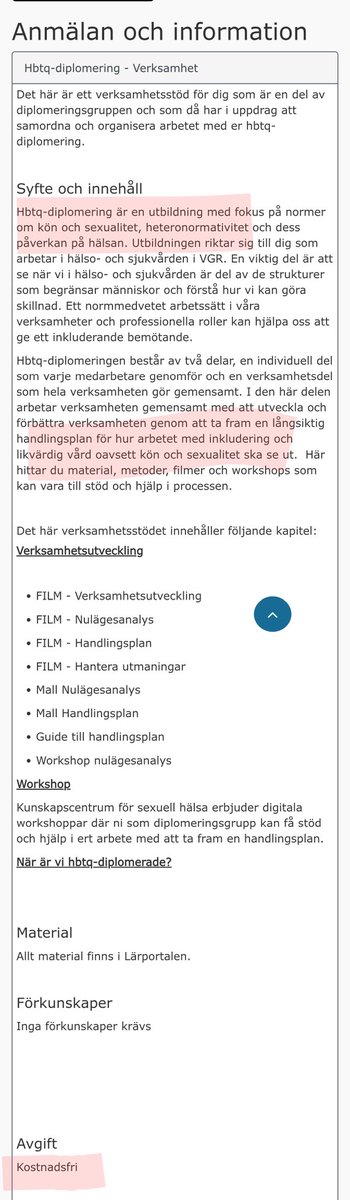
@AgnesWold@LindbergPhoto@MinisterBosse@vgregion Den verkar vara kostnadsfri. Dessutom vet jag med säkerhet att certifieringar av denna typ inom vården varit enormt värdefullt för framförallt äldre bögar med internaliserad homofobi att våga öppna upp och prata om sin sexuella hälsostatus. Med STI-prevention i åtanke är det bra.
@cow_says_what@genusateist@AgnesWold Vad trist att ni känner så. Delar inte inte den upplevelsen utan snarare sett många positiva effekter med certifieringar.
@cow_says_what@genusateist@AgnesWold Var kanske otydlig men syftade till om du haft någon upplevelse inom vården som fått dig tro att certifieringen är just verklighetsfrånvänd och ideologisk? Den känns ju rimlig oavsett politisk ideologi iaf. https://t.co/lwRLjJuwty
@cow_says_what@genusateist@AgnesWold Har du märkt av den verklighetsfrånvända ideologin i dina vårdmöten då? Förutom det du själv tolkar in i certifieringen då?
@genusateist@cow_says_what@AgnesWold Vad tråkigt att du känner så av att bara se ett diplom på något. Jag känner mig stolt, glad och tacksam. Särkilt med tanke på att framför allt många äldre bögar lider av en del internaliserad homofobi vilket kan göra tröskeln högre att våga prata om sina besvär med vårdpersonal.
Detransition Story 📖
I’ve seen a few detransition tweets get amplified like crazy on this site and I’ve decided to share my story about the topic.
Early on during COVID my Endo quit and I couldn’t find anyone local taking new clients because of the pandemic.
Due to this, plus the crazy hours and stress from work I eventually stopped looking for a new one. Causing me to medically detransitioned for about 2 1/2 years.
I felt horrible, depressed and after awhile stopped publicly presenting as female. I even developed a nasty temper once testosterone became the dominant hormone in my body again. It caused my previous progress to regress, and for new facial hair to start growing again even though I previously had laser. I also gained a considerable amount of weight.
Eventually, I had enough and knew this was no way for me to live. I went back on HRT and very quickly started feeling so much better. My self esteem, body image, emotions and happiness levels vastly increased. I finally felt like me again! 💗
Detransitioning was one of the most miserable times of my life…and NOTHING will make me go through that again! 🏳️⚧️
@cow_says_what@AgnesWold Som lesbisk med flera bögvänner i övre medelålder kan jag meddela att vårdplatscertifieringar betytt mycket för en del av dem att våga öppna upp sig och berätta om sin situation. Med andra ord väldigt bra och fint att man visar att man är en tolerant vårdmottagning.
Hi @AndrewGold_ok, when you did this interview, did you know that her name is Maia Abbruzzese, and her mother is Zhenya Abbruzzese, who has run "SEGM" (an anti-trans org) since 2019?
Maybe the story is "insane" because it isn't true?
People have been losing their heads over this paper! I just read it and I find it very limited for a number of reasons:
It looked at medical records of adults (18 and older) with gender dysphoria who received gender-transition surgeries but who had no mental health (MH) diagnoses prior to surgery, and then looked at the proportion who had MH diagnoses in their chart about 2 years after surgery. They compared those figures with those pertaining to adults with gender dysphoria but did not have gender-transition surgery who were matched by sex, age, race and ethnicity. They also compared trans masc people who got surgery but did not have a GD diagnosis with trans femme people who got surgery without a GD diagnosis.
First of all, I find it curious that many people with gender dysphoria would not at least qualify for other MH diagnoses. So that immediately makes me wonder about the validity of these findings. And as the paper suggests, it's possible that after people had surgeries, their gender dysphoria improved and/or they started focusing on other MH issues, which could lead their care providers to input other MH diagnoses into their chart. It's not that these were new issues, it's just that the providers had not noted them in the chart before. Or it's possible that getting surgery means you interface with health care providers more often and thus are more likely to have a MH diagnosis written in your chart just by virtue of having more care appointments.
And of course there is the likelihood that people with MH problems are more likely to seek surgery in hopes that it will help with those problems. And as I mentioned, perhaps those MH problems had not been noted in their chart until after surgery because their care had been focused more intently on the gender dysphoria in particular.
The main thing that I get from this paper are that trans masc people (natal females) who get surgery have much higher depression and anxiety than trans feminine people (natal males) who get surgery (see Table 3. Note that Cohort E is trans masc people and Cohort F is trans femme).
Wait a minute… Fake detransitioner @thepeacepoet99 is actually the daughter of @segm_ebm co-founder Zhenya Abbruzzense??? 😮
This makes so much sense now!!!
I asked the "gender critical" movement's shiny new detransitioner, who says things like "the trans cult is comparable to ISIS," if she was, in fact, the daughter of Zhenya Abbruzzese, who founded an anti-trans org in 2019, and she blocked me, so I think we can take that as true.
@AgnesWold Precis, ingen kausalitet påvisad. Kan ju snarare vara så att efter könskorrigerande behandling läggs fokus på andra aspekter av sitt liv man vill förbättra.
People have been losing their heads over this paper! I just read it and I find it very limited for a number of reasons:
It looked at medical records of adults (18 and older) with gender dysphoria who received gender-transition surgeries but who had no mental health (MH) diagnoses prior to surgery, and then looked at the proportion who had MH diagnoses in their chart about 2 years after surgery. They compared those figures with those pertaining to adults with gender dysphoria but did not have gender-transition surgery who were matched by sex, age, race and ethnicity. They also compared trans masc people who got surgery but did not have a GD diagnosis with trans femme people who got surgery without a GD diagnosis.
First of all, I find it curious that many people with gender dysphoria would not at least qualify for other MH diagnoses. So that immediately makes me wonder about the validity of these findings. And as the paper suggests, it's possible that after people had surgeries, their gender dysphoria improved and/or they started focusing on other MH issues, which could lead their care providers to input other MH diagnoses into their chart. It's not that these were new issues, it's just that the providers had not noted them in the chart before. Or it's possible that getting surgery means you interface with health care providers more often and thus are more likely to have a MH diagnosis written in your chart just by virtue of having more care appointments.
And of course there is the likelihood that people with MH problems are more likely to seek surgery in hopes that it will help with those problems. And as I mentioned, perhaps those MH problems had not been noted in their chart until after surgery because their care had been focused more intently on the gender dysphoria in particular.
The main thing that I get from this paper are that trans masc people (natal females) who get surgery have much higher depression and anxiety than trans feminine people (natal males) who get surgery (see Table 3. Note that Cohort E is trans masc people and Cohort F is trans femme).
VIDEO: A visibly nervous Michigan State Rep. Josh Schriver (R-Oxford) introduces a resolution to condemn the Obergefell decision that legalized gay marriage nationwide.
“If we cannot conserve the bedrock of our civilization, the family, then we cannot call ourselves conservative anymore … Now is the time to reassert Christ as our king.”
Sen. Jeremy Moss (D-Southfield), who is openly gay, sat in the front row then immediately took to the podium to call it “buffoonish.”