🚀 Our technical report for our K2 horizon models is out! It is the most detailed technical report of any open-source models that has ever been released. If you've ever wanted to see all the details that go into LLM training across all training phases, here it is!
A nice survey that addresses the computational bottleneck of sampling from the conditional distribution of X (given Y=y). Is mainly about using measure transport to construct maps with triangular structure (canonically the so-called Knothe-Rosenblatt [+] https://t.co/F1R7KsRUAt
@elyxlz@Jaeyeon_Kim_0 flow matching pretraining with priming model posttraining seemed to work well: https://t.co/afjVpSquSH :)
Code for these (small-scale) experiments is available, so adapting it to diffusion pretraining should be straightforward: https://t.co/YKO2ORSvXD (+the original repo ofc!)
Great follow-up to great work :)
Super interested in a deeper understanding of optimal stage-1 pretraining across datasets, beyond the empirical findings!
Since releasing Priming Models, we’ve received great questions. Here’s a short follow-up with new experiments and release updates!
TL;DR: Diffusion policy setup / (# real samples) vs. Final FID / T2i checkpoints released / new blog post from @moritz_piening!
Idea by @Jaeyeon_Kim_0 and @parkwbin03 was so intruiging that I had to play around a bit.
Check out experiments with Priming Models on CIFAR-10, MNIST, and Fashion-MNIST:
https://t.co/afjVpSpX39
TL;DR: Stage-1-Init is very sensitive, but optimal transport can help a bit! :)
Today, we introduce Priming Models, a new paradigm for training one-step generative models from scratch.
No diffusion teacher. No flow map. No CFG. No JVP.
We believe this work will challenge how we think about building one-step models.
Joint work with @sitanch, @du_yilun, @parkwbin03, Bohyung Han.
🔥 1.19 FID one-step on ImageNet 256×256 while using substantially less compute, e.g., 12X less than Drifting-B, 6X less than Drifting-L
🎨 Scales to text-to-image generation (GenEval 0.82)
🤖 World modeling on RT-1 / Bridge-V2
Priming Model is built on one core message: [Reconstruction pretraining --> Distributional post-training].
Discrete flow matching usually changes one component per edit in a fixed-size state. Can we extend it to general actions, like inserting whole molecular fragments?
Introducing Trajectory Matching 🧵
New paper with M. Lienen, @ludke_david, @guennemann
Got the initial inspiration from the poster by @DoronTheViking and collaborators on "Wasserstein Flow Matching" at ICML 2025 :)
📄 https://t.co/T3zYTXeW8d
Uploaded the camera-ready version of our #NeurIPS2026 paper:
"Generalized Wasserstein Flow Matching:
Nested Couplings for Point Cloud Generation"
→ Multisample Flow Matching in Wasserstein space
📄 https://t.co/2S497yrgVB
with R. Duong & G.Steidl :)
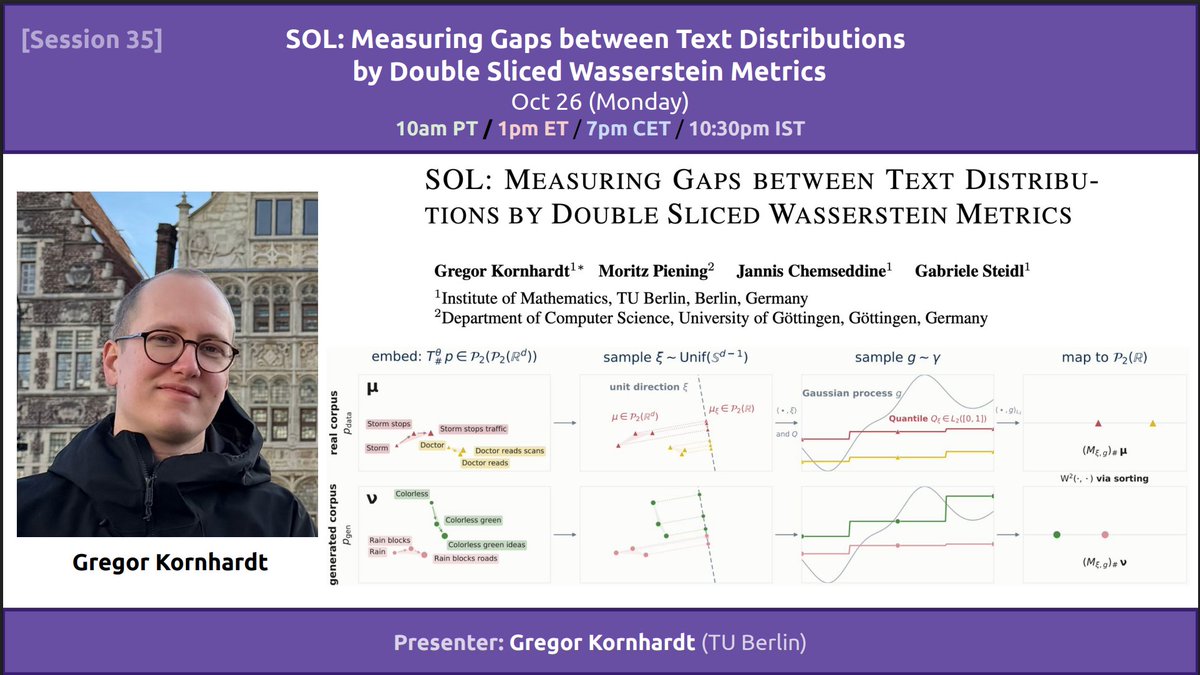
This Monday, Oct 26, Gregor Kornhardt (@gregorkornhardt) will present his paper:
SOL: Measuring Gaps between Text Distributions by Double Sliced Wasserstein Metrics
Equivariance matters not only for networks, but also for interpolation in flow matching
With Christian Wald, we show how graph alignment preserves geometry and improves few-step generation
Preprint: https://t.co/9a1XaOvgDO
Fig: Alignment preserves sparse graph structure (b, c)