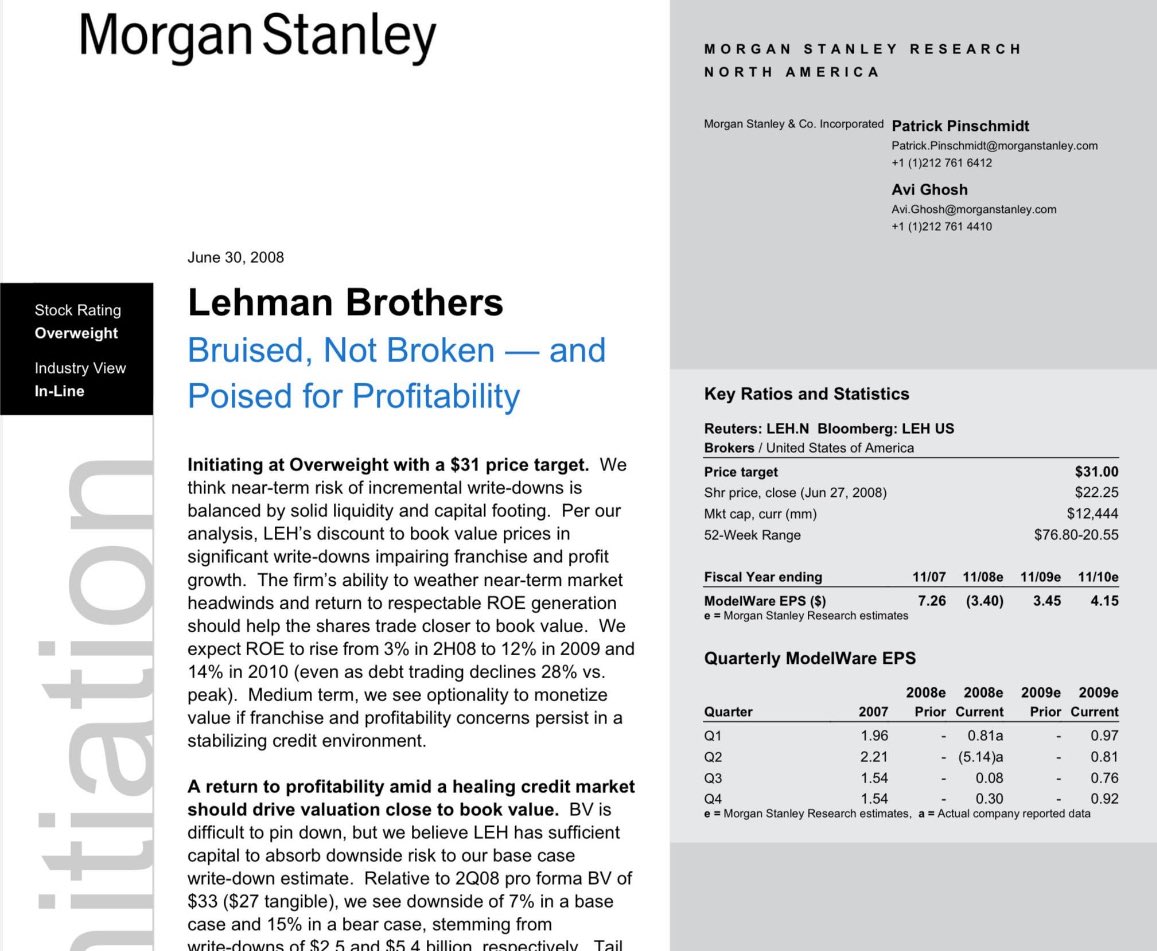
Morgan Stanley released this equity research report just a few months before Lehman Brothers filed for bankruptcy
Good reminder that most experts don’t really know anything at all when it comes to financial markets
Do your own research and come to your own conclusions
Stop modelling orbital compute using Starlink assumptions.
SpaceX is hiring aggressively for solar array engineers and silicon crystal growth roles while Elon has been visiting perovskite leaders in China; direct evidence they’re executing on the solar side of 100 kW/ton
People are still modelling orbital compute satellites using Starlink assumptions, and that’s why the 100 kW/ton target, and the subsequent unit economics, look impossible to them.
The mistake is understandable. Starlink is the only high-volume reference we have, so analysts default to its rigid panels, constant Earth-pointing, and heavy structure. But orbital compute is a fundamentally different mission.
To show what’s actually plausible, we modelled three distinct reference paradigms for the solar array subsystem alone (the biggest lever after chip temperature):
Raw solar array specific power improves as follows:
• 85 W/kg: Starlink V3-like rigid-PV baseline
• 261 W/kg: V1 'Starthink' compute-optimized flexible design (3.1×)
• 490 W/kg: V2 'Starthink' optimal, Perovskite + minimal structure (5.8×)
Most of that 3-6× leap comes from stopping the Starlink design constraints:
1. No need for constant ultra-precise Earth-pointing for phased-array antennas
2. Arrays can deploy radially and stay taut using passive gravity-gradient + centrifugal tensioning
“Flapping allowed” → heavy booms, rigid frames, hinges, dampers, and stiffeners become unnecessary
Result: Solar areal density collapses from 3.0 kg/m² → 1.0 kg/m². Structural mass savings alone drive most of the gain.
(Quick clarification: These are solar array subsystem figures only. The ~10 W/kg people quote for Starlink V3 is the entire satellite. Totally different metric.)
Once you stop anchoring compute satellites to comms-satellite requirements, the solar side of the 100 kW/ton is the obvious next step.
Full breakdown here 🧐:
https://t.co/OYwY5B7J9e
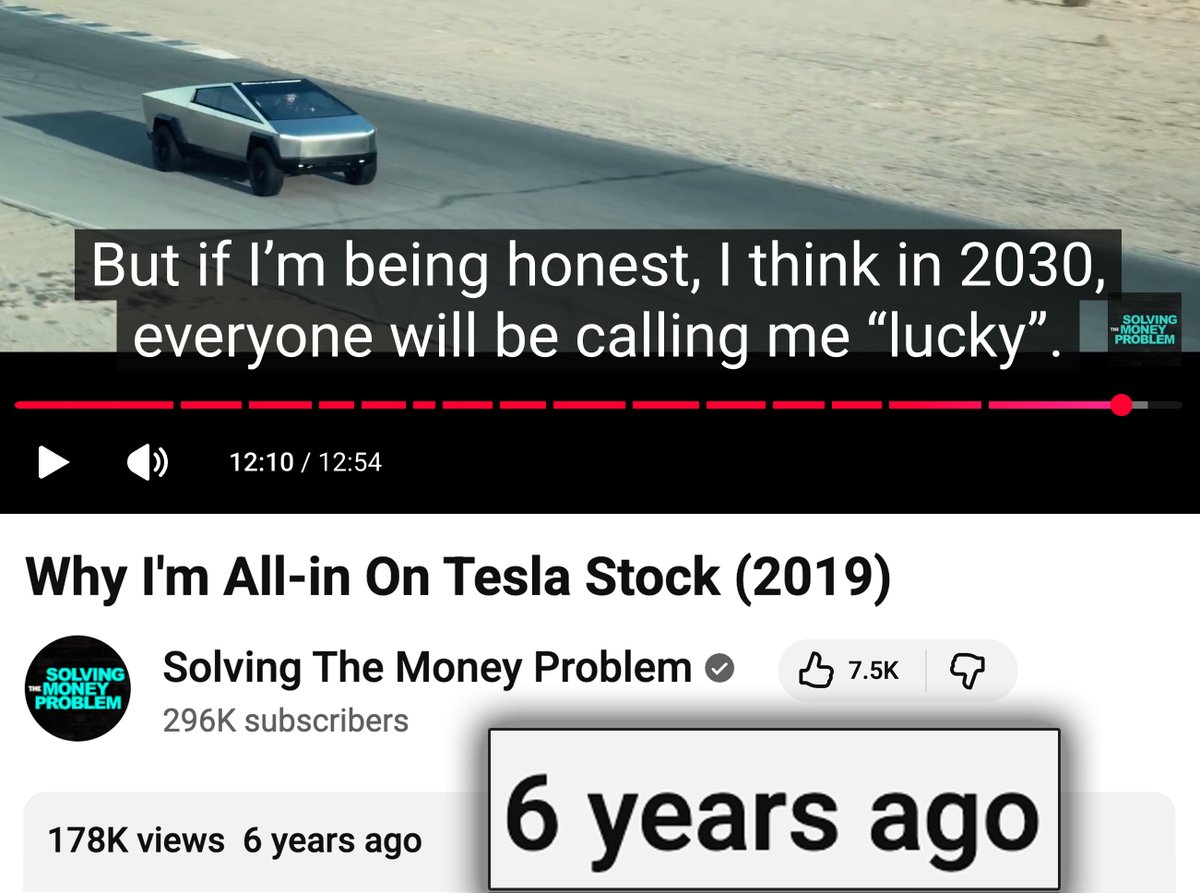
I have $2.2 million in Tesla stock lol
I have no other stocks
Everything is in Tesla stock
Tesla fails I fail
Tesla succeeds I succeed
That is how I want to live life #tsla
Innovation is winning:
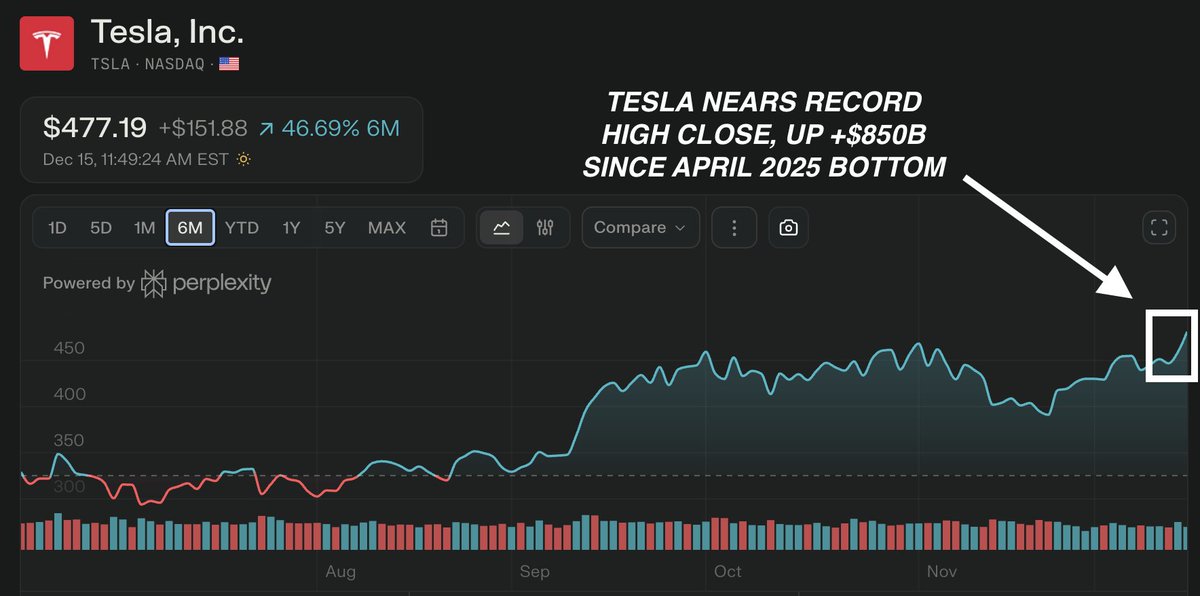
Tesla, $TSLA, is now on track to post a record high close, adding +$850 BILLION since April 2025.
This makes Tesla $1.5 trillion company.
Elon Musk has done it again.