@bcherny Hi Boris, interventional cardiologist here, I use Claude daily for both clinical work and research. Fabie is an incredible model, but ~90% of my prompts get blocked, even fully anonymized tasks. It's hindering work that translates into patient benefit. Is there a solution?
@daridor@DeryaTR_@AnthropicAI Who did you ask? I'm using Claude everyday for my work in cardiology and Fable is blocking 90% of my requests. It's basically unusable!
🫀 Why Photon-Counting CT + High-Iodine Contrast Change Structural Heart Imaging
When a valve goes inside another valve, ultra-high resolution + 400mgI/ml contrast becomes strategy.
Video: TAVI-in-SAVR.
Seeing that a prosthesis is there is not enough.
Seeing how high-concentration iodine flows through it, across frames, leaflets, calcium and prior devices — that’s accuracy.
In complex structural interventions (Valve-in-Valve, TAVI-in-SAVR, redo procedures), diagnostic confidence lives in contrast fidelity, not in spatial resolution alone.
That’s where Photon-Counting CT (PCCT), paired with high-iodine concentration contrast media, truly shifts the paradigm.
⚡ What PCCT + high-iodine contrast deliver in complex structural heart cases
• Much stronger intraluminal iodine signal, even through double prosthetic layers
• Exceptional contrast-to-noise in high-attenuation, metal-rich environments
• Cleaner iodine–calcium–metal separation → less blooming, fewer artifacts
• Precise visualization of frames, neo-leaflets, sealing zones and flow paths
• More reliable assessment of coronary access risk and post-procedural hemodynamics
When you place a valve inside another valve, margins disappear and artifacts multiply.
Conventional CT sees structures.
PCCT with high-iodine contrast reveals function and flow.
Here, iodine is no longer just enhancement.
It becomes quantitative, separable, and diagnostically decisive.
In structural heart imaging, accuracy is not about brighter images.
It’s about contrast integrity in extreme complexity.
From anatomy to strategy.
From visualization to confidence.
That’s the power of Photon-Counting CT combined with high-iodine contrast in structural cardiac intervention. ⚡🫀
#PhotonCountingCT #PCCT #HighIodine #StructuralHeart #ValveInValve #TAVI #CardiacCT #SpectralCT #InterventionalImaging #RadiologyInnovation #yesCCT
15-year data 📅 from the PROLONG registry 📚 show transcatheter #PFO closure is safe ✅ and effective in preventing recurrent stroke and embolism in cryptogenic cases, with very low complication rates ⚠️. Real-world win! https://t.co/PBMfl98jIM #Stroke
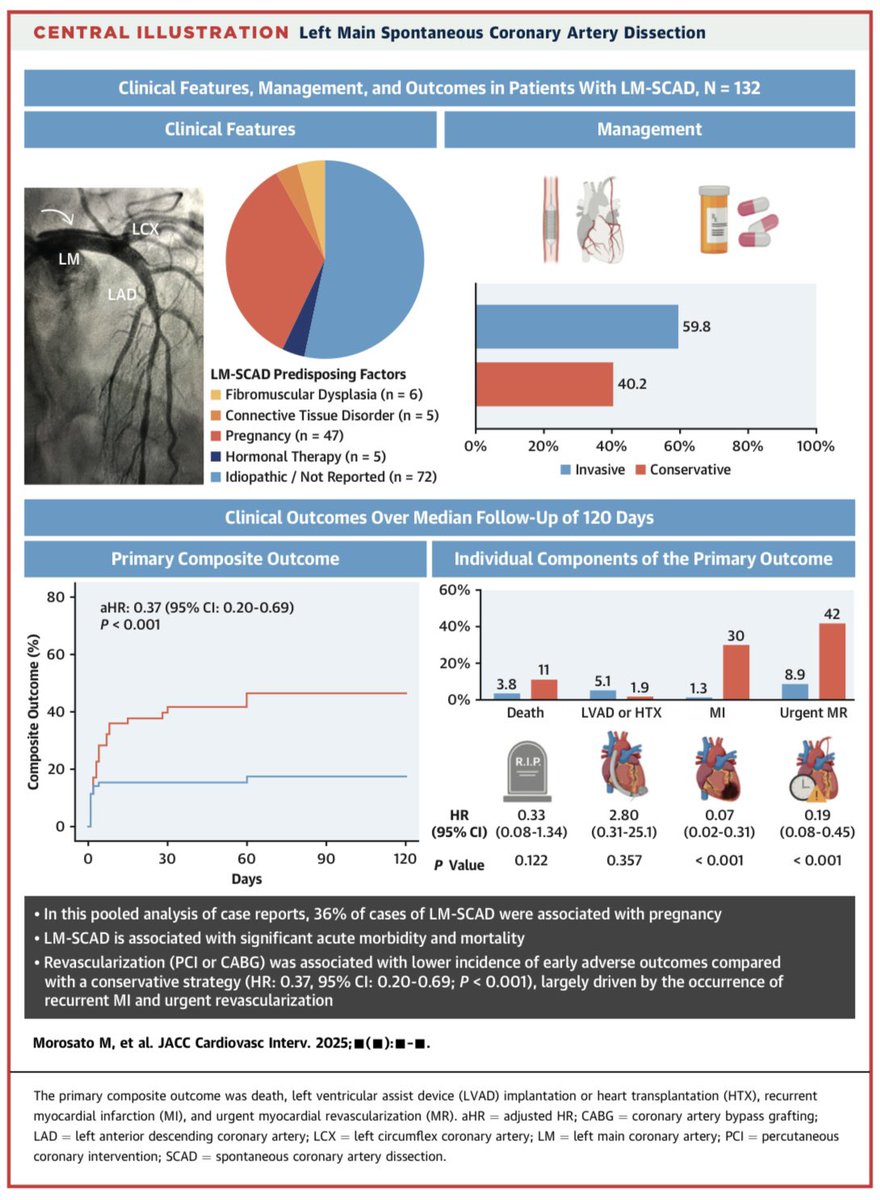
In this #JACCINT pooled analysis of pts w/ left main #SCAD, death occurred in 9%, recurrent MI in 13%, urgent #revascularization in 21%, & #LVAD/heart transplant in 4% at 120 days. Early revascularization significantly reduced these risks! https://t.co/gpptzcEucn #HeartTx#cvMI
Sim publication #GISE2024 🔈🔈
The Delayed atrioventricular block Prediction for eArly disChargE (D-PACE) score, consisting of procedural and electrocardiographic variables, can be used the day after transcatheter aortic valve implantation to stratify patients according to the risk of delayed high-grade atrioventricular block. Based on the result of the score, it is possible to identify patients who can be safely discharged 24 hours after the procedure. @saia_francesco
#EAPCI #CARDIOLOGY #CARDIOTWITTER #TAVI https://t.co/bkeWXMaGMy
Ongoing debate about the EARLY-TAVR primary endpoint, but after 3 days have found Suppl.Figure 4 - All-cause death, stroke, v.robust definition of HF hospitalization. HR 0.60 [0.44 - 0.83] - a positive trial! @dr_benoy_n_shah@vass_vassiliou@djc795@PhilGenereuxMD @mmamas19731
Ouch, QFR. In the FAVOR III Europe trial, it loses out against FFR for PCI guidance. For those who enjoy statistical tortures, QFR didn’t just fail to show noninferiority; it was actually inferior. More stents, more myocardial infarctions. Who will give me back the hours I spent obtaining the certification? #TCT2024 https://t.co/tq8cOVf6MF
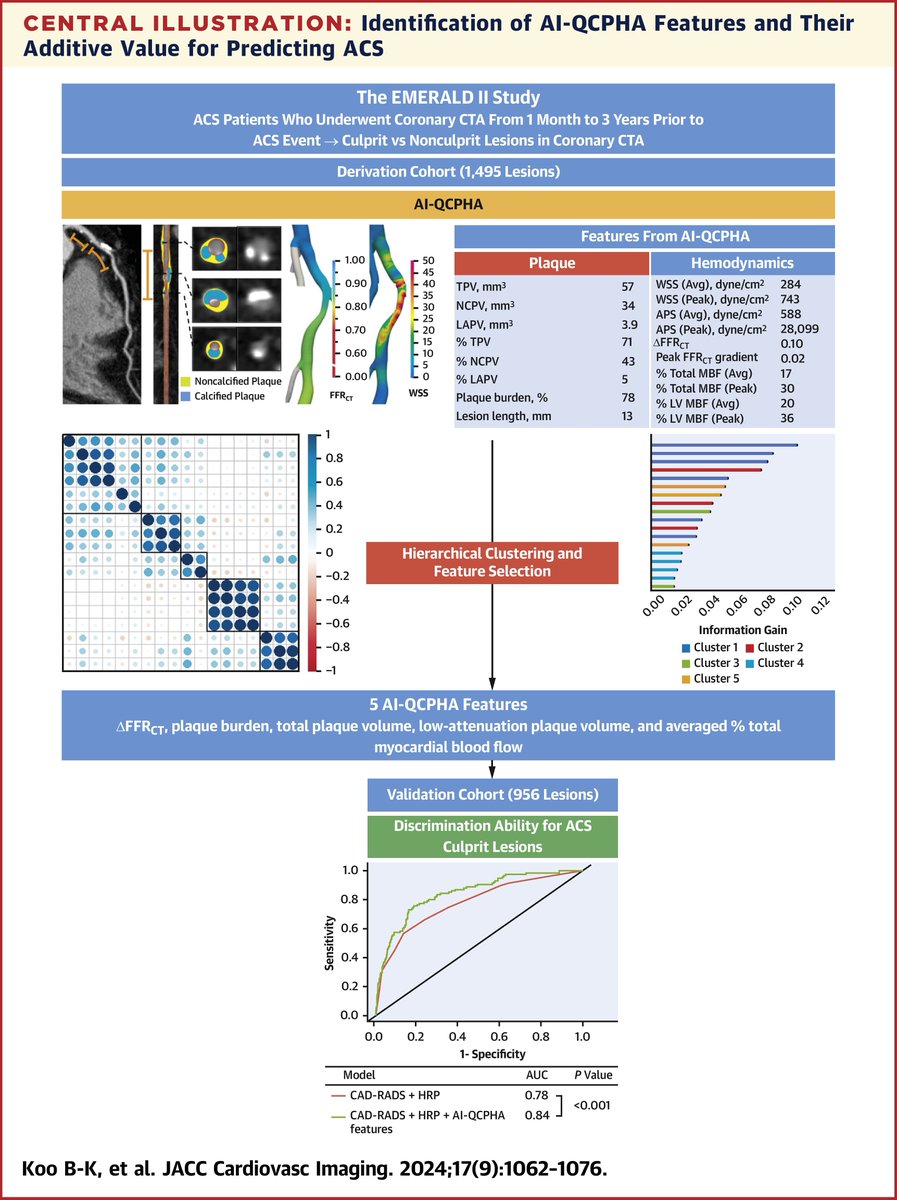
Predicting #cvACS via #AI & #YesCCT? Using AI-enabled quantitative coronary plaque & hemodynamic analyses (AI-QCPHA), the EMERALD II study identified 5 features improving risk prediction for ACS over the standard CCT analysis. https://t.co/HeyxJOr6Lr
#JACCIMG@lesleejshaw