If you are wondering why they are killing journalists, healthcare workers, aid workers, and UN staff, it's because they are the witnesses who will testify in court about the war crimes committed in Gaza and Lebanon.
If you are wondering why they are removing the rubble and the bodies before UN and ICC inspections, it’s because they are the evidence of war crimes committed in Gaza and Lebanon.
If you are wondering why they are calling to dismantle the International Criminal Court and sanction ICC judges, it’s because they are the judges and the court that will prosecute them for the war crimes committed in Gaza and Lebanon.
If you are wondering why they are calling to dissolve the United Nations, terminate UNIFIL's mandate, and sanction UN officials and representatives, it’s because they are the observers who documented the war crimes committed in Gaza and Lebanon.
They are killing the witnesses, the evidence, the observers, and the court, in broad daylight.
شتاء رابع من الحرب. والمعاناة ذاتها.
يواجه الأطفال في #غزة المطر والبرد في خيام هشة. ملابسهم مبتلة، وفُرشهم غارقة بالمياه. حتى خيامهم غمرتها مياه الأمطار.
السماح بدخول جميع المساعدات وتوفير المزيد من التمويل أمرٌ حيوي.
الأطفال لا يستطيعون الانتظار.
I put a map of the "Yellow Line" on a topographic map of Gaza. It shows that Israel is pushing Palestinians into the lowest-lying parts of Gaza, ensuring that as many people as possible are flooded by cold water and sewage.
Let's be clear: This policy is intended to kill.
Living in tents as rains flood them out — bombed into homelessness by Israel — forgotten by much of Western media — Palestinian refugees in their own land.
They need rescuing, land return, new housing, compensation, counselling, support, and security — the world owes them this much at least.
As heavy rain & cold hit #Gaza, families and their #children are facing devastating conditions in makeshift tents with little protection.
@UNICEF is doing what we can to support but much more needs to be done.
Access for all aid & more funding is vital. Children cannot wait.
President Trump claimed that AI oligarchs could regulate themselves because they “love our country.”
Now, Google is threatening schools: if you stop your students from using AI, we will cut off your access to Google Search.
That’s not love. That’s extortion.
PAUSE AI NOW.
Google is trying to use its monopoly power to force AI into our public schools.
No corporation should have the power to dictate how we teach our children.
Our public schools exist to serve students, not to grow the profit margins of Big Tech.
https://t.co/jfACMS1Sh2
For more than two months, I have been working on a truly horrific story about one of the gravest war crimes committed by the United States since Vietnam: The bombing of the Shajareh Tayyebeh school in Minab, Iran. It was one of the first targets struck in the opening hours of the war on February 28, 2026.
At least 156 people were killed in the U.S. cruise missile strikes—120 of them were children and 26 were teachers. We spoke to survivors, first responders, parents, doctors, teachers, psychologists, and other witnesses. Some of them had never before shared their experiences of that day.
It would be impossible to do justice to what happened in Minab that day with words alone. In more than 25 years in journalism and reporting on war, I do not believe I have reported on a more heinous single crime.
Massacre at Minab: The School That Became a Grave
https://t.co/6zcGDYIzCC
Please share this story with as many people as you can.
I'm reposting this below because it's a very clear condensation of the three major claims the holders of big capital - banks, hedge funds, sovereign wealth funds, corporations, insurance funds, private pension funds, very rich individuals etc. - require us to keep believing. Suggest a programme of public spending and investment to reboot an ailing economy, and you'll have these warnings immediately fired back at you. Should we worry? Yes and no. It's very complex, so it's a long read and I'm forced to omit a lot of stuff, but bear with me, I'll try to boil it down.
The claims:
1. Taxes and government borrowing from international bond markets fund public spending.
2. These international bond markets will discipline any government that runs an unfunded deficit, principally by jacking up yields to make borrowing more expensive.
4. Capital will flee the country and invest elsewhere.
OK, spoiler for those short of time. Are any of these claims true? Yes, but only because Western nations continue to believe them and keep electing politicians who, along with central bankers, operate their fiat money systems in accordance with the global system these claims represent. Politically and ideologically yes, technically no. We're conditioned to think that this belief system is 'reality'. This is how belief systems have always worked - metaphysical claims on reality are what the philosophers call 'ontology', often selected and justified by naturalised ethics - this is real, it's just the way things are and it's good (or evil). The basis of this particular and very recently established (300 years or so) belief system is that capitalist markets are good (fair, efficient etc.) and national states representing organised workers are bad (tyrannical, inefficient etc.). So let markets work their magic and allow the state to intervene minimally only when they hit problems (crashes, recessions, unemployment etc.) that can always be overcome - calm down, no sweat, just keep it going. Politics is reduced to the degree of intervention we should tolerate, nothing more, but, whenever possible, less.
So, the bankers, economists, politicians and hacks you see on the telly all the time looking knowledgeable, clever and rational - steady hand on the tiller! - are either 1) subjects of an ontological-ethical belief system they want you to be subjects of too, or 2) liars who know it's just a belief system but want people to keep believing it's real and letting it run as a globally locked-in system because it enriches them and their pals.
A little more detail - what are these bond markets and why can capital just up and run off somewhere else when it wants? Bonds first appeared in C12 Venice as forced loans to fund a war. It all went pear-shaped, the Doge was executed by a mob of angry rich people and hired thugs, and loans were consolidated into a fund called the Monte Vecchio. It paid 5% interest - hey guys, free money to make us richer! - so the richies enjoyed it and didn't press for the repayment of the principal because that would reduce the interest, which later became known as the 'yield' as secondary markets developed in which more interest could be extracted. So, don't ask for it all back, just keep it rolling, forever if you can. Free money forever, and even more when freely trading on secondary markets with discounts. Usurer's Heaven on Earth!
In those days central banks and paper money didn't exist. So governments relied on metallic coins accumulated by the richies extracting labour and produce and doing dodgy deals on coin markets like the Rialto. After that a lot of stuff happened regarding coins and metal, but if we fast forward to the C16 coin values were set by decree (face value) rather than metallic value. Between C17 and C19 paper currencies were issued backed by silver and gold reserves. Government bonds were centralised first in C17 Netherlands. Of course the VOC (Dutch East India Company) loved this as a fairly reliable stash for its boatloads of spare dosh paying yields. Bonds were more reliable than the unstable private banking system because government land and tax were the endless assets of last resort - they even had VAT!
The UK set up its central bank in 1694 under invited Dutch influence and immediately started selling gilts. The richies with spare dosh immediately fell in love with it. Things started moving faster in C18 as UK bondholders struck up friendly relations with politicians to establish dependency on secondary bond markets. Beginning with the famous 'coffee-house trade' - legend has it they liked coffee because it kept them alert while doing dodgy deals - secondary markets developed as a powerful force. The principle is simple - if bond buyers can get higher yields and lower prices in the secondary private trading market, governments are pressured to match them. But only if the politicians and central bankers are friendly. They have to be friendly. And it helps if they're believers in the magic of markets and the ethical notion that savers and investors are glorifying God by making themselves rich and trickling bits of it down to the Godly but less deserving poor.
Of course, now that we had central banks, paper money and government accounting ledgers, fiat currency was used in emergencies, such as the Napoleonic Wars and WWI, but that was kept quiet. The very idea that governments can create money endogenously (from within) by fiat - Franklin and Lincoln also did it in the USA - rather than relying on interest-bearing loans from private moneylenders calling themselves 'bondholders' must be seen as evil. Abandon hope all ye who do this, by Jove! J.M. Keynes worked in the Treasury during WWI, and legend has it that he saw officials fabricating bond sales in order to keep politicians and the public alike believing that private loans are essential.
Bond markets were rolled out across Europe in C19. Yes, the Rothschilds were heavily involved but let's not start blaming the Jooz because that's not the case. It was the richies combined doing it. In C20 a lot of stuff happened as the UK left the gold standard in 1931, then after 1944 Bretton Woods set up a gold exchange standard based on dollar convertibility and imposed capital controls to ensure at least some profits were reinvested in domestic economies. The richies didn't like any of this, and started circumventing these controls via the Eurodollar market.
Between 1971 and 1978 Western nations abandoned Bretton Woods and the gold exchange standard. Free-floating fiat money was adopted. The richies understood the necessity and potential advantages (for them) of this but also saw it as dodgy because people might get the idea that democratic (one day!) governments can issue currency to spend and invest, thereby crowding out mega-rich private lenders and cutting back on their free money. What better mechanism to impose fiscal discipline on governments than the secondary bond markets and their vicious cousin the FX (foreign exchange) markets? All they need are friendly politicians, bankers, economists and hacks. Easy gig - plenty of them, either true believers or practiced liars. So, after 1979, the plan was to set big capital free to circulate around the world, like it did in the (for them) good old days of Empire, funnelling it through global bond markets and FX markets, enriching themselves and simultaneously imposing strict fiscal discipline on governments.
By the way, lately, rapidly developing nations such as China have used massive dollops of public investment and capital controls to boost their economies. So the richies and their little helpers try to convince us to hate them as tyrants and watch as their economy eventually collapses into a vortex of unpayable debt - which it hasn't, of course, but we're supposed to live in hope.
In 1979 the first thing the Thatcherites did was abandon capital controls. Other Western nations got the idea and stock (the productive end is more risky, so careful!), bond and FX markets (less risky and lucrative!) - the 'money markets' - were rolled out globally after 1980 by a powerful politician/banker/investor/media alliance whose adherents firmly believe (or want us to) that money markets should discipline and control governments. Of course they also gift them safe savings and endless oodles of free money in the form of yields, but you know, that's just a little sweetener for the valiant 'risk takers'..... even though these markets aren't very risky.
Technical disempowerment would be quite simple - firm policies in the primary sales, central bank intervention, fixed-rate, non-tradable bonds and capital controls to throttle the secondary market and FX markets - but this would require coordinated policies initially across the G10.... or G8 first, because the Brits and Yanks wouldn't have it, would they? Some nation must be brave and set the ball rolling. We simply lack the politicians willing and able to do this. And we continue believing. Machiavelli said the best way to instill belief is fear - divine punishment. This is how it works. The markets are the divine supplier of fairness, efficiency, consumer democracy and prosperity to Godly (optional these days) sovereign individuals. Disobey them and we will be punished. Escaping this will be as big a leap for freedom as escaping from the Mediaeval Catholic Church.
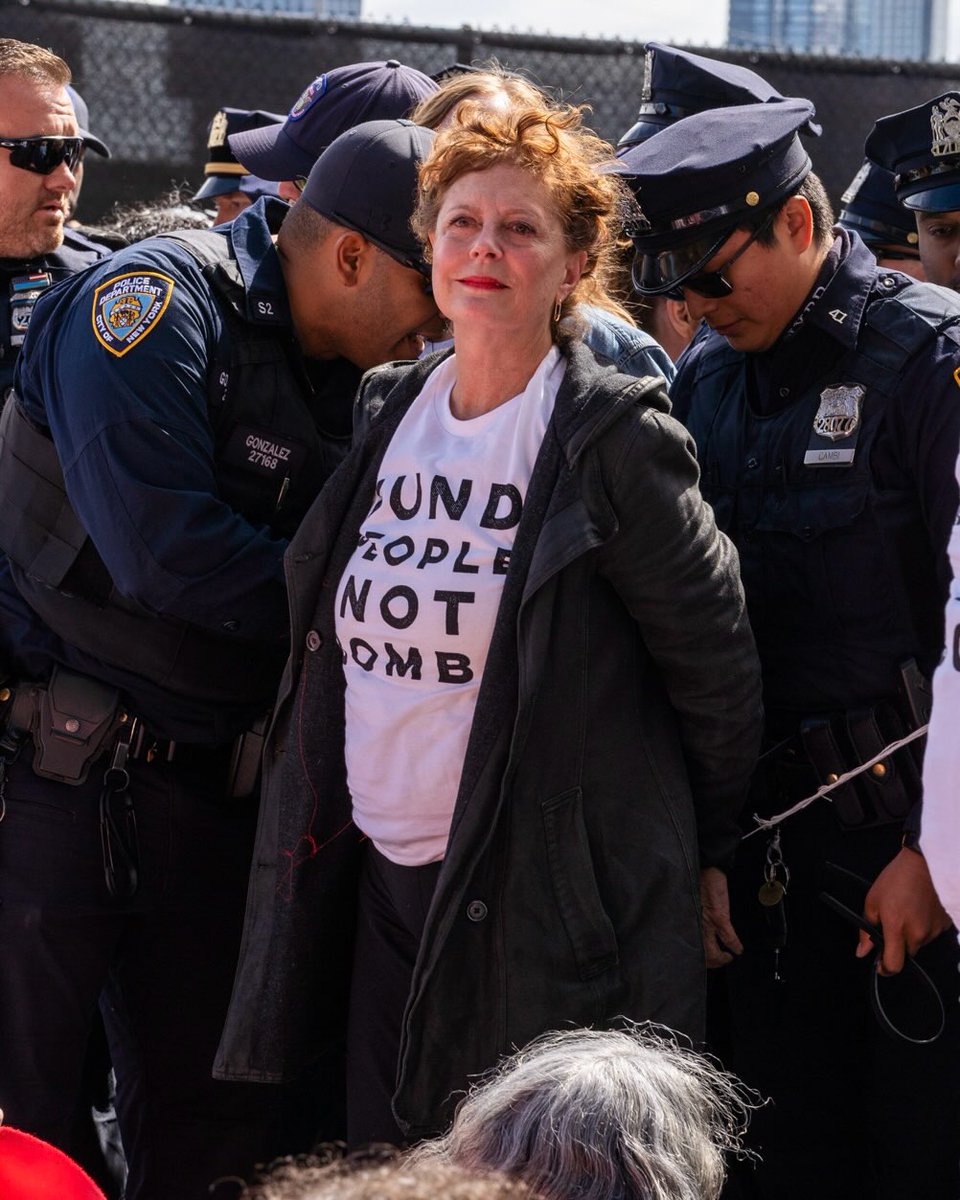
Actress Susan Sarandon being arrested earlier today for protesting Benjamin Netanyahu’s speech at the United Nations. One is speaking out against genocide, one is committing it. One was arrested, one was not.
We can't do 'good' in the economy without a new economic theory of what 'good' is.
That is the argument of my new book, The Common Good Economy, published in the US last week with @BasicBooks. A clip from the audiobook below. Links to the book in replies.
Law enforcers already have authority to charge companies and their CEOs for creating and releasing dangerous, unvetted, or defective products. We shouldn’t let discussions about new legal regimes distract from the fact that there’s no AI exemption from laws already on the books — a point @FTC emphasized repeatedly during my tenure.
1. There is an extensive set of laws that govern dangerous and defective products. For example, releasing unvetted AI models or agents can violate consumer protection laws. Shipping flawed AI tools without implementing adequate measures to detect and stop rogue or defective AI agents can be an “unfair or deceptive” act or practice under the FTC Act (and analogous state laws). And some state AGs are already exploring holding AI firms and their CEOs criminally liable when their models participate in criminal activity.
2. Existing laws also prohibit “unfair methods of competition.” This covers instances where AI firms appropriate the competitively sensitive information of their customers, including through tracking their use of various tools. It can also cover instances where firms pursue dangerous behavior, aware that doing so may compel rivals to do the same.
As the Supreme Court has noted: “A method of competition which casts upon one's competitors the burden of the loss of business unless they will descend to a practice which they are under a powerful moral compulsion not to adopt, even though it is not criminal, was thought to involve the kind of unfairness at which the [unfair methods of competition] statute was aimed."
3. The highly concentrated and interconnected structure of these markets could be creating major risks and conflicts of interest. We had started investigating these partnerships and cross-investments across the stack (and released a preliminarily overview of some findings: https://t.co/jJ5cS3Pin3).
Both federal and state enforcers should be scrutinizing these opaque relationships and inter-dependencies. We are already seeing how these relationships could undermine accountability. For example, OpenAI could face liability given the Hugging Face incident, but Hugging Face being bought up by Nvidia means that we’re unlikely to see it file a lawsuit over this — given Nvidia’s strong incentive to see OpenAI continue full speed ahead.
4. As AI tools dramatically change the landscape of cybersecurity risks and hacks, all businesses should be doubling down on having core security protections in place. Firms that fail to invest in adequate data security measures or fix known vulnerabilities can also be breaking the law. A recent analysis showed that around 1/3 of Fortune 100 companies do not even have a way to notify them about security issues. During my @FTC tenure, we sued firms for poor data security practices and held CEOs liable when they were personally responsible.
https://t.co/nwZ5Av8fOK
https://t.co/KjRye8y9SY
5. As policymakers consider new legal regimes, we should be looking to lessons from prior efforts to govern major sectors, such as banking and other networks, platforms, and utilities. Tools like structural separations, nondiscrimination, and supervision could be key, and there’s a rich history of what works and what doesn’t. But we can and must pursue any new efforts alongside enforcing existing laws.
@ProfSteveKeen@YouTube Thank you for the podcast Steve & Phil. These podcast (over 500 of them) enlighten me, don't want to sound like a fanboy but these are the most valuable knowledge with a lot of wisdom that would pass down to the next generation to come. Thanks for doing it - much appreciated.