Let me summarise this for you...
This is the picture:
-A religiously-motivated, unfalsifiable premise;
-A dedicated funding line that could only ever reward positive outcomes and pre-planned confirmation;
-So-called published "science" sitting at the bottom of the evidence hierarchy with no translational pathway built or even planned;
-A sponsoring ministry that won't show its books; and
-An opportunity cost measured against every competitively-reviewed proposal in real Indian science that didn't get that Rs 98 crore.
Ultimately some compounds we already knew were in animal urine got identified.
Nothing that matters to a person or a society evolved from this colossal wastage of public funds.
My latest piece is on the state sponsored disability & slow poisoning of kids in village of Dhanbad, Jharkhand.
For years the govt knew their water had high fluoride. It failed to provide them safe water. An entire generation of kids affected.
Read: https://t.co/hmY8cmsGwg
“Not only are the present proceedings only mala fide, but also an arbitrary attack and abuse of powers on the free and impartial journalism of the petitioners,” the court stated, according to Bar and Bench.
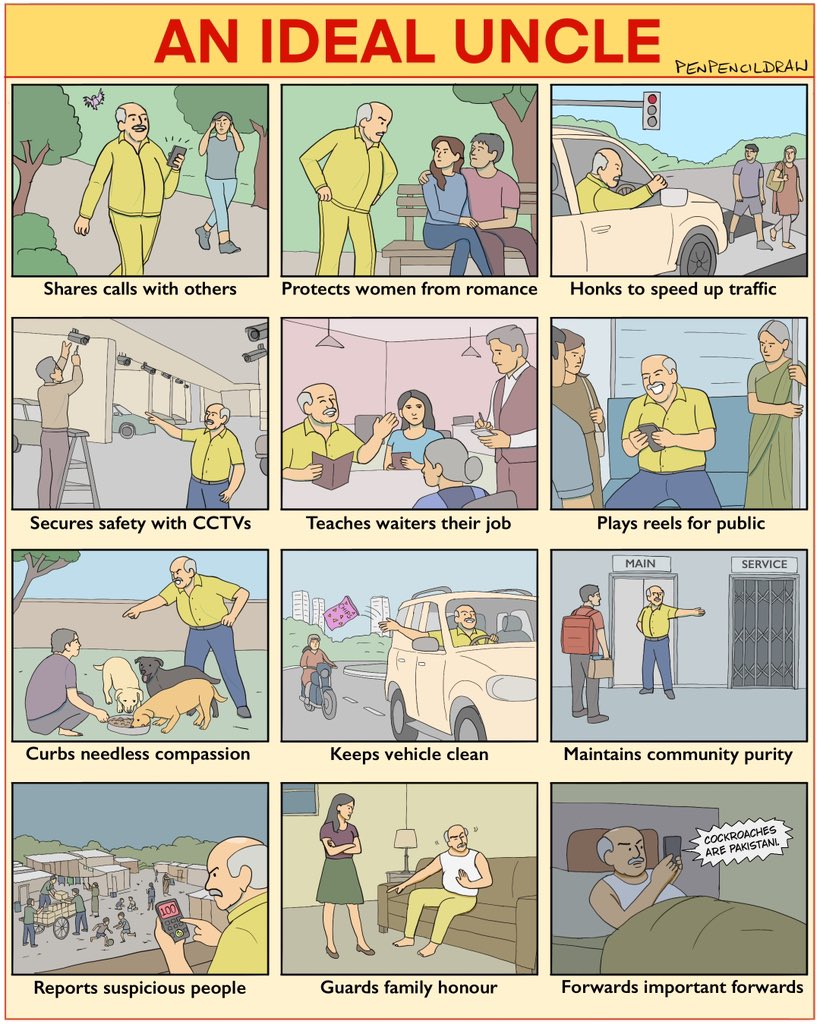
This week’s comic for @thenewsminute
A site that did independent journalism collapsed. Journalists' lives were turned upside down. Their devices were taken away. Prabir's reputation tarnished, and hard to forget the horrible role played by newspapers whose editors give lectures on power of journalism.
NEET a mess. CBSE a mess. Education sector a mess. Students’ lives a mess. But education minister is busy offering prayers in a bizarre display of sycophancy.
It's a huge to loss to every Indian young parent, and their child.
Dr Sivaranjani Santosh had resigned from the Indian Academy of Paediatrics (IAP) ater an eight-year long fight against fruit-based, non-carbonated beverages marketing themselves as Oral Rehydration Solution
Why do you think men have audacity to say "370 rupaye biryani ke paise vasoolna hai?" They know they won't face consequences for making public and online spaces violent and unliveable for women, thanks to judgements like this. By the way, is this the "shayari" being referred to?
Crazy that this is getting barely any coverage. This year’s European Press Prize was just awarded to an investigative report by the Dutch newspaper De Volkskrant. It is entitled “What the Wounds Tell” and in it the journalists Maud Effting and Willem Feenstra document the cases of 114 children in Gaza under the age of 15 who were struck by a single bullet to the head or chest. Almost all of them died or were left severely disabled. They chose to document only the cases of boys and girls under the age of 15 (though often much younger: aged 3, 4 or 7) because these are children who can be immediately identified as such. “A single bullet in these parts of the body is a clear indication that these children were deliberately targeted“, the two journalists write.
This is the article: https://t.co/YkZrpqBWBQ
Yesterday I wrote about how unruly tourists have made backpacker hostels a difficult space for solo travellers. Today I want to talk about something similar, but closer to home for me, the movie-watching experience in Delhi, especially at film festivals. I’m a big cinephile and I genuinely enjoy indie cinema.
Last year, I went to watch Superboys of Malegaon with my mother at Delight Diamond in Daryaganj, one of those old, iconic cinema halls. The hall wasn’t crowded, which I thought would make for a perfect viewing experience. But just behind us sat a young couple, probably in their early to mid-twenties, who kept talking through the film. At first, I ignored it, hoping it would stop. It didn’t. Eventually, I turned around and politely asked them to keep quiet. They paused for a bit, but soon went back to talking. I had to turn again and ask more firmly, this time telling them they were disrupting the film and should step outside if they wanted to chat.
Another experience was at the inaugural International Film Festival Delhi (IFFD) at Bharat Mandapam, where I watched Baipan Bhari Deva, a warm and entertaining Marathi film starring Rohini Hattangadi. From the start, there was constant movement in and out of the auditorium. People kept entering even after the film had already gone past a good 30–40 minutes, walking across rows, and throughout the movie groups of friends kept talking among themselves, and some even took calls inside the hall. It became difficult to stay immersed in the film.
At one point, I found myself repeatedly asking people around me to keep quiet. I was honestly quite frustrated. I tried being polite in the beginning, but when the distractions kept coming from every direction, I lost my patience. I remember telling someone that if they really needed to talk, they should step out to a cafe instead. In a few cases, I directly asked people to either respect the screening or leave the hall.
After the screening, during the audience interaction, I also raised this issue with the organisers. I do understand crowd management has its limits, but a simple reminder before screenings about basic theatre etiquette could go a long way.
On the other hand, my best film festival experiences in Delhi have been at the India Habitat Centre, which hosts the Habitat International Film Festival and the Habitat Film Festival every year. I recently watched Whispers of the Mountains there, and the difference was striking. The audience was attentive, engaged, and fully present with the film. Even after the screening, the discussion that followed was thoughtful and genuinely enjoyable.
That contrast stays with me. Somewhere along the way, the shared understanding of how to behave in a cinema seems to be weakening in certain spaces. Film festivals, in particular, are not just events to attend or document. They are spaces to watch, listen, and absorb.
At its heart, a cinema works on a simple agreement: you sit together in silence so the film can speak. When that breaks, everyone loses a little of what they came for.
#CivicSense
Please remember: The DD News anchor who’s calling your children Pakistani is paid by YOUR TAX MONEY. His salary is paid for by the public — and he actively goes against this public every night with his communal-bigoted-braindead nationalism.
https://t.co/69WKFKP4HQ
IMPORTANT: Gurmeet Ram Rahim Singh (Dera Sacha Sauda chief) granted parole once again, this time for 30 days. It’s the 16th time he has been out on parole since his conviction in August 2017.
He is serving a 20-year sentence for rape. Meanwhile likes of Umar Khaled have stayed in jail for almost 6 years without even a trial commencing. Yeh hai JUSTICE system: Wonder what our Lordships would pontificate on next! 🙏