Data will be queried for agents, not for humans.
SQL was created 50 years ago and it’s still great for human use.
I wonder if this will still be the case in 10 years for agent-native databases (agentDB).
I’m not talking about similarity search. I’m talking about direct data retrieval. SQL works great today.
Right now agents access data through SQL or through apps that use SQL under the hood.
I believe that in a few years a new paradigm built for agents will start replacing SQL.
Why?
Because AI agents are not humans. Their requirements are different. They can work directly on raw data without the SQL layer in between, which means faster queries and lower latency.
This makes me wonder: What kind of metadata will these systems need, and what will they actually look like?
I’ve seen some startups working on this, but I haven’t seen a real killer solution yet.
What do you think? Should we build a new data paradigm for agents?
#AIAgents #AI #Databases #SQL #AgenticAI
@jpridgely@dok2001@eastdakota@Bankless Thanks @dok2001 and @jpridgely!
Appreciate your interest and the quick response.
I sent a DM to Dane and LinkedIn connection requests to you both. Justin, I would love to chat once the DM is open.
Really interesting interview with @eastdakota on @Bankless.
Cloudflare accounts for over 20% of internet traffic. That's 500M transactions per second. It can monetize 1–10% of that traffic (with x402), so it needs 5–50M transactions per second from a blockchain.
I'm a researcher at an L1 blockchain startup that can reach these levels.
Let's change the internet!
As an ex-IBM Research the market is way overreacting to the Claude COBOL news. IBM down ~13% today is classic AI-fear selling.
Yes, Claude can speed up COBOL refactoring but..... the big money still comes from mainframe hardware + support contracts (~$15–16B/year).
Banks/governments/airlines run trillions of dollars daily on these systems; they won’t replace overnight due to risk, cost, and regulation.
@zohar_ofir Agree, and I think stablecoins will be the way AI agents pay each other, especially in micropayments and this really suits stablecoins perfectly.
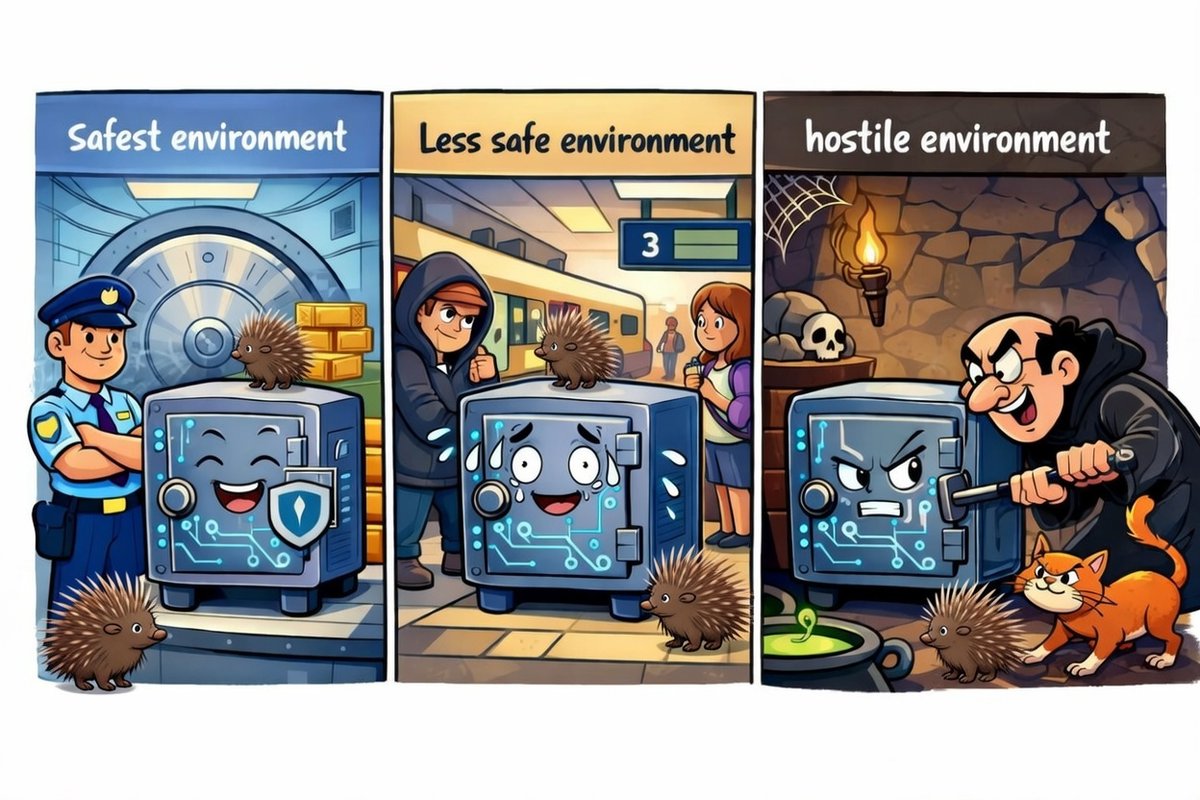
The "Where" Matters: TEE Deployment Environments:
Even with top hardware (SGX/TDX), security depends on where that box lives.
For privacy-focused TEEs: Breach leaks data, but protocol integrity holds (no double-spends).
The "Hostility Levels" define your risk. 👇
1/ Bank Vault (Safest) 🏦
- Env: Trusted clouds (AWS/GCP/Azure) or foundations.
- Pro monitoring & compliance.
- Risk: Side-channels minimized by layers of physical security.
2/ Train Station (Less Safe) 🚉
- Env: Decentralized validators.
- Accessible, mixed motives.
- Risk: Software probes likely (timing/cache via OS exploits). Assume side-channel threats.
3/ Gargamel’s Castle (Hostile) 🏰🧪
- Env: Malicious nodes or state hackers (e.g., Lazarus).
- Attacker owns the hardware.
- Risk: Physical/supply-chain tampering, TEE breach inevitable.
- Avoid or Pivot to MPC or ZK-proofs. If you are building for this scenario, hardware is just the first line of defense.
Bottom Line: A TEE is a "safe." But one in a bank vault >> one in a villain's dungeon.
#Web3 #Privacy #ConfidentialComputing #TEE #Blockchain
The world is changing, FAST.
Software is going to be fast and cheap to create.
Agent are going to be prevalent.
Value will accrue at the platforms that capture the network effect where interactions happen.
Blockchains are perfect platforms for this new world. Even critical.
But dramatic improvement are still needed for blockchain to play that roll.
Privacy, compliance, scale, scale, scale….
Amazing!
NeurIPS 2025 accepted papers with over 100 AI-hallucinated citations across at least 53 of them!
We must change the review process: too many hallucinations and too many papers.
NeurIPS had more than 21K submissions!
A quick must-have: Add an AI reviewer to catch this and handle the burden.
https://t.co/KFB1RTTnoZ
#NeurIPS #Academia #MachineLearning