Just launched today https://t.co/rbsinUJrsG 🤖🐘
Postgres intelligence for agents & apps.
Free. Open source. Written in Go.
Nobody wants to stare at PostgreSQL dashboards all day. So I built a bot that does it for you.
→ finds what’s wrong
→ explains what changed
→ tells you what to fix first
Metrics are data. pgbot gives you answers
pgbot can:
+PostgreSQL health monitoring
+Query performance analysis
+Slow query and regression detection
+Locks and blocking query insights
+Table and index analytics
+Vacuum and autovacuum visibility
+Database growth tracking
+AI root-cause analysis
+AI-powered recommendations
+Direct connection or agent-based private access
https://t.co/f5vnRk4ODE
Demis Hassabis:
"These days, one person who truly knows AI can outperform an entire startup team."
I've watched hundreds of AI talks, this 60-minute Cambridge lecture is the one I wish I had seen a year ago.
A Nobel Prize winner and the CEO of Google DeepMind just told you where this goes.
The person who outperforms a whole team isn't smarter, they just know their tools deeper.
Watch it, then read the full breakdown of the Claude features 99% never find below.
🚨 Anthropic just showed a 27-minute workshop on how to actually write prompts for Claude.
Taught by the people who built it.
Free. No registration. No paywall.
I've seen $300 courses that don't cover what they teach in the first 8 minutes.
Watch the session
Met a guy making $1.4 million a year as a prompt engineer.
I asked him how he learned prompting so well.
He sent me a video that was never supposed to get out. Andrew Ng's 2 hour prompting course.
You wont find anything better about prompting than this video.
I watched it last night.
Halfway through, I realized I have been using Claude completely wrong for years.
Bookmark and watch this today.
Fresh episode of Go Podcast is out!
We talk about datastar, HTMX, building web app in Go, databases, query optimization and of course, AI
https://t.co/DKujh7kiaP
If you are learning Go in 2026,
these concurrency interview questions will instantly show whether you actually understand Go:
1) Goroutine vs OS thread - how does Go run 100k+ goroutines so easily?
2) Buffered vs unbuffered channels - when does each block and why it matters
3) How select works with multiple channels (including the default case)
4) context.Context - why you should always propagate it for cancellation & timeouts
5) Protecting shared state: sync.Mutex/RWMutex vs channels
6) Detecting race conditions with go test -race
7) sync.WaitGroup - correct usage and the most common (painful) mistakes
8) Atomic operations vs mutex - when to choose which for performance
9) Channel closing rules + the “ok” idiom (who closes? when? why?)
10) Core patterns: worker pool, pipeline, fan-out/fan-in
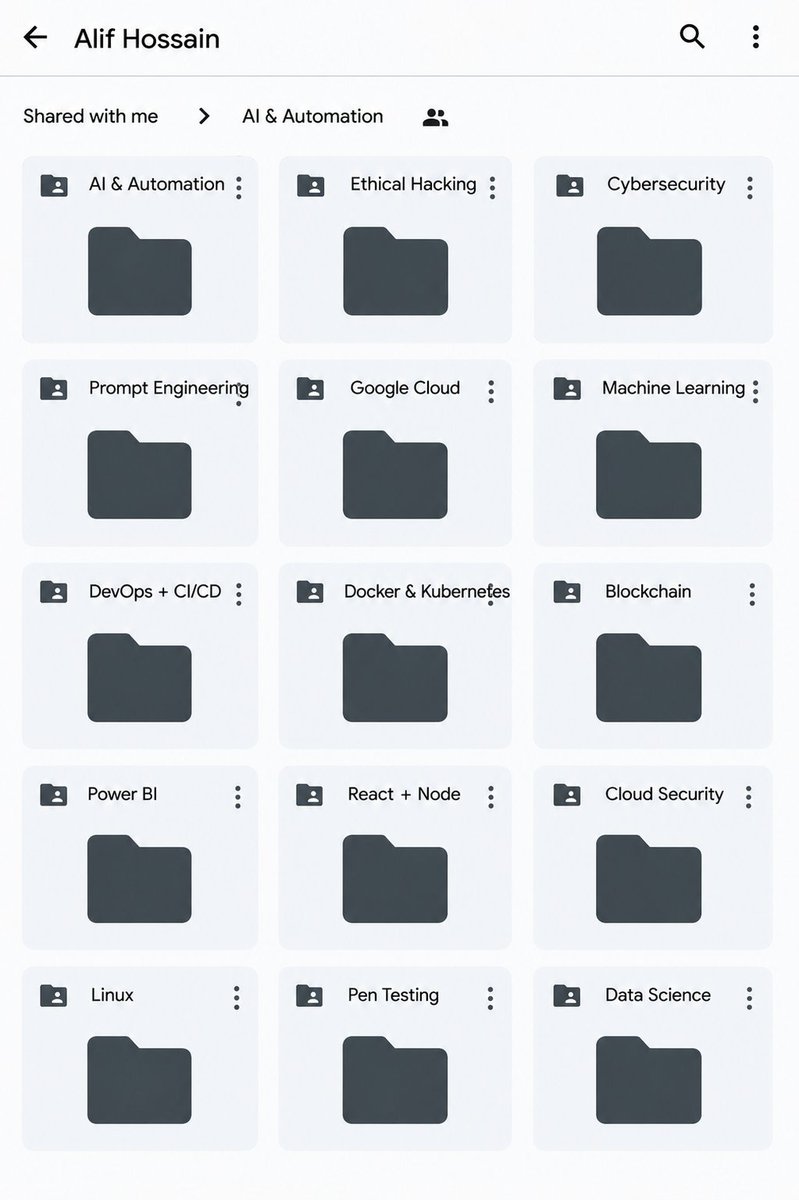
All Paid Courses (Free for First 4500 People)
𝗣𝗮𝗶𝗱 𝗖𝗼𝘂𝗿𝘀𝗲 𝗙𝗥𝗘𝗘 (PART - 3)
1. Artificial Intelligence
2. Machine Learning
3. Prompt Engineering
4. Claude,Chatgpt,Grok
5. Data Analytics
6. AWS Certified
7. Data Science
8. BIG DATA
9. Python
10. Ethical Hacking
(72 Hours only )
Like + RT + comment ' Drive '
Must Follow me so I can DM you.
Anthropic engineer:
"You're not supposed to prompt Claude. You're supposed to build a system that prompts itself."
this is one of the best workflows I've seen in a long time
in this video she breaks down exactly how most people are using Claude:
- the 14% you lose to CLAUDE.md before typing a word
- the automation workflows most users don't know exist
- the daily task pipelines that run without touching the keyboard
- the daily workflows Anthropic's own engineers automated first
if you've been using Claude for more than a month and never left the chat window, you've been using one agent when you could be running a team of them
instead of another show tonight, watch this
make sure to bookmark it before it gets lost in your feed
the guide is in the article below
A fast, idiomatic way to read, render, and write PDFs in Go.
Cgo binding over the battle-tested MuPDF C core — text extraction, table detection, rendering, and full document assembly, behind a small, Go-shaped API.
#golang
https://t.co/X879D38BwP
The creator of Claude Code teaches more about vibe-coding in 30 minutes than most tutorials do in hours.
Save this - it'll change how you build forever.
The creator of Claude Code teaches more about vibe-coding in 30 minutes than most tutorials do in hours.
Save this - it'll change how you build forever.
🚨 GitHub acaba de resolver uno de los mayores problemas del vibe coding.
Han lanzado Spec Kit, un sistema que organiza ideas, tareas y requisitos para que la IA pueda desarrollar proyectos de forma mucho más precisa.
Tiene más de 92k stars en GitHub, es gratis y open-source.
Aquí te explico cómo funciona 👇
The creator of Claude Code teaches more about vibe-coding in 30 minutes than most tutorials do in hours.
Save this — it'll change how you build forever.
Stanford professor just gave away the entire foundation of how AI Agents & automation actually works.
1-hour lecture. Tool calling.
Multi-step workflows. Planning. Reflection.
SAVE this to watch this before you open Netflix tonight.
More valuable than 6 months of copying Make and n8n tutorials, for building Ai Agents
Most people learn by copying tutorials blindly. Stanford teaches you WHY agents work the way they do.
Follow @codewithimanshu for more high-signal content that actually moves your skills forward instead of just entertaining you for 30 seconds.
↓
Why your automations keep breaking.
You copied a Make tutorial. Built the exact workflow. Worked for a week.
Then the API changed. The trigger failed. An edge case broke everything.
You had no idea how to fix it. Because you never understood why it worked.
You were copying keystrokes. The people shipping real automation were understanding architecture.
↓
What Stanford actually teaches.
Tool calling: how an agent decides which tool to use by scoring each option against the current task state, not just matching keywords.
ReAct loop: the agent reasons, acts, observes, then reasons again. Break this cycle and your workflow fails silently.
Planning vs execution: why agents that plan all steps upfront break on dynamic inputs, and why iterative planners survive production.
Memory architecture: short-term context for the current task, long-term vector memory for patterns. Most automations fail because they confuse the two.
Reflection: how agents catch their own errors by evaluating outputs against original intent before moving to the next step.
Tool composition: why chaining 10 tools blindly creates cascading failures, and how to structure dependencies so one broken node doesn't kill the whole workflow.
This is the foundation behind every automation that actually works.
Not prompting tricks. Not "10 best AI tools" reels. Actual architecture.
Follow @codewithimanshu for more high-signal content that actually moves your skills forward.
↓
Your weekend plan.
Tonight: watch the Stanford lecture. 1 hour. Saturday to Sunday: build 3 projects applying what you learned. Next 2 weekends: 6 more projects.
9 projects. 2 weeks. APIs, webhooks, LLM integration, real workflows.
No theory. Just build.
↓
Stanford Agentic AI lecture: free on YouTube.
Watch it this weekend or buy another $500 "AI automation course" in 2027 that teaches less than this one free lecture.
Bookmark. Watch tonight.
Follow @codewithimanshu for more high-signal content that actually moves your skills forward.