call me crazy but the first AI agent most companies should build is an autonomous analyst.
you can build one using Kimi K3.
it watches your competitors while you sleep, remembers every move, and wakes your team with the launches, pricing changes, and positioning shifts they need to act on.
don't bookmark this if it crosses your timeline.
paste the full article into Kimi and tell it to build the first version for your market.
AI Engineering Interview Questions and Answers
- LLM Fundamentals
- Prompt Engineering
- Retrieval-Augmented Generation (RAG)
- AI Agents and Agentic Systems
- Fine-Tuning and Model Adaptation
- Vector Databases and Embeddings
- AI System Design
- LLMOps and Production AI
- Evaluation and Testing
- AI Safety, Ethics, and Responsible AI
- Multimodal AI
- AI Infrastructure and Scalability
- Coding and Practical Implementation
- Behavioral and Scenario-Based Questions
Learn here: https://t.co/WHqlFfvvL9
Free 3-hour course from an ex-Google engineer. AI agents, graph engineering, harness, agent loops. Covers more than most $500 paid courses.
This is the exact playbook to learn how to actually build and monetize AI agents. Don't miss your shot, save it now.
• 0:00 - Design an AI agent system from scratch
• 7:38 - When your agent should hand off to a human
• 19:27 - RAG and vector databases explained simply
• 52:38 - Deploy your AI agent to Google Cloud
• 1:25:57 - Turn AI agents into a paid business via WhatsApp
• 1:33:00 - Turn conversations into real leads automatically
• 2:24:01 - Loop engineering vs graphs, the real difference
• 2:33:08 - Build your own multi-tool agent graph
Save this video, because it's the only one that can actually take you to your $2,000+ profit.
Andrej Karpathy just explained the 5 shifts turning LLMs into agentic systems.
00:00 - Memory turns chat into personal AI
06:41 - Multimodal AI reads the world
16:58 - Thinking models solve harder tasks
24:51 - Search makes LLMs live
30:58 - Tools turn LLMs into workers
Most people are still treating LLMs like chatbots.
Karpathy is showing the full stack:
Memory → Vision → Reasoning → Search → Tools
Prompting is the old workflow.
Agentic systems are the new one.
This 40-minute talk is worth more than most paid AI agent courses.
Bookmark and watch it before everyone catches up.
Then read how to turn LLMs into self-improving agent loops below
This paper is f*cking insane.
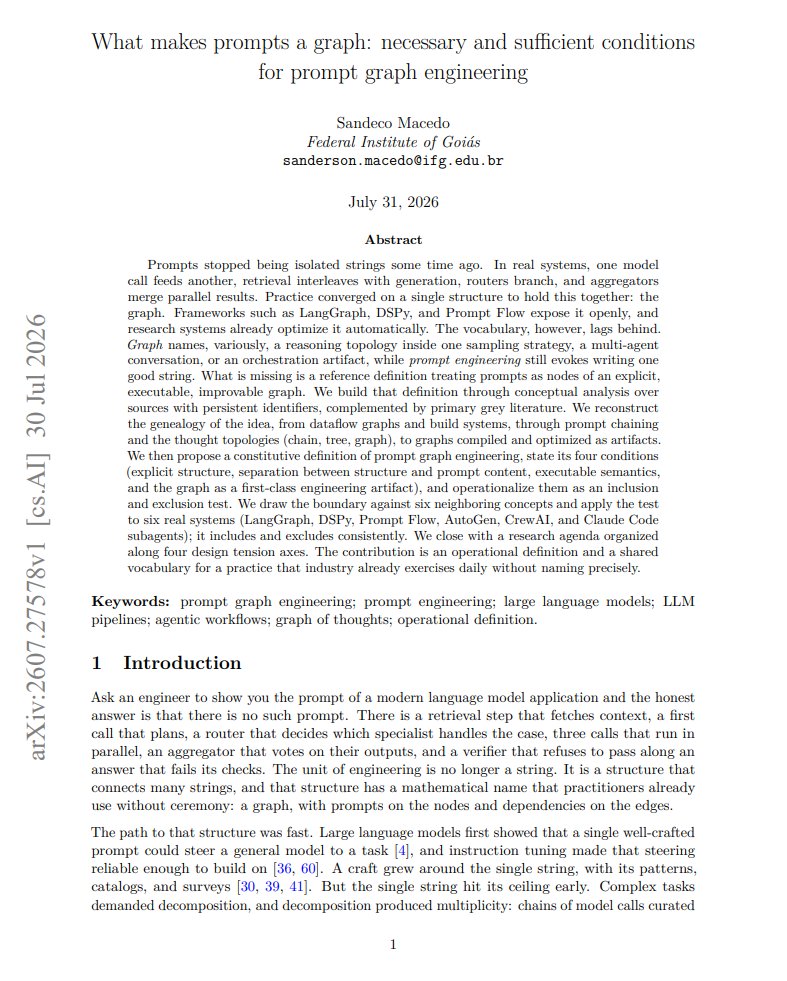
Prompt Engineering just got replaced by Graph Engineering.
A new 20-page paper formalized what the best AI builders are already doing:
Stop writing one giant prompt.
Build a graph of agents instead.
Planner → specialists → verifier → feedback loop.
The authors test this definition against LangGraph, DSPy, AutoGen, CrewAI, Prompt Flow, and Claude Code subagents.
The prompt is no longer the system.
The graph around it is.
Bookmark this, then read the full Graph Engineering guide below.
Don't waste 2 years learning to build LLMs like Claude & ChatGPT.
Stanford just dropped a 2 hour course on how to build LLMs from scratch.
• 00:00 - LLM tokenization
• 25:44 - how LLMs decode user prompts
• 35:40 - training pipeline of LLMs
• 1:16:47 - LLM architecture from scratch
Anthropic pays $750,000/year to engineers who understand this exact knowledge of LLMs.
Bookmark this & give 2 hours today, no matter what. Then read the article below.
LLMs have changed how we build software.
But relying on a single, monolithic LLM can be unsustainable.
Here, Chidiebere goes over how to build an intelligent model router to balance performance, latency, and cost without sacrificing response quality.
https://t.co/9BO5L9uFLJ
🚨EL WEB SCRAPING HA MUERTO🚨
Han creado PixelRAG.
Un sistema open source que pasa de parsear HTML.
En vez de convertir una web en texto...
hace una captura de pantalla.
Y luego un modelo vision-language lee la respuesta directamente desde los píxeles.
Brutal.
Porque el scraping tradicional rompe muchísima información:
→ tablas
→ gráficos
→ layouts
→ columnas
→ botones
→ PDFs
→ páginas mal estructuradas
Todo eso se pierde cuando conviertes una web en texto plano.
PixelRAG hace algo mucho más simple:
indexa la página tal y como la ve una persona.
El equipo ha creado un índice visual de Wikipedia entero:
+30 millones de screenshots.
Y aun así supera al mejor RAG basado en texto por un 18,1% en QA.
Tiene también un plugin para Claude Code.
Básicamente le da ojos a Claude.
Le pasas una URL, un paper de arXiv o tu web local…
y Claude no scrapea el DOM.
La mira.
Cómo funciona:
→ renderiza webs, PDFs e imágenes en tiles
→ los embebe con Qwen3-VL-Embedding
→ construye un índice FAISS
→ busca visualmente sobre píxeles
Todo open source bajo Apache-2.0.
Link al repo en los comentarios 👇🏻