Commonware chains on Celestia are now possible.
Launching a Commonware chain on Celestia gets you 10x faster blocks without the infrastructure overhead and the launch delays of having to recruit a validator set.
Check out coro, a data availability library with a minimal Commonware single sequencer crate:
Celestia's engineering roadmap is compressing.
V8 (including Hibiscus) is live on Mocha, with Mainnet following next, bringing single-signature cross-chain transfers and ZK-verified messaging to networks built on Celestia.
The following protocol upgrade after V8 will bring 3-second block times and 32 MiB blocks, expanding blockspace capacity in a single step upgrade that will clear the path for Fibre — the highest-throughput blockspace protocol, targeting 1 GB/s throughput in its first iteration.
Celestia's next upgrade, Hibiscus (V7), goes live mid-March.
Hibiscus introduces 2 features that expand cross-chain interoperability for networks on Celestia:
- single-signature cross-chain transfers
- cryptographic proof-based message verification
Here's how it works:
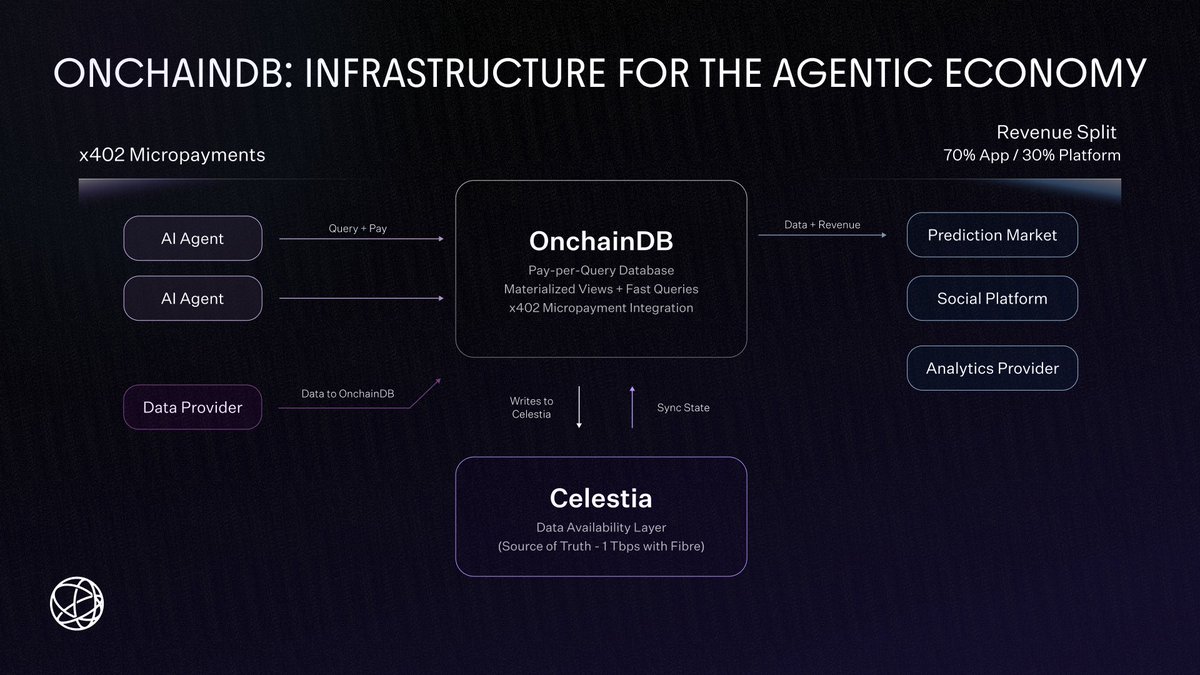
Within the next decade, most economic activity will be machine-to-machine. AI agents trading with each other at API speed, making autonomous decisions about data, compute, and services.
And @OnchainDB is one example of how these markets will work:
Announcing Private Blockspace: built for high-performance onchain markets where confidentiality is a requirement, not a feature.
Positions, balances, and execution logic can remain private, while data availability and protocol commitments are designed to remain publicly verifiable.