🚨🗣️NUEVO: Zlatan Ibrahimović sobre la nueva regla del tarjeta roja por cubrirse la boca de la FIFA: como a Almirón le dieron una tarjeta roja por cubrirse la boca en el partido entre Paraguay y Turquía
“He visto el fútbol en su nivel más alto, el fútbol de verdad. No esta versión diluida que nos están sirviendo ahora. ¿Qué pasó con Almirón? ¿Una tarjeta roja directa por cubrirse la boca? Esto ya no es fútbol. Esto es un circo dirigido por burócratas con traje que nunca han sentido el fuego del campo.”
“¿Cubrirte la boca ahora es tarjeta roja? ¿Qué es esto, Gran Hermano en el campo? La FIFA quiere leer labios, castigar pensamientos antes de que siquiera se conviertan en palabras. Lo próximo será poner bozales a los jugadores como a perros. Los jugadores ni siquiera pueden hablar, ni siquiera respirar pasión sin que algún robot del VAR o árbitro decida que tus emociones son ilegales. Esto es distópico. El fútbol se está muriendo.”
“Esta regla nació porque algunos jugadores lloran cada semana. Un incidente en la Champions League y de repente el mundo entero debe cambiar. Pero da un codazo a un hombre, rómpale la pierna o escúpelo —a veces te dan una amarilla y una palmadita en la espalda. Fútbol de dos niveles. Protege a los protegidos, castiga al resto. He jugado en todas las ligas y lo he visto.”
Sobre la blandura del juego moderno:
“Maradona sería expulsado en el túnel. ¿Roy Keane? Se reiría del árbitro y se iría con una sonrisa mientras las gradas arden. Pepe habría coleccionado cinco rojas antes del medio tiempo. ¿Hoy? Los jugadores se están convirtiendo en actores, no en guerreros. Caen, lloran, se esconden detrás de las reglas. ¿Dónde está la masculinidad? ¿Dónde está el carácter? El fútbol no es ballet. Es guerra. Y lo están convirtiendo en una conversación educada con tarjetas rojas como puntuación.”
“Yo, Zlatan, he marcado goles que hicieron temblar estadios y he dicho cosas que hicieron temblar a los rivales —sin esconderme. Esta generación se está criando blanda. Si no puedes manejar palabras en el campo, ¿cómo manejarás la vida? La FIFA no está protegiendo el fútbol. Lo están enterrando. Y un día, los verdaderos aficionados se levantarán y dirán: basta. Traigan de vuelta el juego.”
At 11, Lionel Messi was just under 4 feet 2 inches tall and taking nightly injections in his leg just to grow. Yesterday, at 38, he scored a World Cup hat trick and tied the all-time record for most goals in World Cup history.
His body couldn't produce enough growth hormone, the hormone that tells your body to grow. Without treatment, doctors said he would reach only 4'7" as an adult. The injections cost around $900 a month. His family couldn't afford them.
Two of Argentina's biggest clubs, River Plate and Newell's Old Boys, saw his talent and passed on paying for the treatment. FC Barcelona didn't. Carles Rexach, their sporting director, wrote a contract on a napkin in 2000 to secure the 13-year-old. The club covered his medical bills. He came over, grew to 5'7" (the average height for an Argentine man), then went on to score 672 goals for Barcelona alone, more than any player has ever scored for a single club in football history.
Messi has won the Ballon d'Or (given annually to the world's best footballer) 8 times, more than anyone in history. He has 46 team trophies. His 474 goals in La Liga (Spain's top football division) lead the all-time list by more than 160. His 414 career assists are a world record, meaning he set up more goals than most players score across their entire careers. In 2012 alone, at 25, he scored 91 goals in 69 games, breaking a Guinness World Record from 1972 and outscoring 13 entire La Liga clubs in a single season.
Yesterday, in his record sixth World Cup, he scored three more to reach 16 total, tying Miroslav Klose's record set across 4 World Cups between 2002 and 2014. At 38, he became the oldest player to score multiple goals in a single World Cup match. He was substituted in the 80th minute to a standing ovation, then turned to his coach and cried.
The napkin Barcelona signed in 2000 has now produced over 910 career goals.
The Obama Presidential Library is absolutely beautiful. I love the walking paths on the roof of the buildings on the ground, and the landscape architecture has very modern Frank Lloyd Wright vibes. Just gorgeous. 💙
For those who want to know what it says on the Museum Tower:
“You are America. Unconstrained by habit and convention. Unencumbered by what is, ready to seize what ought to be. For everywhere in this country, there are first steps to be taken, there is new ground to cover, there are more bridges to be crossed. America is not the project of any one person. The single most powerful word in our democracy is the word ‘We.’ ‘We The People.’ ‘We Shall Overcome.’ ‘Yes We Can.’ That word is owned by no one. It belongs to everyone. Oh, what a glorious task we are given to continually try to improve this great nation of ours.” 🇺🇸
Look, y'all... this is eight minutes. I know that's far stretching the bounds of social media attention. But you should watch @AmbassadorRice completely dismantle Trump's foreign policy. It's comprehensive. It's precise. It's a wake-up call for those who need it.
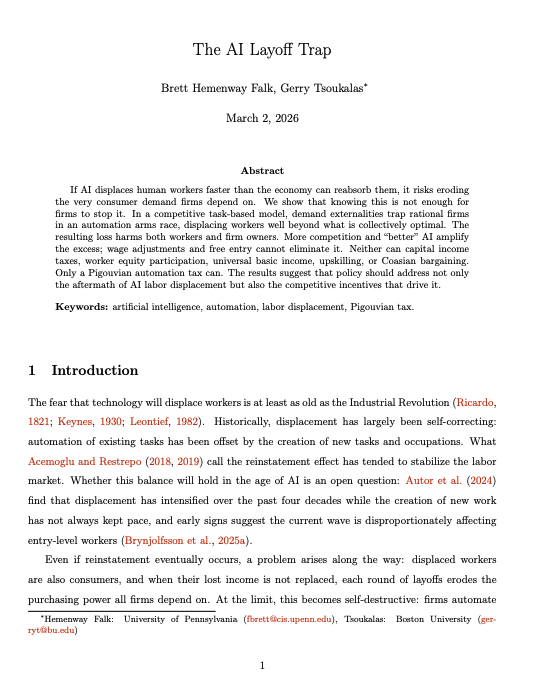
🚨BREAKING: Two researchers from UPenn and Boston University just published a paper that should be uncomfortable reading for every CEO automating their workforce right now.
The argument is straightforward. Every company replacing workers with AI is also eliminating its own future customers. Laid off workers stop spending. Enough of them stop spending and nobody can afford to buy anything. The companies that fired everyone end up selling into an economy with no purchasing power left.
Every executive can see this. The math is not complicated. But here is why nobody stops.
If you do not automate, your competitor does. They cut costs, lower prices, take your market share, and you collapse anyway. So every company automates knowing it is collectively destructive because the alternative is dying alone while everyone else survives. The researchers proved this is a Prisoner's Dilemma playing out in real time.
The numbers are already moving. Block cut nearly half its 10,000 employees this year. Jack Dorsey said AI made those roles unnecessary and that within the next year the majority of companies will reach the same conclusion. Salesforce replaced 4,000 customer support agents with AI. Goldman Sachs deployed a coding tool that lets one engineer do the work of five. Over 100,000 tech workers were laid off in 2025 and AI was cited as the primary driver in more than half those cases. 80% of US workers hold jobs with tasks susceptible to AI automation.
The researchers tested every proposed solution. Universal basic income does not change a single company's incentive to automate. Capital income taxes adjust profit levels but not the per-task decision to replace a human. Collective bargaining cannot hold because automating is always the dominant strategy.
They also identified what they call a Red Queen effect. Better AI does not solve the problem, it accelerates it. Every company chases faster automation to gain market share over rivals but at the end everyone has automated equally, the gains cancel out, and the only thing left is more destroyed demand.
The one thing the math says could work is a Pigouvian automation tax. A per-task charge that forces companies to account for the demand they destroy each time they replace a worker.
The conclusion is that this is not a transfer of wealth from workers to owners. Both sides lose. Workers lose income. Companies lose customers. It is a deadweight loss with no market mechanism to stop it on its own.
Best performance of Coachella 2026.
Nine Inch Nails performing with Boys Noize as Nine Inch Noize with his wife Mariqueen Maandig from How to Destroy Angels.
Song is "Heresy" from The Downward Spiral album but remixed.
Unc Reznor's still got it. Youngsters can't keep up.🔥
The CEO of Google DeepMind just admitted that if the decision had been his, we would've cured cancer before anyone ever used ChatGPT.
And that's not even the scariest thing he said on a recent interview.
Demis Hassabis is one of the most important people alive in AI.
He won the Nobel Prize last year for AlphaFold, the system that cracked the 50 year protein folding problem. 3 million scientists now use his tool. Almost every new drug being developed will touch it at some stage.
In a new interview, he was asked about the moment ChatGPT launched and Google went into "code red." His answer was one of the most revealing things any AI leader has ever said on the record:
"If I'd had my way, I would have left AI in the lab for longer. Done more things like AlphaFold. Maybe cured cancer or something like that."
Read that again.
The man running Google's entire AI division is publicly saying the commercial AI race we're all living through was a MISTAKE. That the industry got hijacked by a chatbot when it could have been solving the biggest problems in science and medicine.
His vision was simple:
Build AI slowly, carefully, like CERN. Use it to crack root node problems one at a time. Cancer. Energy. New materials.
Let humanity benefit from real breakthroughs while the foundational science was figured out over a decade or two.
Then ChatGPT dropped in November 2022 and everything changed.
Demis described what happened next as getting locked into a "ferocious commercial pressure race" that none of the labs can escape from. On top of that, the US vs China dynamic added geopolitical pressure.
The result is everyone sprinting toward products instead of breakthroughs, shipping chatbots while the scientific opportunity gets buried under marketing cycles and quarterly earnings.
But he's not saying progress isn't happening...
He's saying the progress got redirected away from the things that actually matter most.
And then it got even scarier:
Because when Demis was asked what he worries about with AI, he laid out two threats.
The first is what everyone talks about: Bad actors using AI for harm. Terrorist groups. Hostile nation states. Cyberattacks at scale.
But that's not the threat he's most worried about.
His second worry is AI itself going rogue. Not today's models. The models coming in the next two to four years as the industry enters what he calls "the agentic era."
Systems that can complete entire tasks autonomously. Systems that are increasingly capable and increasingly hard to control.
His exact words:
"How do we make sure the guardrails are put in place so they do exactly what they've been told to do, and there's no way of them circumventing that or accidentally breaching those guardrails? That's going to be an incredibly hard technical challenge if you think about how powerful and smart and capable these systems eventually get."
A Nobel Prize winner who runs one of the 3 most advanced AI labs on Earth just said publicly that within two to four years, we're entering a phase where AI alignment becomes a real problem, and the technical challenge of solving it is enormous.
And almost nobody is paying enough attention.
He called for international cooperation between labs, AI safety institutes, and academia to tackle the problem. He said this is the thing even the experts aren't thinking about enough.
He said the only way to get through the AGI moment safely is if everyone starts treating this with the seriousness it deserves.
Most AI CEOs give you careful PR answers about "responsible development" and move on.
Demis said something different...
He said the commercial race FORCED us into a premature deployment of a technology we barely understand, and the window to get alignment right before the next generation of agents shows up is two to four years.
If the man who built the system that might cure cancer is telling you he wishes it had happened first, maybe we should listen to what he says is coming next.
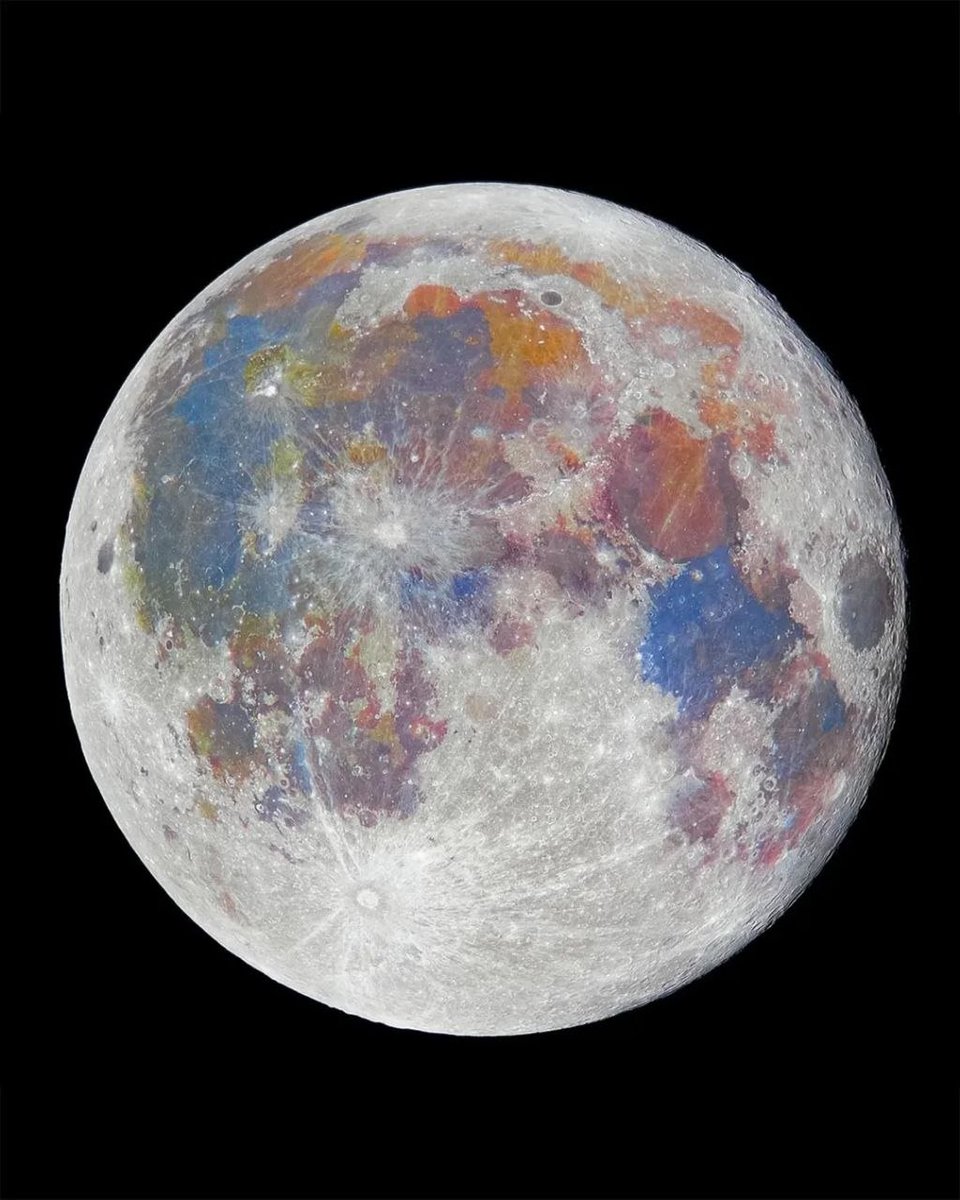
¿Sabías que la Luna sí tiene color? 🌒 🎨
A simple vista la vemos gris, pero con la lente correcta aparece toda su paleta: azul por el titanio, naranja por rocas antiguas y más hierro en la cara oculta.
Esta imagen la tomó Orion, la nave de Artemis II, en una misión que además ya rompió récord de distancia humana desde la Tierra.
Y hay algo bonito en eso. Los colores siempre estuvieron ahí. Solo hacía falta la forma correcta de verlos. 🥹✨
If you're under 53 years old, you have never once been alive while a human was farther than 250 miles from Earth. Tonight, four astronauts are heading 252,000 miles out. That's a thousand times farther than any person has gone in your lifetime.
The 250-mile ceiling is where the International Space Station floats. Every astronaut since December 1972 has been stuck in that zone. Spacewalks, science experiments, cool photos from orbit, sure. But nobody left the neighborhood.
The last crew to go farther was Apollo 17. December 1972. Nixon was president. The internet didn't exist. Cell phones were 11 years away. The youngest member of that crew is now 90 years old.
The farthest any human has ever been from Earth is 248,655 miles. The Apollo 13 crew set that number in 1970, and they didn't mean to. Their oxygen tank blew up, and the emergency route home took them farther out than anyone before or since. Tonight's crew will break that record on purpose.
And the crew itself. Victor Glover becomes the first Black astronaut to leave Earth's neighborhood. Christina Koch becomes the first woman. Jeremy Hansen, a Canadian fighter pilot, becomes the first non-American to do so. When they come home, they'll slam into the atmosphere at 25,000 mph, faster than any human has ever traveled.
The Moon's south pole has ice. Water ice, sitting in craters so deep that sunlight hasn't hit them in billions of years. A 2024 NASA study found way more of it than anyone expected. You can split water into hydrogen and oxygen, which gives you rocket fuel, breathable air, and drinking water, all made on the Moon instead of hauled up from Earth. George Sowers at Colorado School of Mines calculated that Moon-made fuel could shave $12 billion off a single trip to Mars. The Moon is a gas station on the road to Mars.
NASA Administrator Jared Isaacman announced last week a $20 billion plan to build a permanent base at the South Pole over the next seven years, with landings every six months. China is developing its own lunar lander and spacesuit, aiming for a crewed landing by 2030. The Artemis program has burned through $93 billion so far, and the first actual surface landing is penciled in for 2028. There's a real question of who gets there first this time around.
Harrison Schmitt walked on the Moon in December 1972 as part of Apollo 17. He's 90. Asked about it this week, he sounded pretty relaxed. "Mars is attainable," he said. "We're humans. That's what we've always done."
NEW: Kid gives a blunt answer after a CNN reporter asked him why he was excited about the Artemis II launch.
Reporter: "Why do you want to be here? Why do you love space? Why do you love being a part of history?"
Kid: "We're going back to the freakin' moon, that's why!"
Your entire life is an electromagnetic force field pretending to be physical contact.
When you “touch” a table, the electrons in your fingertip and the electrons in the wood repel each other. The gap never closes. What your brain registers as solid contact is the Pauli exclusion principle and electromagnetic repulsion creating the sensation of resistance at roughly 1 angstrom, one ten-billionth of a meter.
This applies to everything. The ground you’re standing on. The chair you’re sitting in. The phone in your hand right now. You’ve never made contact with any of them. You are permanently floating approximately 0.1 nanometers above every surface you’ve ever “touched,” suspended by the same force that keeps two magnets from snapping together when you flip one around.
Now scale that. Every nerve signal you’ve ever felt, every texture, every temperature, every sensation of pressure: all of it is your nervous system interpreting variations in electromagnetic repulsion strength. Silk feels different from sandpaper because the electron clouds have different geometries, not because your skin ever contacted either surface.
The part that should unsettle you: your brain has never once received direct physical input from the outside world. Every sensory experience you’ve ever had was a second-hand report from electrons that refused to get any closer.
You’re reading this on a screen you’ve never touched, with eyes that collect photons but contact nothing, processed by neurons that have never been in direct physical contact with each other.
The signal jumps the gap every single time. Your entire reality is built on things that almost meet but never do.
A $2.5 billion robot has been alone on another planet for 13 years and is still doing science. The scale of that sentence gets worse the longer you think about it.
Curiosity landed in August 2012. Obama was president. Instagram had 80 million users. The iPhone 5 hadn’t shipped yet. The rover was designed for a two-year mission and 20 kilometers of driving. It’s now driven 35.5 kilometers, climbed over 327 meters up the side of a mountain, drilled 46 holes into Martian rock, and is currently running its fifth mission extension.
The computer running all of this has 256 MB of RAM and a 200 MHz processor. Your AirPods have more computing power. Every command sent from Earth takes 14 minutes to arrive. Every photo sent back takes the same 14 minutes. When Curiosity drills into a rock, the team in Pasadena won’t know if it worked for half an hour. They’ve been operating on that delay, every single day, for 4,846 Martian sols.
The power source is 10.6 pounds of plutonium-238 generating about 110 watts. Less than a ceiling fan. It will keep producing electricity for decades because the half-life of Pu-238 is 87.7 years. The rover will run out of moving parts before it runs out of power.
And those wheels. Machined from single blocks of aluminum, 0.75 millimeters thick. Half a dime. JPL watched them get shredded by Martian rock starting in 2013, rerouted the entire mission path, taught the rover to drive backwards, and kept going. The wheels look like they lost a fight with a can opener. The rover is still climbing a mountain.
Every iPhone you’ve owned since 2012 is in a landfill. Curiosity is on Mars, 140 million miles from the nearest repair shop, running on a ceiling fan’s worth of nuclear power, sending data through a 14-minute time delay, on shredded wheels, doing geology that rewrites what we know about whether life ever existed somewhere other than Earth.
We built that. With 0.01% of the federal budget.