As time passes, Warsh's influence may grow by setting the FOMC's meeting agenda and putting his "thumb on the scale" over which economic issues and monetary policy issues get prioritized by central bankers, says @macroderek.
@SPGlobal@BrianJScheid
https://t.co/w0BLONNG25
"Rather than building a case for rate cuts, Warsh will now have to spend his energy fending off growing pressure to tighten policy, or at least hold, from colleagues and the public alike," says @macroderek.
Kevin Warsh faces a new challenge as Fed chief: How to restrain a sudden shift in expectations for higher rates as fellow policymakers warn that inflation is back https://t.co/v0DN4AtTvX
"It sounds like the White House is giving itself an offramp in advance, because we’re not going to get a rate cut in June. This creates breathing room for Warsh to find his footing in his first few months as chair."
@macroderek@MarketWatch
Trump says he’ll let Warsh ‘do what he wants to do’ with interest rates. It’s a remark that Fed watchers have been bracing for. https://t.co/6yZ1YYGYxm
The story over the Fed’s independence — the belief that the U.S. central bank sets interest rates and makes monetary-policy decisions based on economic data and not Washington political pressure — might still be "in the first chapter," says @macroderek. Read the full piece below.
"The opposition against the easing bias was likely broader than just [Hammack, Logan and Kashkari]. But the question is, when will the dam break on inflation expectations? Inflation has been above their 2% target for a while now." @macroderek@CNN https://t.co/ALkSff1sH7
We have long assumed that Powell will remain on the Fed board after stepping down as its chief as a buffer against Trump's efforts to exert control at the central bank.
@Reuters
https://t.co/MNHJaOiL3M
"Powell's presser will focus on uncertainty remaining high, while declining to provide much forward guidance except to refer to the Fed's inflation and employment mandates," predicts @macroderek.
@AmerBanker@mvol4ok
"The Fed is likely to approach the coming quarters with a bias toward caution, balancing still-elevated inflation against a gradually softening growth backdrop," said Christopher Hodge, chief economist at Natixis Corporate & Investment Banking.
https://t.co/3upInPhPOL
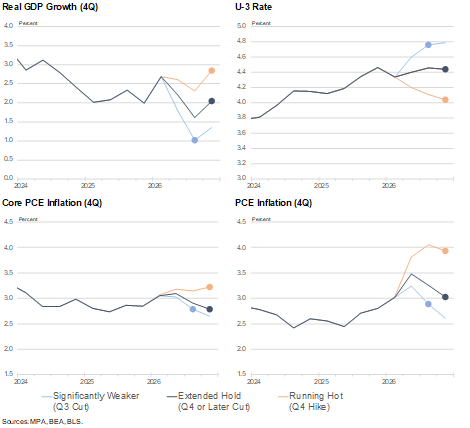
Monetary policy outcomes depend importantly on how the economy evolves over the next few quarters. We discuss a few scenarios to show how the Fed outlook may shift.
Message us to learn more.
@macroderek expects the impact of energy shortages to eventually make its way to American shores. "The US is insulated, but not fully. So you can see the shortages beginning in Asia and they're going to move to Europe, and eventually this corner of the world as well."
"I am unsure it meets Powell’s 'finality' precondition to
leave the Fed. After all, what’s to stop a probe from coming up again, once the White House gets Warsh confirmed? At that point, Tillis and Powell would have lost leverage." @macroderek
"Warsh would like Treasury and the Fed to communicate more clearly to each other their respective plans" over Treasury debt issuance, and to better coordinate their respective positions, says @macroderek.
"In the next few months, the reality on the ground is inflation is going to be really high. Do you really want one of your guys in place to be the fall guy for keeping rates high?"
@macroderek in latest from @Reuters@annsaphir.
https://t.co/HkwSBAnYo4
"People will look at Powell not just for economic but for moral leadership," says @macroderek.
Read the latest from @senoj_erialc@FinancialTimes https://t.co/ZE930ygkkz
Fed officials "really don’t want to see inflation expectations rise," said @macroderek. "The problem is, they don’t know how close to the edge they are."
"The war in Iran certainly adds insult to injury on the inflation front, given poor inflation performance and the trauma of high inflation the last few years [...] However, markets were already jumpy." @macroderek
https://t.co/KCpWlXsBSy