I am very happy to make public my first Data Science project outside the biological background. In this project, I focused on the analysis of my Steam library using two approaches.
https://t.co/PBrixpjZBc
Journals can’t find peer reviewers. Preprints aren’t taken seriously. Garbage papers slip through peer review. Meantime, AI is slowly taking over.
Nature describes the current situation. I highly recommend reading the article.
📍 The summary (+ my comments):
1. We are facing a SIGNIFICANT overload on reviewers. Fatigue is epidemic. Few scientists have time for much peer review. As a result, manuscript turnaround times are chaos. They’re unpredictable and painfully slow.
2. Grant and facility proposals demand massive peer review too. They push the system even further.
3. Review quality is decreasing. Rigor is inconsistent. Technical aspects are poorly assessed.
4. Gatekeeping and bias are very real (we all know how manuscripts are rejected due to competition & jealousy). It causes a growing dissatisfaction among scientists.
5. Paid reviewing does NOT automatically improve the acceptance rate. Trials show mixed results. For example, acceptance rates barely increased from 48% to 53% for Critical Care Medicine. The quality of PR remained the same. But for Biology Open, the PR process has become much faster. In either case, paid reviews are very hard to scale business-wise.
6. Distributed Peer Review is becoming more popular. Some funding agencies now require applicants to review peers’ proposals. But to to eliminate bias in it? I don’t know.
❗ There’re no simple solutions.
As a careful observer, I think that the complex picture is evolving along the following trajectory:
AI-assisted peer view (AI pre-screening, AI PR-assistant, AI audition of peer reviews)
+
Community reviewing
+
Some form of compensation
+
Involvement of wider community in PR lists (not only most recognized scientists)
What’s your view on it?
Honored to present my first-author work during my stay at Chalmers' Department of Mathematics, grateful to have learned so much from a brilliant team. Special thanks to @zacccc93 for the trust from day one, I hope we can work together again in the future.
https://t.co/oOpp7ob9vo
Happy to see our methodological chapter on endometrial analysis through single-cell published! Excited to keep exploring this fascinating field.
https://t.co/S69ZqwyeIh
Proud to be part of the latest study on preeclampsia published in Nature Medicine. Special thanks to my colleague Raúl for his knowledge and support; I hope we can continue working together in future projects.
https://t.co/ZUmxtad4eU
Si en vez de llamarle IA (inteligencia artificial) le hubieran llamado AC (algoritmos correlacionales), que es lo que esencialmente es, nos hubiésemos evitado muchos debates mal planteados.
Strong evidence showing that getting a PhD is extremely bad for your mental health.
A new paper uses Swedish medical records and matches them to the full population of PhD students for which the authors could get gender and birth year data from 2006 to 2017. After some exclusion criteria, they end up with a sample size of 20,085 individuals.
The paper compares PhD students to those who have masters degrees and don't start a PhD program.
Before starting a PhD program, people who stop at a masters and those who go on to seek a PhD have similar rates of psychiatric medication use and hospitalization.
A few years into a PhD program, however, 40% more individuals are on psychiatric medications, before the number falls off as people leave or finish their studies.
You see the same pattern with psychiatric hospitalizations. PhD students are up to 150-175% more likely to be hospitalized after starting a program!
These are incredible numbers, too massive to be the result of chance or a flaw in the methodology. This is comparing the same people over time.
If you're considering a PhD program, and the terrible job prospects and waste of time aren't enough, here's yet another reason to stay away.
A phenomenon similar to an economic principle known as the Great Gatsby Curve—which describes how generational wealth predisposes one’s children to higher incomes—also plays out among scientists, argues a new study. https://t.co/K8OiXAwCWw @ScienceCareers
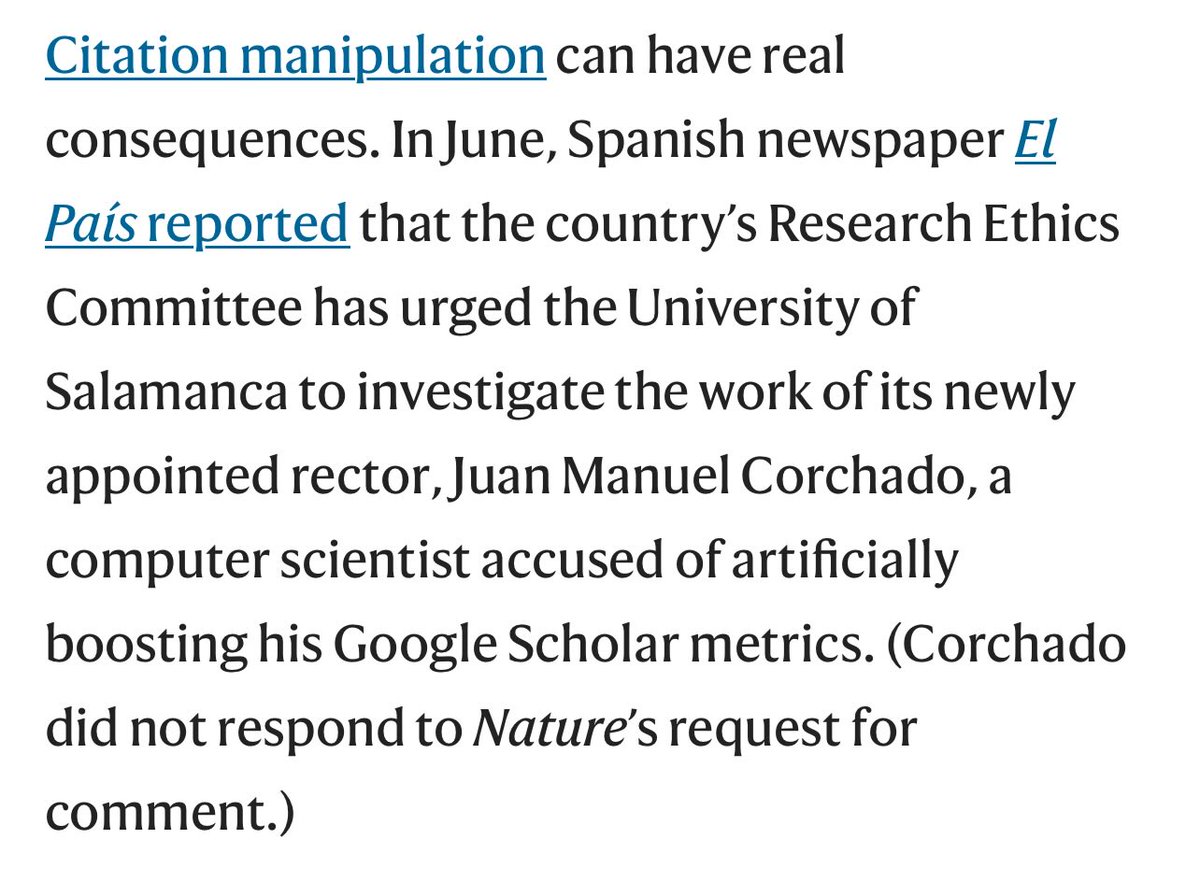
El mercado negro de las citas: los servicios de venta de referencias falsas alarman a los científicos. Con cota al trabajo de @manuelansede sobre el rector de la #USAL https://t.co/91RRRkHBbM
Las editoriales científicas disparan los precios y multiplican su facturación
Seis de los principales grupos han incrementado el precio medio por publicar artículos un 26,6% en los últimos cuatro años, alcanzando una facturación de un 250% más https://t.co/VGty6Robh6
ATTENTION academics! Do love collecting data and running analyses but HATE writing and publishing? Boy, do I have the solution for you.
Step 1: collect a BUNCH of cool data
Step 2: leave academia
New advances in ARG research, in our last paper we characterized new aminoglycoside resistance genes related to human pathogens.
https://t.co/9mE9PMhuuA
“Pet bioinformatician” as coined by @BioMickWatson is still an issue in #research. Why would you place a junior person in a position with no access to experience and expect all-things-#bioinformatics from said person? I simply do not get it - It’s a lose-lose scenario 🤷♂️
Happy to share our last publication in antibiotic resistance genes resistome in natural environments. Congrats to all my colleagues for the effort!
https://t.co/JbxFCg68Ou
I am very happy to make public my first Data Science project outside the biological background. In this project, I focused on the analysis of my Steam library using two approaches.
https://t.co/PBrixpjZBc