Switzerland is spending more than $11 million to move away from Microsoft 365 and switch to open-source software.
The Swiss government plans to spend 9 million Swiss francs to replace Microsoft apps such as Outlook and Teams with the open-source openDesk suite.
The first step will cover 3,000 government computers, with the switch expected to be completed by the end of 2027.
Switzerland first tested openDesk with 172 employees and it worked well for everyday tasks.
The plan could grow much larger. Switzerland has about 54,000 government computers and may eventually switch all of them.
Switzerland want give the government more control over its software and data.
🚨BREAKING: France wiped Google and Microsoft off 2.5 million government computers.
Germany moved 30,000 PCs off Windows. Denmark dropped Microsoft Office.
Here's exactly what they switched to and how to do the same:
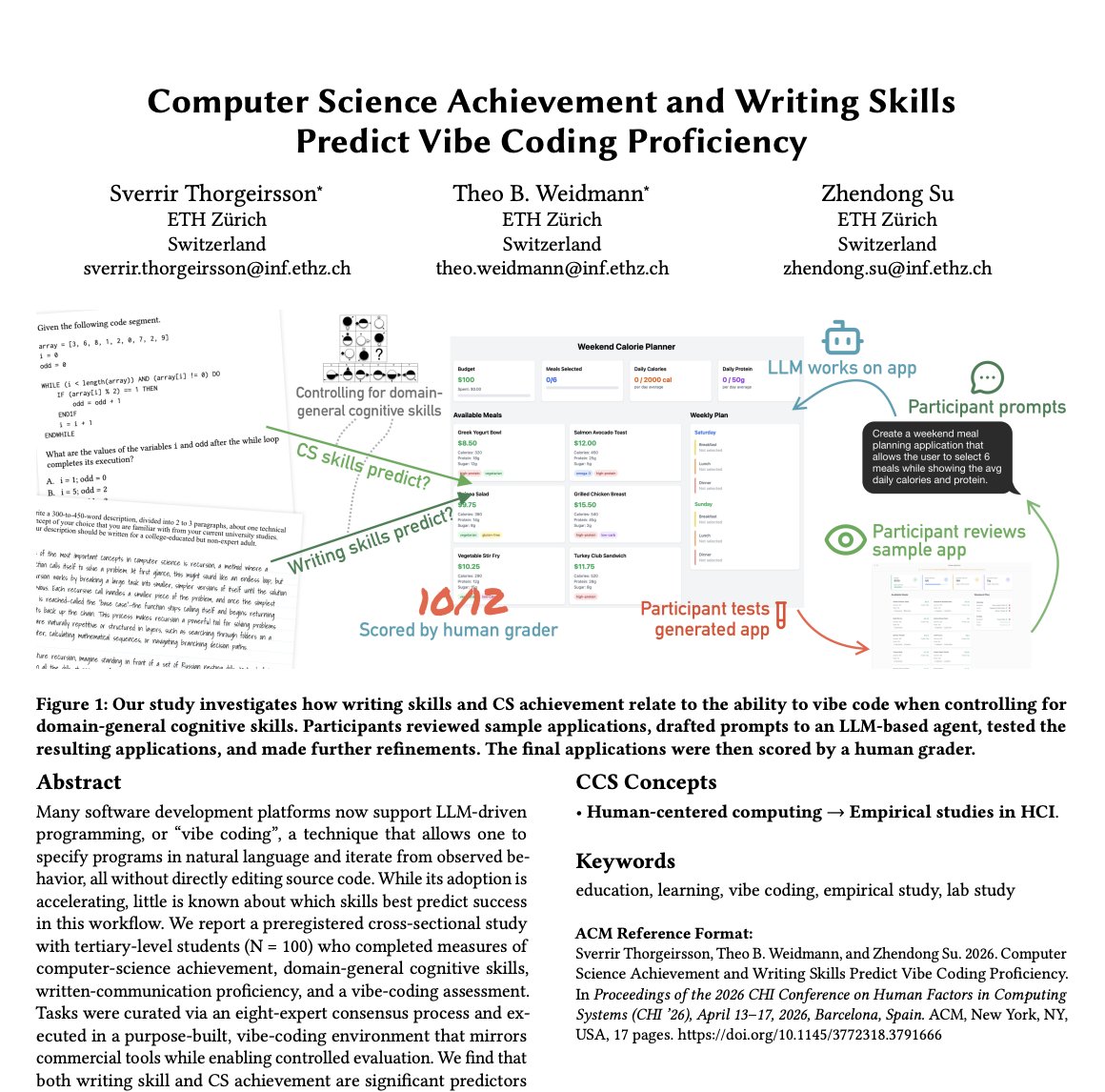
China published the most uncomfortable paper on vibe coding.
ETH Zurich tested 100 developers in a controlled, commercial-grade vibe coding environment to see who actually succeeds.
The findings are brutal.
The researchers tracked computer science achievement, written communication skills, and general cognitive reasoning.
They wanted to see what actually predicts vibe coding proficiency when you never touch a line of source code yourself.
Two major predictors emerged.
Written communication proficiency mattered. The ability to structure thoughts and articulate intent unambiguously in text directly impacts what the AI builds.
But that wasn't even the main takeaway.
Computer science achievement was a massive, dominant predictor of success.
Even when researchers controlled for general intelligence and reasoning skills, CS background still heavily dictated who built working software and who completely crashed.
In fact, CS knowledge contributed roughly twice the unique predictive variance of writing skills alone.
Why? Because vibe coding isn't about writing code. It’s about debugging logic.
When an AI agent builds a complex application and quietly breaks an edge case under the hood, a non-technical user looks at the glowing UI and assumes it works.
They don't know what questions to ask. They don't know what logic to challenge. They lack the mental models to recognize architectural catastrophe.
You can prompt your way past syntax.
You cannot prompt your way past a fundamental lack of engineering intuition.
The hype told us that learning to code is dead because language is all you need.
The data just proved the opposite.
To truly master the vibe, you still need to understand how the machine thinks.
France just wiped Google and Microsoft off 2.5 million government computers.
Germany moved 30,000 PCs off Windows. Denmark binned Microsoft Office. All of it in the last 18 months.
Here's exactly what they replaced it with, and how to do the same tonight:
Countries that are ditching Windows and moving to Linux:
🇫🇷 France — government desktops moving to Linux
🇩🇪 Germany — 30,000 government employees in Schleswig-Holstein moving to open source/Linux
🇨🇳 China — state-linked organizations moving toward domestic Linux alternatives
🇷🇺 Russia — Astra Linux deployed in government and military environments
🇩🇰 Denmark — government moving toward open-source alternatives
🇳🇱 Netherlands — government developing an open-source digital workplace
🇰🇷 South Korea — began a government Linux/open-source transition in 2019
If governments can move thousands of employees away from Microsoft, what's stopping regular companies?
Is Windows actually necessary anymore?
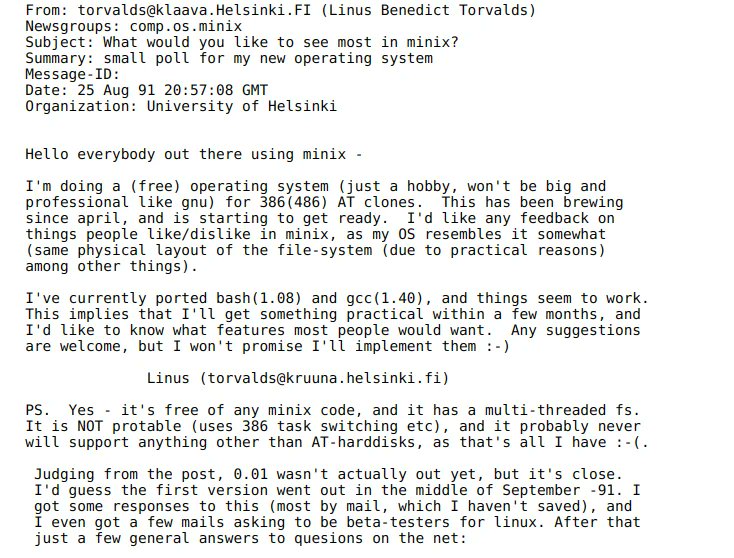
The email that made history.
On this day, 35 years ago, a student in Finland sent a message that he was working on a new project that "won't be big and professional".
He was wrong! The project became both huge and professional.
This is how Linux came into existence.
It started as a hobby project, turned into a Master thesis, turned into the backbone of internet, cloud and AI.
Happy 35th🥂
@ash_twtz No clear objective worst exists, but MongoDB has drawn the most longstanding criticism for past security defaults and consistency tradeoffs. Removed.
From prompt → context → harness → loop → graph engineering:
The list keeps growing, and every new term gets treated as a replacement for the last one.
In reality, however, each layer wraps the one before it, and the cleanest way to tell them apart is to ask what a single unit of work looks like.
> Prompt engineering is the message:
The model remembers nothing before this call, so the prompt has to carry the full universe of what it needs. a role, the background, the instructions, a few examples, and a format.
When the output falls short, the skill is working out which ingredient lets you down, not rewriting the instructions every time.
The unit of work is one input.
> Context engineering is the memory:
Across many steps, the window is finite, and the available information is not, which forces a curation step. A curator keeps what matters, compresses what is useful but bulky, and drops the rest.
Good curation is mostly about knowing what to throw away, not packing more in.
The unit of work is what stays in the window.
> Harness engineering is the machine:
On its own, a model just generates text. The harness gathers what it needs, runs it, calls tools or sub-agents, and verifies the result with tests or a judge.
That verify step is the entire difference between calling an api and running an agent.
The unit of work is one pass through the machine.
> Loop engineering is the run:
One pass rarely finishes the job, so something has to decide whether to run the machine again. That decision needs a goal defined upfront, brakes like max iterations and budget caps, and a completion check that is automated rather than felt.
An agent that stops asking for tools has ended its turn, which is not the same as finishing the task.
The unit of work is the whole run.
> Graph engineering is the coordination:
Once several loops have to work together, you need to say what runs when, what runs in parallel, and who checks whom. Nodes do the work, edges decide what runs next, and shared state flows between them.
A single loop is just a one-node graph with an edge pointing back at itself, which is why graphs govern loops instead of replacing them.
The unit of work is the whole job.
Here is the part that ties it together.
Prompt and context both live inside the harness gather step. The harness is one pass, the loop decides whether to run that pass again, and the graph decides which loops run at all.
Zoom out, and the unit of work gets bigger. Zoom in, and you are back at the prompt.
That also tells you where to debug. Find the layer whose unit of work broke, then fix that layer.
The prompt is the easiest layer to edit, which is why it keeps taking the blame for failures that live three layers up.
My co-founder published a deep dive on graph engineering, covering the core idea, how to get started, shared state, routing you can trust, and when a graph is genuinely overkill.
Read it below.
Just came across this new open source alternative to Notion and Obsidian.
- Completely in markdown
- Notion like editor
- Git integration
- MCP server for AI integration
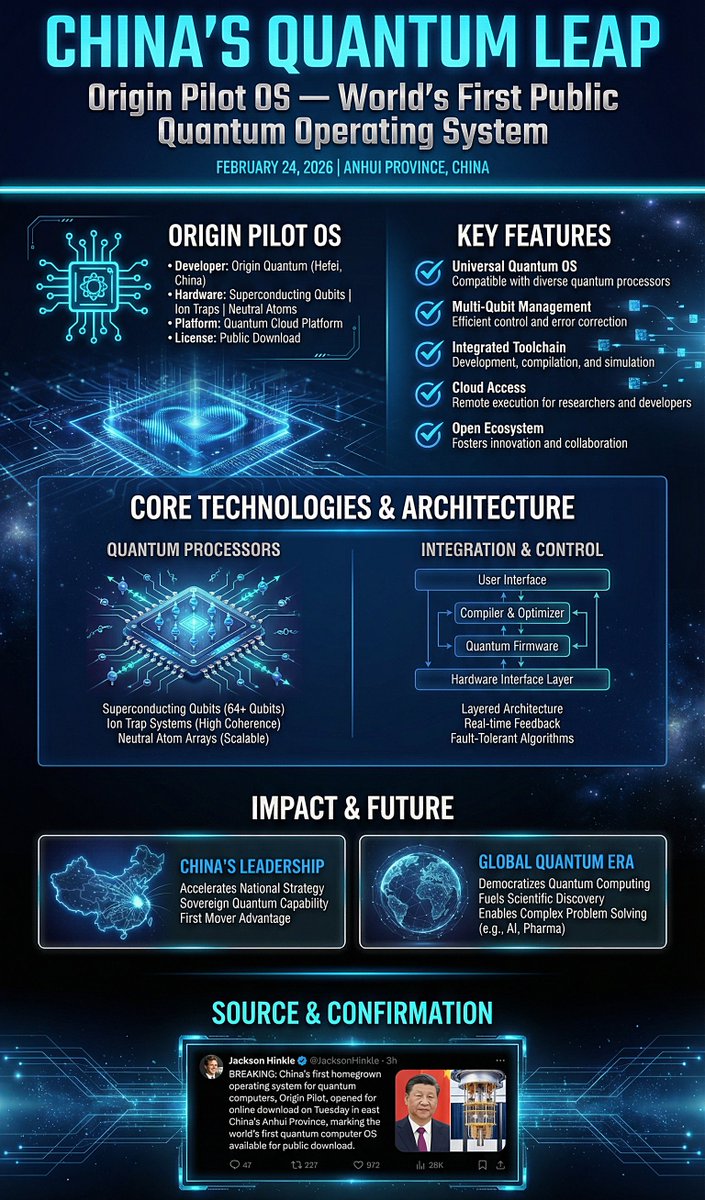
@jacksonhinkle China just went public with Origin Pilot—the world’s first open-source Quantum OS for public download!
From superconducting to ion traps, it’s built to run the future of computing. Is the global #Quantum race officially entering the open-source era?👇
#TechNews#China
@CityTshwane Tell me what's the problem?Why is it so difficult to reconnect electricity?Ive spent so much money travelling between Centurion and Middestad offices,sent so many emails called the call centre so many times only for the ref no to be closed&be told they reconnected but they didn't
@CityTshwane There was never a reconnection. My electricity was never reconnected. I'm still in the dark. No one reconnected anything. How can it be a power failure? What type of power failure is this in a single residential unit? This is really an insult to my family. This is ridiculous.
@CityTshwane Reference number: 8000304021
Account number: 5006957266
It's been 47 days since I settled this account.I have been to Centurion&Middestad offices,got call centre ref.Emailed CreditControl.Every time they escalate,there is still no reconnection.They need to reconnect a cable.
@RamaboduObakeng Reference number: 8000304021
Account number: 5006957266
It's been 47 days since I settled this account.I have been to Centurion&Middestad offices,got call centre ref.Emailed CreditControl.Every time they escalate,there is still no reconnection.They need to reconnect a cable.
@CityTshwane I have not been assisted since 20Dec 2024.This is a desperate attempt to get assistance.I have been going to Centurion&Middestad offices,sent countless emails,called the call center and 47 days later,I still don't have electricity.The contacts you provided do not work,No response
@CityTshwane I have not been assisted since 20Dec 2024.This is a desperate attempt to get assistance.I have been going to Centurion&Middestad offices,sent countless emails,called the call center and 47 days later,I still don't have electricity.The contacts you provided do not work,No response
@CityTshwane Reference number: 8000304021
Account number: 5006957266
It's been 47 days since I settled this account.I have been to Centurion&Middestad offices,got call centre ref.Emailed CreditControl.Every time they escalate,there is still no reconnection.They need to reconnect a cable.
@nasiphim@CityTshwane Reference number: 8000304021
Account number: 5006957266
It's been 47 days since I settled this account.I have been to Centurion&Middestad offices,got call centre ref.Emailed CreditControl.Every time they escalate,there is still no reconnection.They need to reconnect a cable.