@RediTlhabi@GovernmentZA@RediTlhabi wait for the ‘why should the Fed be independent when it failed at controlling inflation’ brigade. Then hear how quickly that narrative changes when the discussion is about the SARB.
@cllrfoleyward94@cllrfoleyward94 and @JHBWater can we please get an update regarding the water situation in the Fourways garden area. Surely our human rights are being violated now 😢
@SongezoZibi The minister will unfortunately need to cut by more than R75bn given the deterioration in the growth outlook. With growth projected around 1-1.5% for 2025, that’s significantly lower than the 1.9% NT expected in Feb. Revenue shortfall will be larger.
18) This long thread is for young black men CA's (SA), and only them. Because I know they are men capable of critical thinking, analysis and thought leadership. I train them.
Introducing my new book, "A Country of Two Agricultures".
It will be available in all major bookstores from this Friday, 01 September 2023.
The Kindle version is already out: https://t.co/E55P3rWzPr
Join us next week on Friday 16 June 2023 for our Post Budget Dialogue.
Our expert panel will discuss the 2023/24 budget under the theme of full monetisation of the Uganda Economy through commercial agriculture, industrialisation & expanding markets. 1/2 #AbsaPostBudgetForum
SA has the coal mafia in the electricity sector. We have construction mafia. Now it's the water tanker mafia. Criminal activity is ruining freight rail between Joburg & Durban. Crime is devastating the SA economy & inflicting untold suffering on individuals. A national crisis.
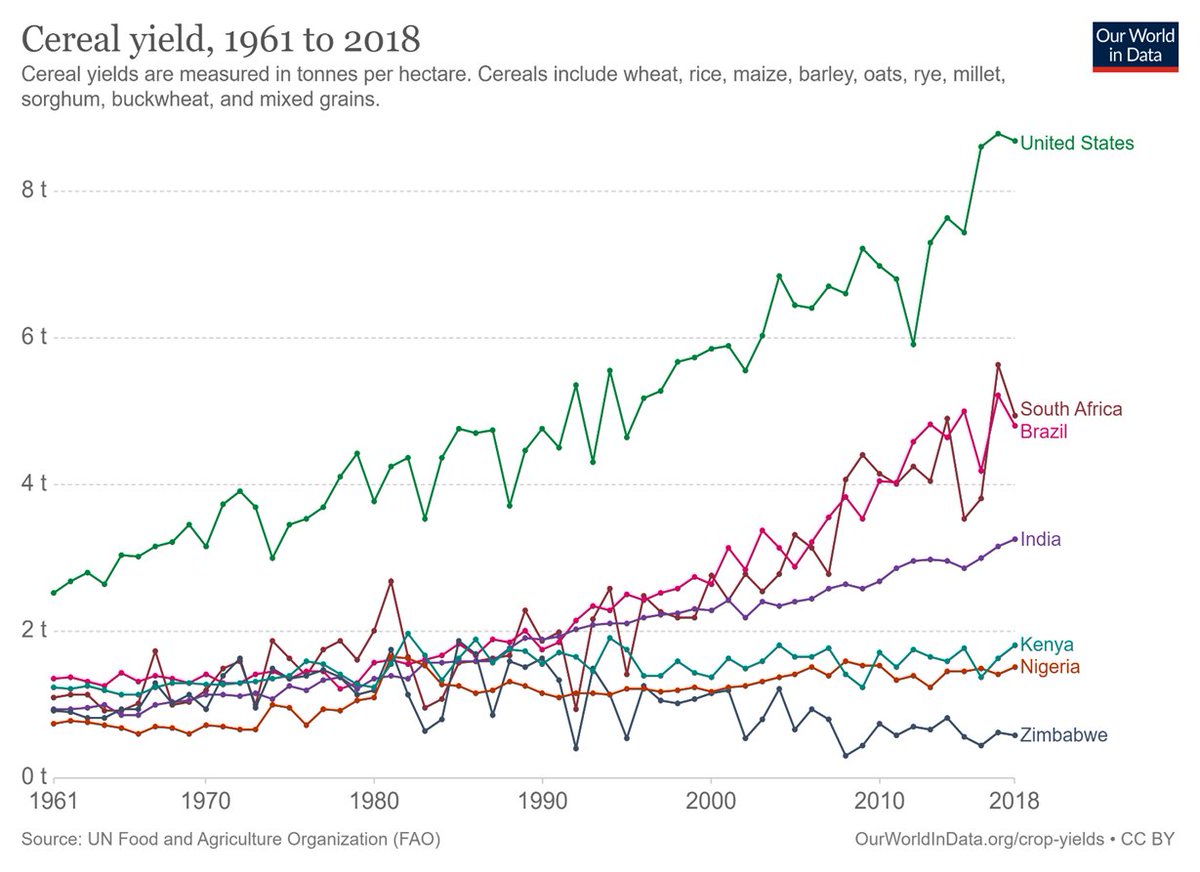
It is disappointing to see that in Kenya, President William Ruto’s government lost a case seeking the Court of Appeal's nod to import Genetically Modified Organisms (GMO) maize into the country.
President Ruto wanted to lift the ban on the cultivation and importing of GMO white maize in Kenya in response to growing food insecurity in Kenya. The country has struggled with drought in the recent past and remains a net importer of maize.
The liberalisation of the Kenyan seed market would have benefited farmers like in South Africa, Brazil and the US.
In fact, the sentiment towards the cultivation and importation of GMO crops is changing worldwide, partly because of the global food crisis and countries’ efforts to boost domestic production.
For example, at the beginning of June 2022, the Chinese National Crop Variety Approval Committee released two standards that clear the path for cultivating GMO crops. Now that this hurdle has been cleared, the commercialisation of GMO crops in China is a real possibility.
South Africa was an early adopter of GMO technologies. We began planting GMO maize seeds in the 2001/2002 season.
Before their introduction average maize yields in South Africa were about 2.4 tonnes per hectare. This has increased to an average of 6.3 tonnes per hectare in the 2022/23 production season.
Meanwhile, the sub-Saharan African maize yields remain low, averaging below 2 tonnes per hectare.
While yields are also influenced by improved germplasm (enabled by non-GM biotechnology) and improved low and no-till production methods (facilitated through herbicide-tolerant GM technology), other benefits include labour savings and reduced insecticide use, as well as enhanced weed and pest control.
With Kenya struggling to meet its annual maize needs, using new technologies, GMO seeds and other means should be an avenue to boost production in future.
Certain macro-economic fundamentals suggest SA doesn’t have the same inflation problems that the US faces. RMB’s Economist Mpho Molopyane shares her insights: https://t.co/3UBwjF7kD7 #Economy#InterestRates