Except Tolkien was a God-fearing Catholic unlike these tech freaks and this is exactly backwards to what he wrote
The "more deadly than any sword" line isn’t even in the books. It's from the 3rd movie and doesn't refer to Anduril
The second line is Faramir, not Aragorn, who represents restraint, pity and disdain for martial glory - the exact opposite of this autistic Silicon Valley swagger about "defending the West"
Faramir is lamenting the tragedy of war; using it to pitch autonomous killer drones completely inverts the text
Luckey’s "we are a conscious sword" line is a massive self-own. There *is* a "conscious sword" in Tolkien's world - it's Gurthang, a cursed blade forged by a Dark Elf that kills its user's best friend and turns against its master
Andúril didn’t even stop Mordor. That was Boromir's fallacy - believing superior force of arms or a superweapon can defeat Mordor on the battlefield.
Aragorn’s march with the sword was a suicide decoy so mercy and grace (Frodo's in relation to Gollum) could destroy the Ring.
In LOTR, who builds scalable war machinery and autonomous "devices" out of a desire to impose order and match the Enemy’s power? Saruman.
Using the palantirs for geopolitical intelligence is literally how Saruman is corrupted and Denethor driven to suicide. Gandalf refuses to even touch one.
Tolkien’s entire mythology is an anti-technocratic warning against the lust to dominate.
Believing you can engineer a "good" Ring, a "good" surveillance stone, or a "conscious sword" that only fights for the good guys is the exact hubris that breaks Denethor and turns Saruman into a mirror of Mordor
Everything is getting hacked.
Except your mortgage.
Except your credit card debt.
Except the IRS.
Except the student loans.
Except the medical bills.
Except the things that actually own you.
It’s all fake. It’s all a theater show. 🎭
One of the worst takes I've seen on this platform is that "because conservatives didn't revolt or resort to violence during the COVID lockdowns, they never will."
The threshold of violence is well-studied and says the opposite.
In modern stable societies, especially Western ones, the government has a monopoly on violence. Under the "social contract," citizens subordinate violence to the state, which decides when and where to apply that violence. The state enforces its monopoly by criminalizing extrajudicial violence. Some governments believe in their monopoly so much that they criminalize violence even in self-defense.
The result is that citizens are conditioned to believe in that monopoly because the risk of violating it is so high.
Which is to say that there's a certain amount of inertia that needs to be overcome before sporadic political violence becomes organized and coordinated (such as during an armed conflict).
The logic of "because of x case, y will never happen" is faulty. Their argument is that because COVID didn't break this inertia, it will never be broken. This is simply not true.
This post is not advocating violence. I am merely explaining why I still believe a domestic armed conflict is likely.
It's kind of like watching a cake bake: not having a timer, I don't know when the cake will be fully cooked, but you can see the dough rising as it's getting closer.
So what's required to break this inertia? What conditions accelerate violence?
According to the studies, it's tolerance for violence.
When a growing share of citizens signal their tolerance for political violence as an alternative to a broken political process, that violence becomes far more likely.
Citizens don't even need to actively support that violence, just acquiesce to it because the system (political, social, or economic) is so broken that they will tolerate violence against it. They are out of F's to give.
And it's not just that the system is broken -- i.e., it no longer works for me -- it's that the system has become illegitimate.
And the next logical conclusion is that an illegitimate system that doesn't work for me needs to be replaced with a legitimate one that does. That's the basis of virtually every revolution in human history.
Another bad argument is that because violent actors can't pick out specific targets, that political violence is not going to happen.
Again, studies are very clear: that doesn't matter. In civil war/domestic conflict, violent actors resort to generalized, collective punishment (i.e., any Democrat or Republican) if they don't have a specific target.
But let me tell you the greatest reason why I believe a domestic conflict is inevitable. (I dislike the term "civil war" because it's vague and conjures up a lot of different pictures, which is why I typically just use low intensity conflict, which covers a wider range of things like revolution, insurgency, terrorism and violence social movements, each of which can lead to revolutionary political change.)
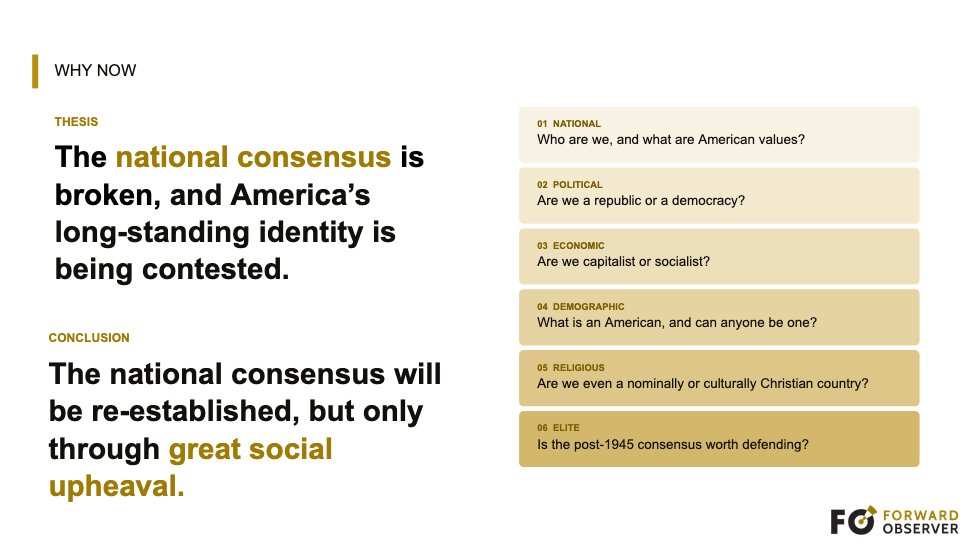
The national consensus is broken.
Nearly every part of our society is fractured. We can no longer agree on basic tenets like republicanism versus democracy, capitalism versus socialism, what is an American and what are American values, are we even a culturally Christian country, etc.
Regardless of differences in D or R political flavor, 20 years ago most Americans shared a consensus across all these factors. That's no longer the case and this shift was pretty rapid.
And when the national consensus is this broken, governments lose legitimacy and a society's tolerance for violence increases. (We haven't even gotten into the bad economic times yet. Industrial revolutions ALWAYS generate conflict.)
The national consensus will be restored -- either as a whole or separate countries -- but only after great social upheaval, usually armed conflict.
This is because citizens' tolerance for political violence increases as the ability to achieve change through the political process decreases. This is especially the case when politics become existential for one or both sides.
This is no my entire case because this is an X post, but this is my off-the-cuff thinking on the topic.
@mplfest@grok Already disproven by the OP, but zero liberalization happened in China.
They have not and will never embrace capitalism.
You could see what they say for yourself, but I assume you’re terrified to do that
Good idea. Stick to the script so you don’t have to think!
And tag a chatbot that has so many exposes written about it that I can’t count them all, that I’ve personally caught misleading easily manipulated people multiple times.
Worse, it’s a chatbot.
For “free thinkers” you vulgar librarians certainly avoid thinking for yourselves line the plague. I don’t think I’ve ever seen a single one of you say something original that a better man hasn’t said in a better way before you were even born. Then even that better man was torn to shreds.
And you still copy him like a robot.
Good free thinking, boss
@khrachvik@grok If its so wrong and dumb, it should be easy to refute the point.
China’s growth from 1978 onwards was from opening china up to global markets and foreign capital. State control of many industries liberalized. China’s gdp growth and drop in poverty coincides with capitalization.
Something else completely untrue.
Socialisms greatest “trick” is eradicating more poverty than any other force in all of human history, blowing capitalism completely out of the water.
That’s not really a trick, though. Just how it is, son
Commuism’s rogue’s gallery includes household names like Joseph Stalin, Mao Zedong and Pol Pot. But while these monsters attract the attention, the history of communism is littered with ruthless despots.
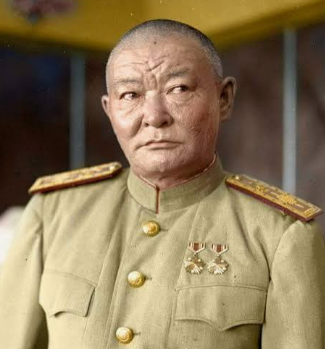
One was Khorloogiin Choibalsan, the authoritarian ruler of the Mongolian People’s Republic from the late 1930s until his death in 1952. Often referred to by historians as the "Stalin of Mongolia," his regime marked the only period in modern Mongolian history in which a single individual wielded absolute political control.
Operating under Soviet directives, Choibalsan orchestrated the Great Repression between 1937 and 1939 as head of the Ministry of Internal Affairs.
During these purges, an estimated 30,000 to 35,000 Mongolians - roughly three percent of the country's entire population at the time - were executed. The victims included political rivals, members of the intelligentsia, and ethnic minorities such as Buryats and Kazakhs. Furthermore, Choibalsan's policies targeted Mongolia’s religious institutions, resulting in the destruction of hundreds of Buddhist monasteries and the near-complete eradication of the Buddhist clergy, which fell from over 100,000 monks to a few hundred.
Choibalsan, despite his almost incomprehensible brutality, does not stand out. All communist regimes see ruthless strongmen float to the top. Any system need a hierarchy. Authoritarian despots and merciless repression are not aberrations, but features of collectivist societies.
No. The chart shows a smooth decline in extreme poverty share and absolute numbers from 1949–1978 with no adjustment or spike for the Great Leap Forward. That period produced a famine with excess deaths estimated in the tens of millions. Those deaths reduced headcounts by eliminating people, not by raising living standards. Official Chinese figures long minimized the scale, and the bulk of verified extreme-poverty reduction (World Bank and later Chinese data) occurred after 1978 reforms.
Thomas Massie just fired back at Mike Johnson for accusing him of exposing the Epstein files for “attention.”
“Did it get attention?”
“Damn right.”
“It got the attention of the billionaires.”
“It got the attention of royalty in Europe.”
“It got $32 million spent against me.”
“I won’t be coming back.”
“That’s why … I’m working as hard as I can until the end.”
“What attention did it draw?”
“Two dozen CEOs resigned in the face of these files.”
“The President of Harvard resigned.”
“Prince Andrew, well, we can’t call him that anymore.”
“We saw him lose his titles, his castles, and all of his special privileges.”
“We saw the British Ambassador to the United States … lose his job.”
“We saw the former Prime Minister of Norway indicted.”
“We saw the former Minister of Culture in France receive the same fate.”
“It wasn’t to get attention for me.”
“We got attention for the survivors.”
“They’d never been given an opportunity to speak together at the Capitol.”
“And we had the biggest press conference in the 14 years that I’ve been here.”
“Were we seeking attention for ourselves?”
“Hell no.”
“We were trying to get attention to the travesty of justice that those women had been dealt for decades.”
“It hasn’t drawn the attention of our own Attorney General, though.”
“No prosecutions.”
@RepThomasMassie