If you’re an adult and you’re not reading middle grade books, you’re failing yourself. Here’s why.
The MG books I’m talking about are written for kids between 8-14, and before you start coming at me saying kids books are for children and therefore are boring and can’t fully
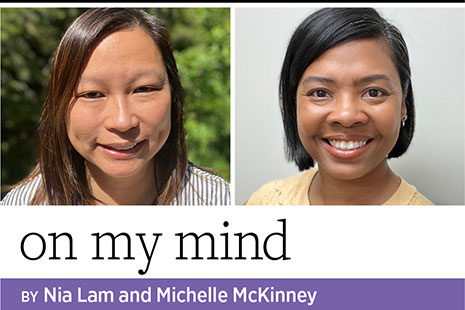
On My Mind: Fighting Posttenure Fatigue by Nia Lam of University of Washington Bothell and Cascadia College Library and @mpmleonard of @uclibraries https://t.co/XYvFf12C9E
Our second grant in partnership with @BlkWomenPhoto (BWP) is here! We're committed to empowering #photographers from both the BWP and Flickr communities to refine their skills. $2,500 in funding awaits to support their #photography journey.
Join in! 👇
https://t.co/QZqZWgAabC
Today we officially welcome our new Dean and University Librarian Elizabeth Kiscaden on her first day at the University of Cincinnati Libraries. #libraries
For all those who love baking, but want the task to be made easy as possible. Anna M. Mangin foresaw your needs. She invented the pastry fork in 1891.
—Anna M. Mangin invented the pastry fork in 1891.
The utensil was used to mix dough for pie crusts, cookies, butter and flour pastries without needing to mix the ingredients by hand. The fork was also used to beat eggs, mash potatoes, and prepare salad dressings. Mangin was awarded a patent on March 1, 1892, for the pastry fork for mixing pastry dough
PATENT PASTRY-FORK.
SPECIFICATION forming part of Letters Patent No. 470,005, dated March 1, 1892.
Application filed July '7, 1891. Serial No. 398,705. (No model.)
With this invention, Mangin paved the way for future cooking gadgets to shorten cooking durations and alleviate the physical strain of kneading, mixing, and mashing by hand.
In 1893, Mangin's Pastry Fork displayed the ingenuity of African American inventors and the tenacity of African American women at the World's Columbian Exposition. Held in Chicago, Illinois, people of color and women were initially denied opportunities to participate in exhibits.
After repeated demands for inclusion a limited number of non-white exhibits including
Mangin's Pastry Fork were allowed. Although her invention occupied only a small corner on the second floor, a writer on female inventions noticed the kitchen wonder and called it "the only thing of its kind at the patent's office."