❤️🇮🇷 BREAKING: IRANIANS are forming human-chains nationwide on bridges & around critical infrastructure to safeguard their country against U.S & Israeli strikes
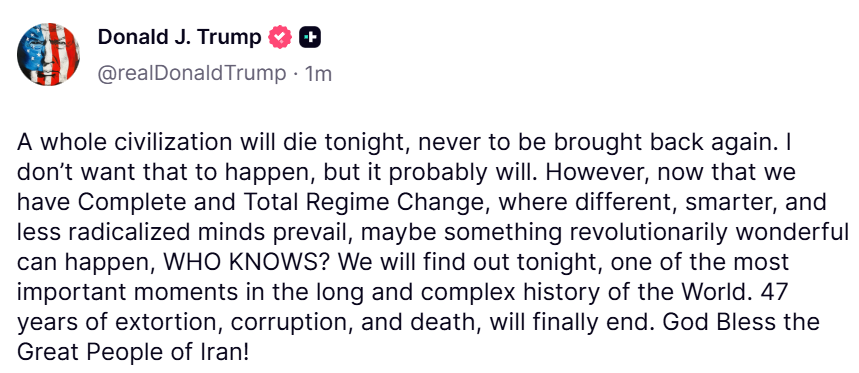
Trump is a real monster. US and Israel want to finish off Iran. Iran has said that no more self restraint from their side. Since gulf countries are providing base and supporting US, Iran has said it is going to destroy gulf region such that oil and gas are not available from gulf region for years to come.
If desalination plants get hit, millions of people would not have water to drink. The threat of dying without having water to drink is very real.
For the last few hours, intense attacks have been happening from both the sides. If nuclear weapon is used against Iran, the radiation would affect all the gulf countries. Various defence experts mention that China and Russia have conveyed that if Iran is attacked with nuclear weapon, Israel would cease to exist.
When people thought that Trump is a clown, I always pointed out he is a pure evil. The chain effects of this conflict on the whole world is going to be huge.
Nothing more to say for now.
✨Parag Parikh Flexi Cap in 2023 vs 2026.
Same fund. Same fund manager. Completely different portfolio.
India's largest actively managed mutual fund quietly made one of the biggest strategic pivots I've seen — and most investors holding it have no idea what changed.
I went through 3 years of monthly disclosures. Here's what Mr. Rajeev Thakkar actually did:
𝗧𝗵𝗲 𝗕𝗶𝗴 𝗡𝘂𝗺𝗯𝗲𝗿𝘀
AUM in early 2023: ~₹30,000 Cr AUM in March 2026: ~₹1,34,000 Cr That's 4.5x in 3 years.
But the portfolio didn't just grow. It shapeshifted.
👉𝗦𝗵𝗶𝗳𝘁 #𝟭: 𝗨𝗦 𝗧𝗲𝗰𝗵 𝗗𝗲-𝗥𝗶𝘀𝗸𝗶𝗻𝗴
2023: Foreign equity was ~17-18% of portfolio
→ Alphabet ~5%, Microsoft ~5%, Amazon ~4%, Meta ~4%
→ US tech was the defining identity of this fund
2026: Foreign equity dropped to ~10.5%
→ Alphabet ~4%, Microsoft ~2.7%, Amazon ~2.4%, Meta ~2.7%
→ Still there, but no longer the star of the show
They didn't panic-sell. They just stopped adding. As AUM grew 4.5x, the US allocation was diluted by design. Quiet, deliberate rebalancing.
👉𝗦𝗵𝗶𝗳𝘁 #𝟮: 𝗟𝗼𝗮𝗱𝗶𝗻𝗴 𝗨𝗽 𝗼𝗻 "𝗕𝗼𝗿𝗶𝗻𝗴 𝗜𝗻𝗱𝗶𝗮"
This is where it gets really interesting.
The stocks PPFAS has been aggressively buying are not what fintwit would call exciting:
→ Coal India — high dividend, government cashflow machine
→ Power Grid Corporation — ₹6.92% of portfolio, massive accumulation
→ ITC — grew from minor position to 5%+, added crores of shares every single month through 2025
→ HDFC Bank — now the #1 holding at 7.73%
→ ICICI Bank, Kotak Bank — steadily increased
These are cash-rich, dividend-paying, low-PE giants. Not the high-growth darlings that dominate social media watchlists.
👉𝗦𝗵𝗶𝗳𝘁 #𝟯: 𝗧𝗵𝗲 𝗖𝗮𝘀𝗵 𝗣𝗶𝗹𝗲
2023: Cash allocation ~12-13% 2026: Cash allocation ~24-25%
Read that again. India's largest active equity fund is sitting on roughly ₹33,000 crore in cash.
That's not laziness. That's a statement. Thakkar is telling you: "I can't find enough cheap stocks to deploy this money into."
When a value investor hoards cash, it means they think the market is expensive. When they do it while simultaneously buying Coal India and Power Grid, it means they're preparing for a downturn by loading defensive, dividend-heavy positions.
👉𝗦𝗵𝗶𝗳𝘁 #𝟰: 𝗧𝗵𝗲 𝗥𝗲𝗰𝗲𝗻𝘁 𝗠𝗼𝘃𝗲𝘀 — 𝗚𝗮𝘀 & 𝗛𝗼𝘂𝘀𝗶𝗻𝗴 𝗙𝗶𝗻𝗮𝗻𝗰𝗲
February 2026: Added Mahanagar Gas + Indraprastha Gas (city gas distribution)
September 2025: Added Aptus Value Housing Finance
November 2025: Added Indus Towers + TCS
Gas distribution + affordable housing + telecom infrastructure.
These aren't glamour plays. They're structural India bets — regulated businesses with predictable cashflows.
Meanwhile, exited: MCX, IPCA Labs, ITC Hotels, Himadri Speciality, HP Adhesives, Laxmi Dental
Pattern? Dumped the cyclical/speculative names. Loaded the boring compounders.
👉𝗧𝗵𝗲 𝗛𝗶𝗱𝗱𝗲𝗻 𝗦𝗶𝗴𝗻𝗮𝗹
Here's the number that tells you everything:
PPFAS portfolio PE: 17.51
Flexi cap category average PE: 27.28
PPFAS is running a portfolio that's 36% cheaper than its own category. While the rest of the market chases momentum, they are buying yield.
👉𝗧𝗵𝗲 𝗣𝗮𝘁𝘁𝗲𝗿𝗻 𝗕𝗲𝗵𝗶𝗻𝗱 𝗜𝘁
2023 PPFAS = "Global tech + Indian quality"
2026 PPFAS = "Domestic cash cows + massive cash buffer"
The fund hasn't changed its philosophy. It's still buying businesses below intrinsic value with strong cashflows.
What changed is WHERE that value exists.
In 2023, it was in beaten-down US tech (post-2022 crash).
In 2026, it's in boring Indian dividend aristocrats that nobody on Twitter wants to talk about.
Mr. Thakkar and Team aren't predicting a crash. They're positioning for a world where returns come from dividends and compounding — not from PE re-rating.
That's either very smart or very early. Usually, with Rajeev Thakkar, it's both.
@Akshat_World I've always been in awe of your knowledge. You don't move with the crowd, and views like that help in understanding what is being missed. I've submitted my replies. Hoping on getting selected.
@AnshulGarg1986@PulkitA30298377 And the counter-attitude was correct for the attitude that the shark threw. Also, it's wrong to bring a man down without knowing his whole story. Did you check his background before calling it a fake? Get your facts checked!
How 100-Baggers Are Really Created and how to Spot them.
2025 reminded us that markets are noisy, emotional and unpredictable.
But history shows that the biggest fortunes were not made by predicting events — they were made by owning great businesses and letting time do the heavy lifting.
They came from owning ordinary-looking businesses that quietly compounded year after year.
Take a simple example.
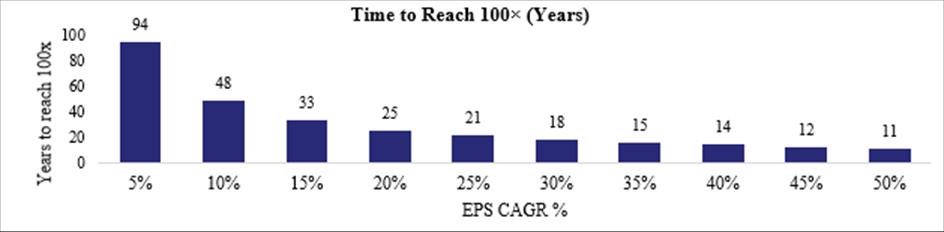
A company that grows its profits at 20% a year does not look exciting in any single year. But if that growth continues for 25 years, the business becomes 100 times bigger. And over time, the stock price tends to follow.
That is what we call a 100-bagger
Over the last 25 years, multiple Indian companies have delivered 100× returns.
These include names like Titan, Bajaj Finance, Pidilite, SRF, Shree Cement and TVS Motor etc. They did not become 100-baggers because of one big event. They became 100-baggers because they kept growing steadily for decades.
No hype. No frenzy. No big story.
The fascinating part is this: most of these companies never looked extraordinary in the beginning.
ZUDIO is slowing down and here’s the real reason :
Zudio follows a mass-production model.
The same T-shirt is produced and sold across 1,000+ stores.
Their core target audience?
College-going youths
But Zudio’s biggest strength slowly turned into its biggest problem.
As the brand exploded in popularity, everyone started wearing Zudio.
And for Gen Z, common = uncool.
Once customers began seeing the same designs everywhere, they pulled back.
The numbers reflect this:
44 stores opened in Q2
40 stores shut in the same quarter
SSSG (Same Store Sales Growth) is weak
Now compare this with V2 Retail :
V2 follows a completely different playbook.
They source from 70+ different vendors
High design churn
Faster inventory rotation
If a T-shirt at V2 sells in 15 days,
the same category product at Zudio may take 30 days or more.
Why?
Because variety + freshness > scale alone in value fashion.
I knew people will say ki zudio ka scale toh dekho 1000+ stores hain par I visited zudio and v2 retail stores and crowd at V2 RETAIL >> ZUDIO.
For women needing assistance - anytime, anywhere! Dial 181, to access round the clock support. From police assistance to legal guidance & counselling, the Women Helpline is here for you - always. 181 Listens to you.
The next five years are going to be very interesting for natural gas…
Revolution #1: Massive increases to U.S. compute infrastructure driving huge increases to natural gas sourced grid power.
Large data center completions were doubling every 4 years, but AI has compressed this to every 2 years. Estimated US hyperscale completions since 2020: 300. Leading operators: Amazon (150+ US sites total), Microsoft (60+), Google (30+ new since 2020).
By 2030, expect 500+ more large US facilities. These centers are primarily in: Northern Virginia (largest market, +83% capacity since 2020), Texas/Arizona (power availability), and Atlanta/Phoenix.
Energy demands: 20-25 GW from new large data centers completed since 2020. That’s the equivalent to the output of ~15-20 new natural gas plants / ~16-20 million U.S. homes annually. If trends hold, new builds 2026-2030 add another 50-60 GW (more than double existing demand).
Energy sourcing for new builds reveals a dominant reliance on natural gas. This is driven by the need for reliable, scalable baseload power to meet 24/7 demands.
Bottomline: Today, if all large/hyperscale data centers were run at 100% capacity and were powered only by U.S. natural gas, they would consume roughly 6% of total existing natural gas production. By 2035, that figure will be over 20%.
Revolution #2: Natural gas export demand is about to almost triple.
In 2024, natural gas exports (11.9 Bcf/d / 4.35 Tcf annually) consumed 11.5% of total U.S. production.
There are currently seven major LNG construction projects near-completion, underway, or planned and approved: ExxonQatar’s Golden Pass (2.4 Bcf/d); VG’s Plaquemines (1.6 Bcf/d); Cheniere’s Corpus Christi Stage 3 (1.7 Bcf/d); NextDecade’s Rio Grande (3.6 Bcf/d); Sempra’s Port Arthur (1.8 Bcf/d); VG’s CP2 (3.3 Bcf/d); and EnergyTransfer’s Lake Charles (1.6 Bcf/d).
When completed (2029) these facilities will add another 18 Bcf/d of export capacity, taking total export capacity to 30 Bcf/d (11 Tcf annually) – roughly 3x current export capacity. This represents roughly 30% of U.S. production. That’s more than the entire U.S. electrical generation sector uses today.
By 2030, LNG exports + AI compute energy demand will consume 50+Bcf/d of natural gas – or roughly half of total production. Supply is expected to grow, at most, by 10%.
The coming natural gas price spike will be extreme at times (like in the winter) when demand surges. Pipeline capacity is very tight. Permian takeaway is already at 95% of capacity. And new pipelines take forever to permit and built. The other major issue is, unlike LNG, data centers never turn off. There’s zero seasonal flexibility.
We’ll see consistent $10+ natural gas prices by 2030. And, when there's a significant demand spike in the winter, we'll see $50 gas.
Case of Irony: India continues to remain under Top-5 most expensive markets & has delivered the lowest 1-yr return in Aug: -8%. However, GDP growth in Q1FY26 remains the highest @ 7.8% v/s other economies.
Key takeaways from @melrobbins podcast with @morganhousel - "All happiness is the gap between expectations and reality." Expectations, in most cases, rise when one compares its success to the other.
The same well water feeds all crops. Yet bitter gourd stays bitter, sugarcane turns sweet, and tamarind remains sour. The fault isn’t the water, but the seed. Likewise, all humans are born alike- it’s the values and upbringing that shape who we become.
Mumbai receives 8 months of sunshine and experiences a hot and humid climate.
It now has a 5.25 km sea-facing promenade without any tropical trees 😭
Indian bureaucracy is perhaps the world's worst urban planners in the world