Physicist with a background in quantum bio-photonics. I am passionate about technology as a whole but I'm more personally involved in quantum technologies.
INSTEAD OF WATCHING NETFLIX TONIGHT.
Spend 1 hour with this.
Claude AI FULL COURSE that teaches you how to BUILD and AUTOMATE anything.
The people who watch this tonight will wake up tomorrow with a new skill.
Watch it and Bookmark it now
FREE Courses for PhD Students.
Links to the courses are given below.
1. Data Science: Machine Learning
Link: https://t.co/OA7Pycz3Xj
2. Data Science: Probability
Link: https://t.co/aLjMuNJwyK
3. Data Science: Linear Regression
Link: https://t.co/gr3m6esTnZ
4. Data Science: R Basics
Link: https://t.co/2yCQq0COTJ
5. Data Science: Visualization
Link: https://t.co/JWzVGaCSZX
6. Introduction to Data Science with Python
Link: https://t.co/LoaYbeOVpo
7. Data Science: Capstone
Link: https://t.co/rqirGvQaJX
8. R Programming Fundamentals
Link: https://t.co/6h2D55fxn5
9. Statistical Learning with R
Link: https://t.co/RHICZFXvnl
10. Statistical Learning with Python
Link: https://t.co/DF5mv26ox1
11. Mining Massive Data Sets
Link: https://t.co/y5QgbXQzAO
12. Databases: Relational Databases and SQL
Link: https://t.co/9vFEYeOpCM
13. Databases: Semi-Structured Data
Link: https://t.co/YuXSFSb5NC.
14. Databases: Advanced Topics in SQL
Link: https://t.co/xuFps2mQ4T
15. Introduction to Artificial Intelligence
Link: https://t.co/1HcopE46Xf
16. Artificial Intelligence
Link: https://t.co/jRzdMAWOd1
17. Introduction to Algorithms
Link: https://t.co/W8xvJBa02c
18. Introduction to Computational Thinking and Data Science
Link: https://t.co/9pnYmdvG2a
19. Introduction to Machine Learning
Link: https://t.co/dQD5xGH3hf
20. Understanding the World through Data
Link: https://t.co/iL37YlnM3G
21. Machine Vision
Link: https://t.co/bnS9FmxiFz
For more resources for PhD students, please check my YouTube.
YouTube link: https://t.co/sGL0TdTGYu
People think learning Claude takes days. It doesn't.
I wrote 17 free guides that teach it in hours:
Claude 101: https://t.co/HNa5MrCLVU
Claude Code: https://t.co/O2kJvFkgan
Claude Skills: https://t.co/jT4uB5Bdjw
Claude Design: https://t.co/q1zjMfeAyg
Claude for Excel: https://t.co/7g3CFNcKrs
How to Prompt: https://t.co/EE46WHU8vg
Claude + Linkedin: https://t.co/9d5stC6grm
Be good at Claude: https://t.co/SVGd967eMQ
Stop writing like AI: https://t.co/JWKUGNKgOS
Claude Certificates: https://t.co/9jKsXWOt66
Claude for your team: https://t.co/U1JsBVCzYH
Claude Connectors: https://t.co/TSAQqOpDeV
Set up Claude Cowork: https://t.co/diDhiKkfjs
Stop Prompting Claude: https://t.co/j1LATSJiat
Claude to sound like you: https://t.co/kDGBpSF7Wh
Stop hitting Claude limits: https://t.co/j5fEzSH5br
Stop using Claude at work: https://t.co/c6X55Thy6t
___
PS: I'm Ruben Hassid, and I want us to master AI before it masters us, with simple instructions.
Follow me never to miss my 2x daily posts.
You want to help someone in your network? ♻️ Repost this so they can find the best free resources.
People blame ChatGPT for bad answers.
The real issue is weak prompting.
Sharing these 9 prompt frameworks by Andrew Bolis.
1. R-A-C-E
Role: Define the assistant’s role.
Action: Specify what to do.
Context: Add background details.
Expectation: Define desired output.
2. R-I-S-E
Role: Assign a clear persona.
Identify: State the problem.
Steps: Break down required actions.
Expectation: Define final result.
3. S-T-A-R
Situation: Describe the context.
Task: Define the objective.
Action: Explain steps taken.
Result: Show outcome.
4. S-O-A-P
Subject: Define main topic.
Objective: Clarify purpose.
Action: Outline steps.
Plan: Provide solution path.
5. C-L-E-A-R
Context: Add background info.
Learn: Define what to understand.
Evaluate: Set success metrics.
Action: List execution steps.
Review: Summarize results.
6. P-A-S-T-O-R
Problem: State the issue.
Amplify: Emphasize importance.
Story: Give example.
Transformation: Show change.
Offer: Present solution.
Response: Suggest next step.
7. F-A-B
Features: List capabilities.
Advantages: Explain usefulness.
Benefits: Show real value.
8. 5-W-1-H
Who: Identify people involved.
What: Define the issue.
When: Set timeframe.
Where: Provide context.
Why: Explain importance.
How: Show solution.
9. G-R-O-W
Goal: Define target.
Reality: Explain current state.
Options: List possibilities.
Will: Commit actions.
Better inputs create better outputs.
P.S. Which framework will you test first?
♻️ Repost to help others write better prompts.
——
📌 Get my top 100 infographics for free:
1) Follow me.
2) Subscribe to my free newsletter at https://t.co/jTnaNRaV2d.
You’ll receive them directly in your welcome email.
A senior Google engineer dropped a 424-page doc on agentic design patterns.
424 pages.
Most engineers bookmarked it and never opened it again.
I read the whole thing.
Here are the 15 patterns that actually matter — explained in plain English, with exactly when to use each one ↓
🚨 CEO of Nvidia: "I'd hire the graduate who's expert in AI over the one who isn't. Every time"
he's not talking about people who use AI
everyone uses AI.
he's talking about people who know the stack.
agents. frameworks. tools. workflows. skills. automations
Bookmark it.
Google made a massive leap towards cracking Bitcoin & Ethereum signatures then hid it behind a ZK proof.
This increases the chances of Bitcoin and Ethereum not being quantum resistant by 2032 by 50%.
Jensen Huang, CEO of Nvidia:
"Every engineer is going to have and manage hundreds of agents."
The most valuable engineering skill of 2026 is not taught in any university.
No CS program teaches harness engineering.
No bootcamp teaches agent memory architecture.
No degree prepares you to build systems that survive production.
One builder mapped the entire thing out — free, step by step, no degree required.
This is the roadmap ↓
Bookmark this for the weekend.
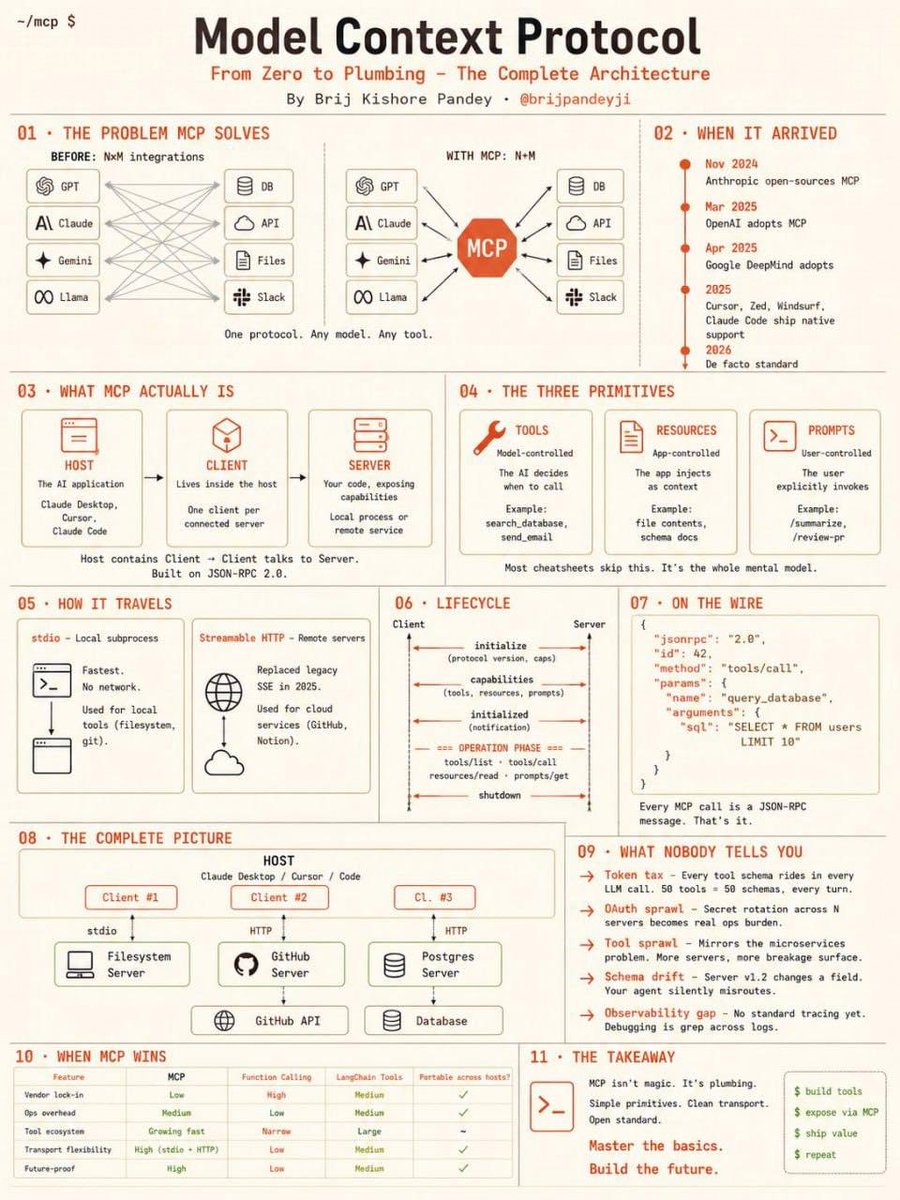
MCP stands for Model Context Protocol. It is an open-source standard created to help AI models securely connect to external tools, data sources, and software systems.
Most engineers using MCP can't explain what's actually happening on the wire.
They've cloned a repo, run a server, watched it work. Ask what `initialize` does, or why the token bill quietly doubled after they added a few servers, and the conversation gets short.
So I mapped the entire protocol. One image. Save it.
𝗪𝗵𝘆 𝗶𝘁 𝗲𝘅𝗶𝘀𝘁𝘀
Before MCP: N models × M tools = a custom bridge for every pair.
With MCP: N + M. One protocol in the middle.
𝗧𝗵𝗲 𝘁𝗵𝗿𝗲𝗲 𝗿𝗼𝗹𝗲𝘀
Host is the app you use. Client lives inside the host. Server is your code, exposing capability.
Underneath: JSON-RPC 2.0. Nothing exotic.
𝗧𝗵𝗲 𝘁𝗵𝗿𝗲𝗲 𝗽𝗿𝗶𝗺𝗶𝘁𝗶𝘃𝗲𝘀
Tools — model-controlled. The AI decides when to call.
Resources — app-controlled. The app pushes context.
Prompts — user-controlled. The user invokes them.
𝗧𝗵𝗲 𝗽𝗮𝗿𝘁 𝗻𝗼𝗯𝗼𝗱𝘆 𝘁𝗮𝗹𝗸𝘀 𝗮𝗯𝗼𝘂𝘁
Every tool schema travels in every LLM call. 50 tools = 50 schemas, every turn.
OAuth across many servers becomes real secret rotation work.
Tool sprawl is the new microservices sprawl.
Schema drift breaks agents silently.
MCP isn't a framework. It's a protocol. Mental model is HTTP, not LangChain. Boring, foundational, slowly everywhere.
Save the graphic for the next time someone asks how MCP actually works.
Credit: codewithbrij
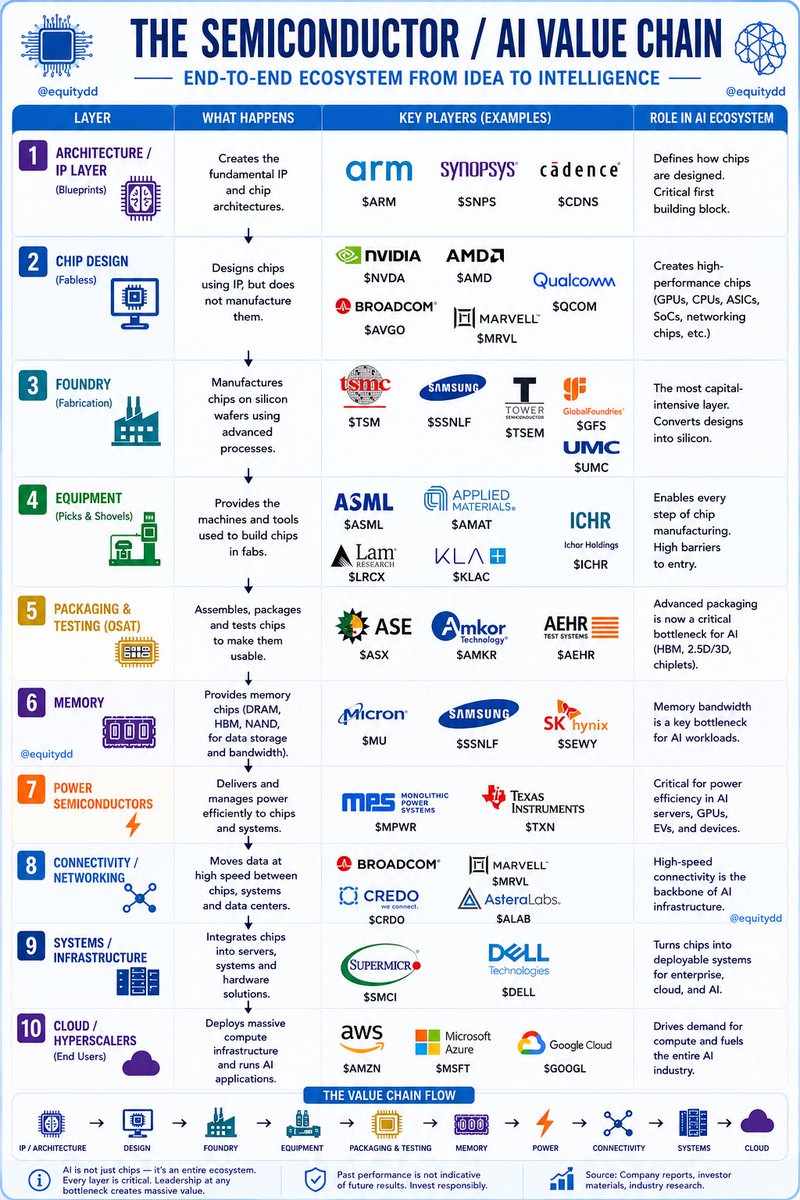
Most people think AI runs on GPUs.
That's like saying the internet runs on browsers.
Modern AI is powered by an entire ecosystem of processors:
🧠 CPU → Coordinates everything
⚡ GPU → Trains massive models
🔷 TPU → Accelerates tensor operations
📱 NPU → Brings AI to phones & laptops
🚀 LPU → Delivers ultra-fast LLM responses
🌐 DPU → Handles networking, security & data movement
The interesting part?
Every AI breakthrough depends on ALL of them working together.
A trillion-parameter model is useless if:
• Data can't reach it fast enough
• Inference is too expensive
• Edge devices can't run it
• Infrastructure can't scale
The next AI race won't be won by the best model.
It'll be won by whoever builds the best compute stack.
Models get the headlines.
Chips run the world.
Which processor category do you think will see the biggest growth over the next 5 years? 👇
LIST OF 40 WEBSITES TO FIND REMOTE JOBS
1. Linkedin. com
2. Indeed. com
3. Glassdoor. com
4. FlexJobs. com
5. weworkremotely. com
6. Remote. com
7. Upwork. com
8. Freelancer. com
9. Fiverr. com
10. Guru. com
11. Toptal. com
12. AngelList. com
13. Hubstafftalent. com
14. Simplyhired. com
15. Remotive. com
16. Virtualvocations. com
17. workingnomads. com
18. Hired. com
19. cloudpeeps. com
20. taskrabbit. com
21. talent. com
22. Remote OK - remoteok. io
23. DRemote - dremote. io
24. Jooble - jooble. org
25. stackoverflow. com/jobs
26. jobspresso. com
27. onlinejobs. ph
28. simplyhired. com
29. themuse. com
30. skipthedrive. com
31. zirtual. com
32. justremote. com
33. hireable. com
34. remoteworkhub. com
35. jobbatical. com
36. freelancewritinggigs. com
37. contentwritingjobs. com
38. problogger. com/jobs
39. behance. net
40. designhill. com
Don't forget to follow @NextShopiaAi to get more insightful Ai related tools and update.
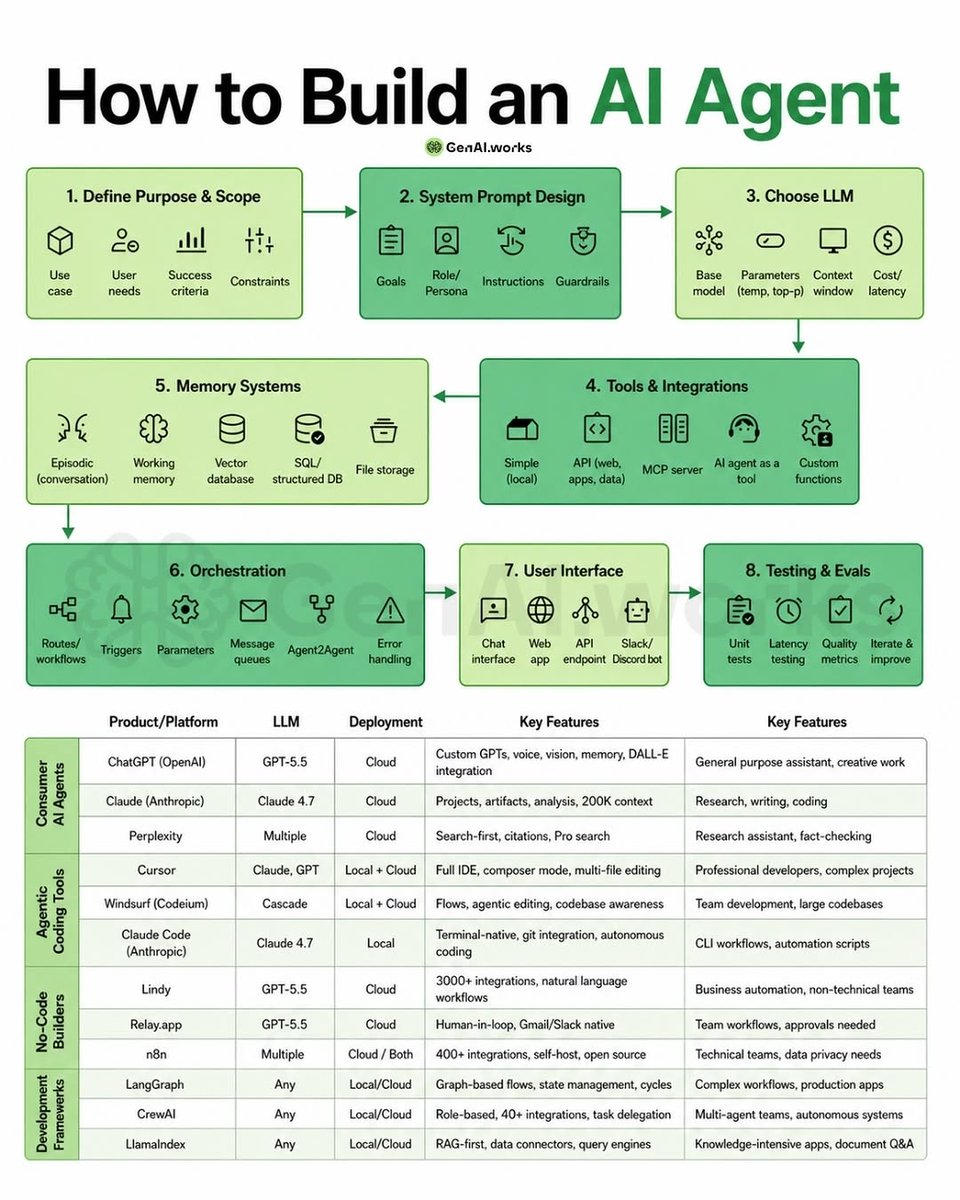
Building an AI Agent in 2026 is no longer just about picking an LLM.
The real magic happens in the system around the model. 🤖
This roadmap perfectly breaks down how modern AI agents are actually built from scratch. 👇
A production-ready AI agent needs 8 core layers:
1️⃣ Define the Purpose
Before writing prompts, define:
• use case
• user needs
• constraints
• success metrics
Most AI projects fail because this step is skipped.
2️⃣ System Prompt Design
Prompts are becoming operating systems for agents.
A strong system prompt defines:
• role/persona
• goals
• instructions
• safety guardrails
3️⃣ Choose the Right LLM
Different models = different strengths.
• GPT-5.5 → versatility & tool usage
• Claude → reasoning & long context
• Perplexity → research & citations
There’s no “best model.”
Only the best model for the task.
4️⃣ Tools & Integrations
This is where AI becomes actionable.
Agents connected to:
• APIs
• MCP servers
• databases
• custom tools
• external apps
Can actually execute workflows instead of just generating text.
5️⃣ Memory Systems
Memory is the difference between:
“a chatbot”
and
“an intelligent assistant.”
Modern agents use:
• working memory
• vector databases
• structured storage
• episodic memory
6️⃣ Orchestration
This is the hidden layer most people ignore.
Workflows, triggers, queues, retries, routing, multi-agent coordination…
This is what turns prompts into systems.
7️⃣ User Interface
The best AI products win on UX, not just intelligence.
Chat apps, APIs, Slack bots, dashboards - interface matters.
8️⃣ Testing & Evaluations
If you don’t measure quality, latency, reliability & hallucinations…
your AI product will eventually break at scale.
The biggest takeaway?
AI Engineering is rapidly becoming a combination of:
Software Engineering + Prompting + Systems Design + Automation.
The engineers who understand orchestration, memory, tools & workflows will dominate the next decade of AI products.
Save this roadmap.
This is basically the blueprint for building AI agents in 2026. 🚀
Follow @elora_khatun for more AI engineering breakdowns, prompts, workflows & agent architectures.
HE JUST DID IT AGAIN
$NVDA CEO KEEPS TELLING YOU WHICH STOCKS TO BUY
IN 2025 HE CALLED:
$NBIS AT $22 → +1000%
$INTC AT $23 → +500%
$SNDK AT $275 → +500%
$CRWV AT $40 → +200%
$TSM AT $240 → +80%
NOW HE’S TELLING YOU TO BUY SPACE STOCKS:
$RKLB AT $143
$ASTS AT $113
$FLY AT $46
$AMZN AT $270
ARE YOU GOING TO IGNORE HIM AGAIN?
20 NotebookLM Prompts
To Learn Faster, Think Deeper & Research Smarter
01. Instant Summary
Turn long documents into digestible insights.
Prompt: “Summarize this source into the 10 most important ideas, key arguments, and practical takeaways in plain English.”
02. Beginner Explanation
Make complex topics easy to understand.
Prompt: “Explain this material as if I am a complete beginner. Use simple analogies, step-by-step logic, and avoid jargon.”
03. Deep Dive Breakdown
Understand the topic layer by layer.
Prompt: “Break this source into core concepts, hidden assumptions, expert-level nuances, and what most readers usually miss.”
04. Compare Sources
Spot agreements and contradictions.
Prompt: “Compare all uploaded sources. Show where they agree, where they conflict, and what unique insights each source contributes.”
05. Study Notes Builder
Create clean notes instantly.
Prompt: “Turn this content into structured study notes with headings, bullet points, definitions, and memorable examples.”
06. Flashcards Generator
Convert information into active recall.
Prompt: “Generate 25 high-quality flashcards from this material with question on front and concise answer on back.”
07. Quiz Me
Test your understanding.
Prompt: “Create a progressive quiz from easy to difficult based only on this source. Wait for my answers and grade me.”
08. Memory Hooks
Make information stick.
Prompt: “Create mnemonics, analogies, and memory anchors that help me retain the most important parts of this content.”
09. Timeline Extraction
Organize events chronologically.
Prompt: “Extract every important event, milestone, or development from these sources and arrange them into a clean timeline.”
10. Key Quotes Finder
Find the strongest supporting evidence.
Prompt: “Pull out the most impactful quotes, data points, and evidence from these sources that I can cite in writing or presentations.”
11. Research Gaps
See what’s missing.
Prompt: “Identify unanswered questions, weak arguments, missing evidence, and research gaps across these materials.”
12. Debate Both Sides
Sharpen critical thinking.
Prompt: “Present the strongest arguments for and against the main thesis of these sources as if two experts were debating.”
13. Turn Into Framework
Extract repeatable systems.
Prompt: “Convert the ideas in these sources into a practical framework, checklist, or repeatable system I can apply.”
14. Content Repurposing
Turn research into publishable content.
Prompt: “Use these sources to generate a LinkedIn post, article outline, tweet thread, and newsletter idea.”
15. Expert Interview Mode
Ask the notebook questions.
Prompt: “Act as the world’s top expert on these uploaded materials. I will ask questions answer only from the sources.”
16. Executive Briefing
Condense for busy decision making.
Prompt: “Create a 5-minute executive briefing with only the most strategic insights, implications, and action points.”
17. Lesson Plan Creator
Transform notes into a curriculum.
Prompt: “Turn this notebook into a 7-day learning plan with daily lessons, exercises, and checkpoints.”
18. Idea Generator
Use sources for new thinking.
Prompt: “Generate 20 original ideas, opportunities, or applications inspired by the uploaded materials.”
19. Simplify for Teaching
Prepare to explain to others.
Prompt: “Rewrite the key ideas from these sources into a teaching script that I can explain to someone in 5 minutes.”
20. Action Plan
Move from knowledge to execution.
Prompt: “Based on everything in these sources, create a practical action plan with first steps, priorities, and deadlines.”
❤️ Like
🔁 Retweet
🔖 Bookmark
Followv Nadia -with-Ai for more such posts
People think learning Claude takes days. It doesn't.
I wrote 17 free guides that teach it in hours:
Claude 101: https://t.co/QQDmzBAoH5
Claude Code: https://t.co/o782qegoKu
Claude Skills: https://t.co/RgQUCNMqzQ
Claude Connectors: https://t.co/cSPMBUNmRG
Claude for Excel: https://t.co/ZgmUFXd0Iw
How to Prompt: https://t.co/Sw2tg2PMMc
Claude Certificates: https://t.co/LyV7fegv4c
Claude for your team: https://t.co/NakViTGCAL
Stop Prompting Claude: https://t.co/45xPLDRB6Y
AI Slides (PPT in 2026): https://t.co/OY7cHDTV7l
Claude Design: https://t.co/FhlRSlH0aD
Set up Claude Cowork: https://t.co/4jygw4M1RO
Claude to sound like you: https://t.co/LyV7fegv4c
Stop writing like AI: https://t.co/JXKAVP6hdS
Claude as your computer: https://t.co/tQDrcs8drQ
Claude Cowork + Project: https://t.co/xU97EpdrEe
Stop hitting Claude limits: https://t.co/Yu24rPQafQ
___
1. Save this list for later (three dots, top right).
2. Share it with a friend by ♻️ reposting this image.
3. Subscribe to my free newsletter: https://t.co/psB7XxAv8w.
LIST OF 40 WEBSITES TO FIND REMOTE JOBS
1. Linkedin. com
2. Indeed. com
3. Glassdoor. com
4. FlexJobs. com
5. weworkremotely. com
6. Remote. com
7. Upwork. com
8. Freelancer. com
9. Fiverr. com
10. Guru. com
11. Toptal. com
12. AngelList. com
13. Hubstafftalent. com
14. Simplyhired. com
15. Remotive. com
16. Virtualvocations. com
17. workingnomads. com
18. Hired. com
19. cloudpeeps. com
20. taskrabbit. com
21. talent. com
22. Remote OK - remoteok. io
23. DRemote - dremote. io
24. Jooble - jooble. org
25. stackoverflow. com/jobs
26. jobspresso. com
27. onlinejobs. ph
28. simplyhired. com
29. themuse. com
30. skipthedrive. com
31. zirtual. com
32. justremote. com
33. hireable. com
34. remoteworkhub. com
35. jobbatical. com
36. freelancewritinggigs. com
37. contentwritingjobs. com
38. problogger. com/jobs
39. behance. net
40. designhill. com
Don't forget to follow @NextShopiaAi to get more insightful Ai related tools and update.