Non-profit research org | Based in Harare, Zimbabwe 🇿🇼 | Proudly serving as @Afrobarometer's National Partner | Focused on public opinion and social research
We've got great news to share! Afrobarometer has been recognised by Acquisition International as the Best Social Research NPO in Southern Africa in 2025 under the Non-profit Organisation Awards category. We're honoured to receive this award and look forward to continuing to champion the voices of African citizens.
#VoicesAfrica
Join us for the launch of @afrobarometer’s flagship report on citizen engagement in Africa! This event will bring together leading voices from research, policy, civil society to explore how Africans are participating in democracy. Register:https://t.co/WzVD5kU1Vw
#VoicesAfrica
From Tuesday 20th to Thursday 22nd May 2025, #IJR’s Head of Peacebuilding Interventions, Prof. Tim Murithi, will be presenting at a Departmental Seminar Series hosted by @SOAS University of London and the Centre for Pan-African Studies (CPAS).
The three-part series includes:
🔹 Tues 20 May: Pan-African Perspectives on the Emerging Global Order: Africa’s Quest for a New Democratic International System
🔹 Wed 21 May: The African Union’s Reparations Agenda: Institutionalising Accountability, Redress and Restitution
🔹 Thurs 22 May: The African Union’s Transitional Justice Policy: The Elusive Quest for Continental Peace and Security
Join the conversation on Africa’s role in reshaping the global order.
#IJRTurns25 #PanAfricanism #SOAS
@tmurithi12@SOAS
Drugs don’t build nations they break them. A drunk, addicted generation is a doomed one. We need urgent and united action that spans from policy to prevention to rehabilitation 🙏🏽
Eight in 10 Zimbabweans (79%) say that drug and substance abuse is widespread in their communities, including a clear majority (56%) who consider it to be “very widespread.”
Head over to our website to read more: https://t.co/sJWeKrJpaS
#VoicesAfrica#Zimbabwe#DrugAbuse
Nine out of 10 Zimbabweans say the government is performing poorly on job creation, their top priority for government action.
Head over to @afrobarometer’s website to read more: https://t.co/nl3iwgPdTF
#VoicesAfrica#Zimbabwe#Unemployment
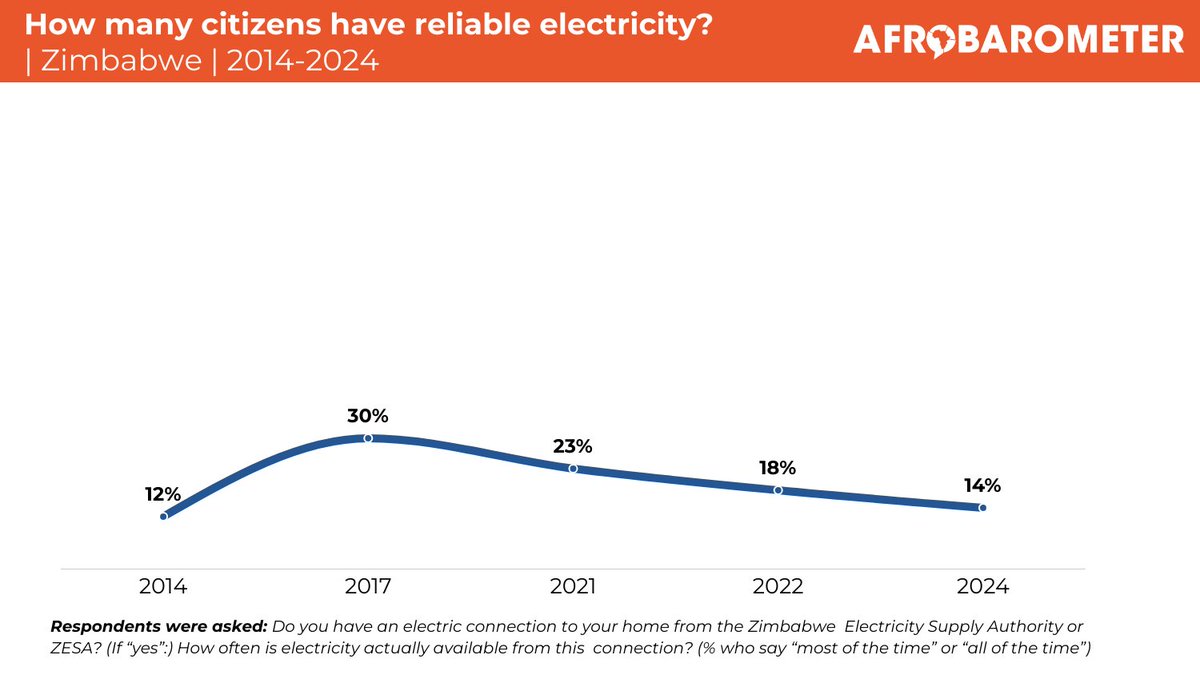
Only one in seven Zimbabweans (14%) enjoy a reliable supply of electricity from the national grid. Half (50%) of citizens report that they are using alternative sources of energy.
Head over to @afrobarometer’s website to read more: https://t.co/usJQE7Zz2f
#Zimbabwe#Electricity
Unemployment tops the list of important problems that Zimbabweans want government to address: Almost half (45%) cite it among their priorities. Food insecurity ranks second (32%), health (31%), education (21%), water supply (20%), corruption (20%), management of economy (19%).
Slightly more women (77%) than men (73%) endorse equality in politics, as do younger citizens (77%) compared to their elders (73%), urban residents (78%) compared to their rural counterparts (73%), and better-off respondents (78%) compared to the poor (72%).
Should women have an equal chance to be elected?
In Zimbabwe, three-fourths (75%) of citizens say women should have the same chance as men to vie for political office, rejecting the idea that men make better political leaders and should thus be given priority as candidates.
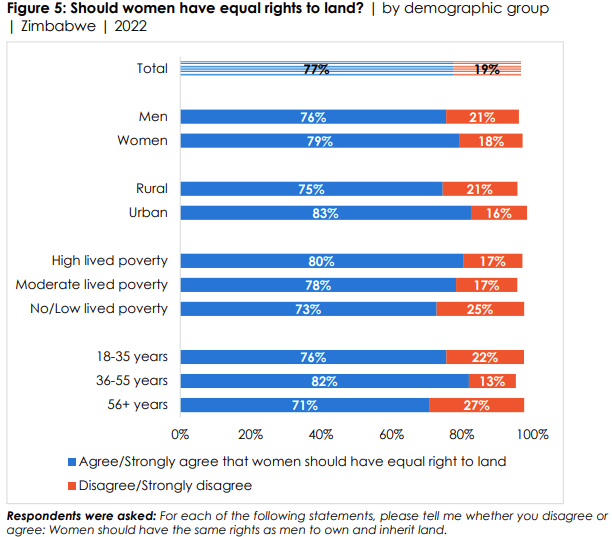
But support for equality is higher among urban than rural residents (83% vs. 75%) and among poor respondents (83%) compared to their better-off counterparts (73%- 78%). Older respondents are least likely to endorse equal rights to land (71%).
A larger majority (77%) endorse equal rights to own and inherit land. Only 3 percentage points (the survey’s margin of error) separate women’s support for equality (79%) from men’s (76%) (Figure 5).
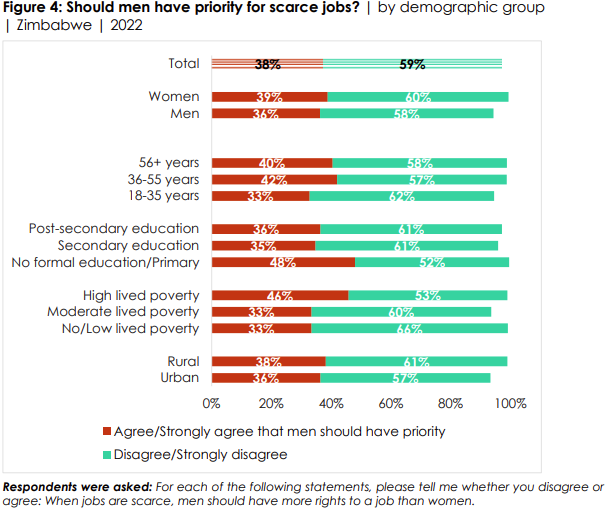
A majority (59%) of Zimbabweans reject the idea that men should be given priority over women in hiring when jobs are scarce, but almost four in 10 (38%) endorse this form of gender discrimination.
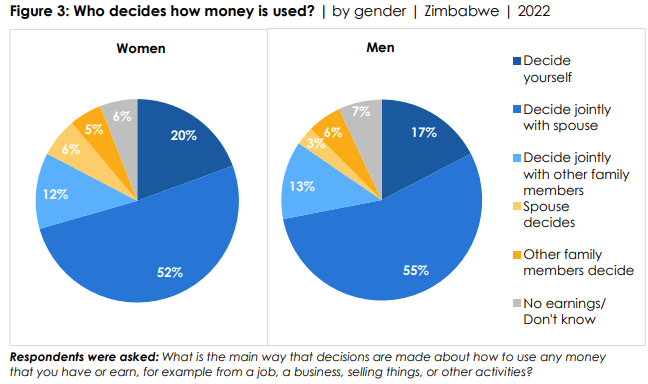
In decisions about how household money is spent, women and men also report very similar results: Most women say they make financial decisions themselves (20%) or jointly with their spouse (52%), and so do most men (17% and 55%, respectively) .
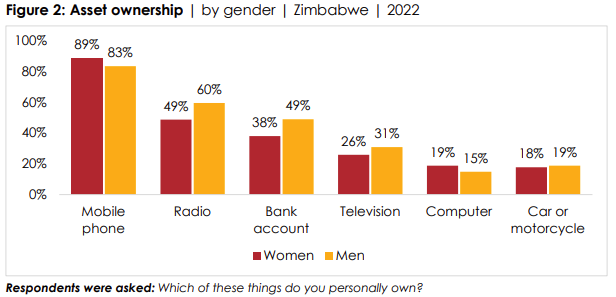
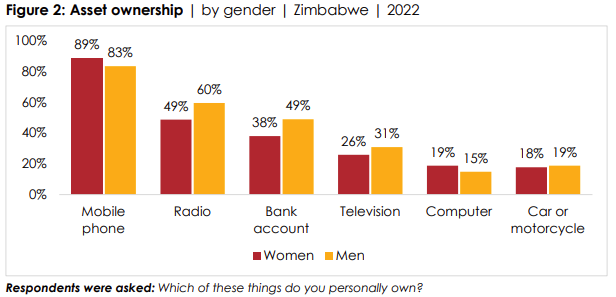
Women trail men when it comes to ownership of a bank account (an 11-percentage-point gap), a radio (11 points), and a television (5 points) (Figure 2).
When it comes to control over assets, slightly more women than men own a mobile phone (89% vs. 83%) and a computer (19% vs. 15%), and the two are about equally likely to own a car or motorcycle (18% of women, 19% of men).
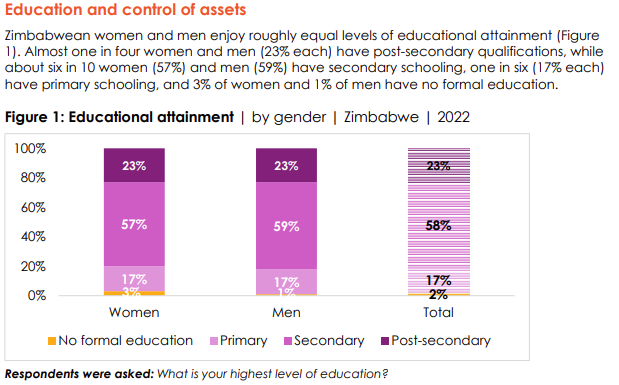
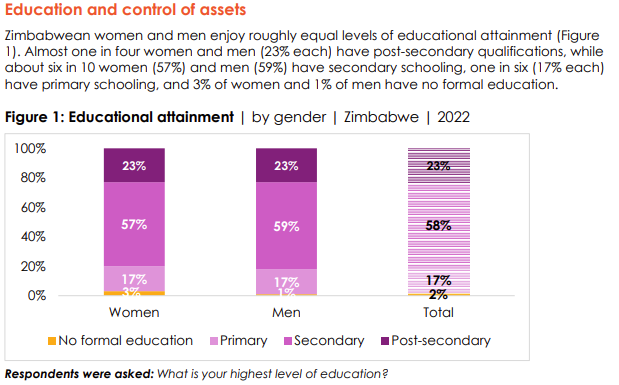
Zimbabwean women and men enjoy roughly equal levels of educational attainment (Figure 1). Almost one in four women and men (23% each) have post-secondary qualifications, while about six in 10 women (57%) and men (59%) have secondary schooling...