Ollama
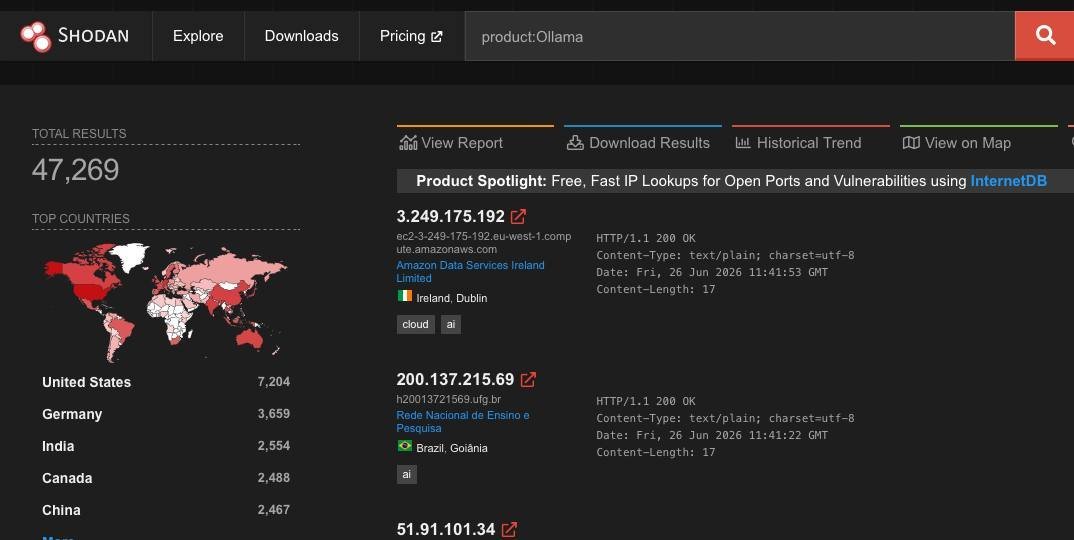
Shodan indexes over 47.000 exposed Ollama instances, including many running on expensive cloud GPUs.
The API has no authentication, which means hackers can run prompts, steal models and exploit vulnerable versions.
To spread awareness we made an article showing you what can be done. Make sure you're safe
https://t.co/deeQ1abKd3
‼️ BREAKING: Hackers tore down a Flock license plate camera, copied its storage and found an encryption key on the device that unlocked footage of thousands of passing vehicles.
The recovered data covered about 21 days of activity. In that time, the camera photographed roughly 50,000 vehicles and took about 1.6 million images.
Flock had previously told a security researcher that even someone who got into one of its cameras couldn't reach footage, because images stayed on the device only briefly.
Flock calls the removal illegal and said it didn't have enough detail to assess the claims.
Its software also detects people. When researchers ran the camera's own models over 27,321 clips stored on it, they flagged people in 11.
‼️ ALERT - Critical Docker Sandboxes flaw lets malicious guest code escape the shared workspace and read or modify files across a macOS host.
CVE-2026-77179 crosses the virtio-fs boundary with the host account’s rights.
Read how the escape works → https://t.co/omP4N4koPp
Researchers spent 500 hours and $70,000 and found LG TVs logging plain text transcripts in standby, mapping every device in the house, and feeding it to LG's ad arm
Unplug the internet and it saves the files until you plug back in.
LG says its TVs don't record ambient conversations.
The evidence begs to differ.
216 million of these are sitting in living rooms.
Where are the regulators?
Writer: Daniel
Your LG TV is spying on you, even with no internet connection.
According to @GamersNexus, LG Smart TVs can scan local networks, identify content, and record/transcribe audio in standby.
They also found webOS flaws that could enable remote code execution. https://t.co/3m6sklywkj
If you see something, save something.
Web pages disappear every day. 🕳️ They change, move, get deleted—or simply get forgotten.
Save Page Now lets you preserve a webpage that's important to you before it changes or disappears.
See something worth keeping?
Save it today. ➡️ https://t.co/qwmJ1iYC3B
#ToolsYouCanUse
‼️ WARNING - Attackers are exploiting a Chrome V8 zero-day.
CVE-2026-85046 allows arbitrary code execution inside the browser sandbox via a crafted HTML page. Google fixed it in Chrome 152.0.7977.82/.83.
How the V8 type confusion works: https://t.co/oi8DcrCAQG
Iranian hackers are posing as recruiters on LinkedIn and hiding cross-platform remote access trojans inside coding tests.
The campaign, attributed to Nimbus Manticore, delivers two newly documented malware families: NodeRabbit and PollCat. Both can execute commands and establish persistence across Windows, Linux, and macOS.
Read: https://t.co/7qcjsJqWUy
❗️Thunderbolt is finally coming to Linux on Apple Silicon thanks to volunteers who reverse-engineered it, without help from Apple.
Asahi's Sven Peter posted the first USB4/Thunderbolt driver for M1, M2 and M3 to the kernel list yesterday, after years of reverse-engineering.
Scammer: “You have been hacked. Send us $5,000.”
Cybersecurity guy:
“No, no… OUR computer now.” 😂
Reverse hacking a scam center has to be one of the most satisfying plot twists on the internet.
#DDW#CyberSecurity#Scam#CyberHumor#Hacking
We've been getting a lot of questions lately about how the Internet Archive digitizes books.
The short answer: page by page, by hand.
You may remember our viral 2021 video of Eliza Zhang scanning a book. That's still how we do it.
Meet Eliza, and learn how we scan books: https://t.co/gt9s5lbPE4
Linus Torvalds just used AI to help fix a Linux kernel bug. This is a rare event.
Rare because Torvalds doesn't code on Linux kernel anymore. He just reviews code and merge pull requests from contributors.
So this is a rare occasion in recent time where he made a kernel patch himself. And he took assistance of AI this time.
The bug was in the Intel Xe graphics driver for Battlemage G21 cards. It caused GDM, the display manager, to restart endlessly. Tracking it down required 24 debug patches and 18 kernel boots.
The culprit turned out to be a single line where round_up() should have been round_down().
The AI "did the grunt work" for Torvalds: adding debug instrumentation, running analysis, and even writing the final commit message.
But it was not all a smooth sailing. The AI told Linus multiple times that the problem was "impossible and unsolvable." Each time, Linus pushed back and kept going.
In his words: "I suspect those things have been trained by people who may not be quite as stubborn as I am."
That once again is what we always say. AI is just a tool and it is essentially useful when there is a capable human driving the process. Left to its own conclusions, it would have called this bug unfixable and walked away.
But Linus Torvalds has experience. He could understand what the AI was doing right or wrong.
The patch is now in Linux 7.3 and has been backported to stable kernel branches.
The creator of Linux needed 18 boots to find a one-line fix. The AI helped him get there. Although, I think he would have got there all by himself as well, even if it would have taken a bit longer.
🚨 Teams and Google Drive Leveraged to Compromise Systems Within 20 Minutes
Source: https://t.co/A7kA57hhgG
Hackers are increasingly abusing trusted enterprise platforms such as Microsoft Teams and Google Drive to deploy stealthy remote access malware, with a newly observed campaign leveraging social engineering and cloud-based command-and-control to evade detection.
Within minutes, the threat actor delivered a Java-based remote access trojan known as Nimbus RAT, completing the compromise in under 20 minutes. The attack followed a structured, repeatable kill chain, highlighting the growing operational maturity of these campaigns.
#cybersecuritynews
This is the closest thing to a real-life God Eye.
OSIRIS is an open-source "Palantir" running entirely in your browser.
10k+ live aircraft & 2k+ satellites tracking in 3D 🛰️
1,400+ live CCTV streams worldwide 🎥
Built-in OSINT/Recon tools (Nmap, WHOIS, IP lookup)
No login, no paywalls, completely free. Absolutely insane. 👇
#OSINT #CyberSecurity #OpenSource #GeoInt #ThreatIntel
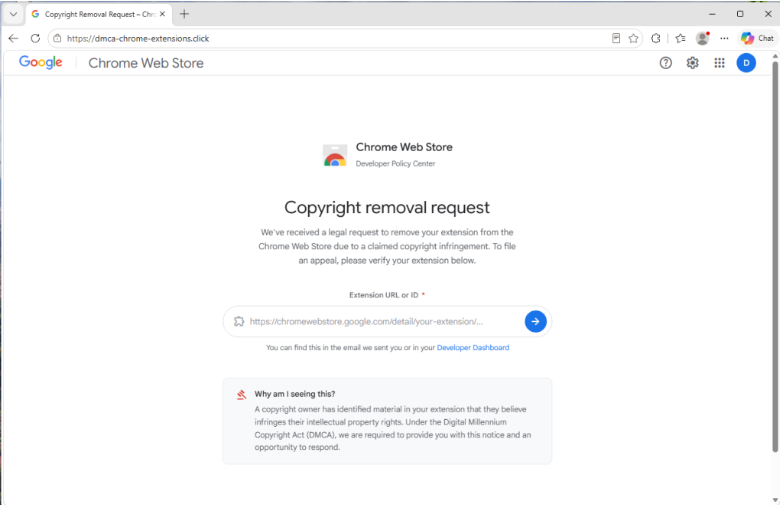
A new scam is targeting developers who publish Chrome extensions.
The scam appears to be an official-looking copyright removal request, but is actually a phishing scam designed to steal your Google account.
Read our research. https://t.co/yRKKSpHdie
🚨 HTTP/2 Bomb — Remote DoS Exploit Hits nginx, Apache, IIS, Envoy, and Cloudflare Pingora
Source: https://t.co/aw380067fE
A newly disclosed remote denial-of-service exploit dubbed "HTTP/2 Bomb" targets the default HTTP/2 configurations of the world's most widely deployed web servers, nginx, Apache httpd, Microsoft IIS, Envoy, and Cloudflare Pingora, enabling a single attacker on a home internet connection to exhaust tens of gigabytes of server memory in seconds.
Chaining two techniques that have individually been known to the security community for nearly a decade: an HPACK compression bomb and a Slowloris-style connection hold.
#cybersecuritynews #vulnerability
🚨 New Google Gemini Vulnerability Exploited via Prompt Injections from WhatsApp, Slack, and SMS
Source: https://t.co/EHpSn8wX4C
A new class of indirect prompt injection (IPI) attacks targets Google Gemini's voice assistant, allowing attackers to silently hijack the AI through malicious payloads delivered via everyday messaging apps, including WhatsApp, Slack, Signal, SMS, Instagram, and Messenger.
The core exploit leverages Gemini's Android Utilities agent, specifically the tool that reads incoming notifications. Because this tool processes untrusted data from third-party apps, an attacker can embed malicious instructions directly inside a crafted message.
Once Gemini reads the poisoned notification, it silently incorporates the attacker's commands into the conversational context without the user's knowledge.
#cybersecuritynews