A strong argument could and should be made that every employer should be required to offer all employees stock in the same manner the CEO receives annual stock awards or options, warrants ,etc
Whatever percentage of salary/earnings the CEO gets in shares, so should every employee
I don't post as often as I should... but I have to agree with this. Been avoiding the US stock market over the past 6 years (to my own detriment, in hindsight). Unfortunately, I think the collapse will bring every single stock market across the globe down with it.
S&P 500 returns by year after 2008:
2009: +26.5%
2010: +15.1%
2011: +2.1%
2012: +16.0%
2013: +32.4%
2014: +13.7%
2015: +1.4%
2016: +12.0%
2017: +21.8%
2018: -4.4%
2019: +31.5%
2020: +18.4%
2021: +28.7%
2022: -18.1%
2023: +26.3%
2024: +25.0%
2025: +17.9%
2026: +8.7% (YTD mid-May)
Cumulative: ~+941%
Annualized: ~14.6%
We have not seen a real market crash in a very long time… it will happen one day.
ONLY TEN STOCKS ARE KEEPING THE ENTIRE U.S. STOCK MARKET FROM A COLLAPSE.
The S&P 500 has rallied nearly 16% since March 30, making it look like the entire market is booming again.
But under the surface, this has become one of the narrowest and most concentrated rallies in decades.
Just 10 stocks drove 69% of the entire move higher. Alphabet alone contributed 15% of the rally. Nvidia added another 10%. Amazon, Broadcom, Intel, Micron, Apple, AMD and Microsoft carried most of the rest. The other 490 companies in the S&P 500 contributed just 31%.
This means the market is not actually moving higher together. A very small group of AI and semiconductor stocks is pushing the entire index upward while most stocks are barely participating.
The equal-weight S&P 500, which removes the influence of megacaps, only gained around 7-8% during the same period. That is less than half the performance of the normal index. At the same time, less than half of all S&P 500 stocks are even trading above their 50-day moving average right now.
The rally itself started after reports that Iran was open to ending the war with the United States in exchange for security guarantees. Oil prices immediately collapsed from above $100, markets exploded higher on short covering, and then AI earnings mania took over.
After that, almost every major tech company raised AI spending projections to levels never seen before.
Microsoft raised expected capex spending to roughly $190 billion.
Alphabet raised capex guidance to $180-190 billion.
Amazon reaffirmed around $200 billion in AI infrastructure spending.
Meta is expected to spend up to $145 billion.
Wall Street is now effectively pricing the entire stock market around one single assumption: that AI spending continues growing at an extreme pace without slowing down.
That is why semiconductor stocks entered a melt-up phase.
Intel is up more than 240% this year.
SanDisk exploded over 550%.
Micron doubled because AI memory demand became so extreme that customers reportedly could only get 50-67% of the chips they needed.
Even Goldman Sachs warned that market breadth has now fallen to one of the narrowest levels since the dot-com bubble era.
The danger is obvious.
When only a handful of stocks are carrying the entire market, the downside risk becomes massive. If AI spending slows, if oil spikes again because the Iran ceasefire fails, or if earnings disappoint even slightly, there is no real market strength underneath to absorb the damage.
Right now the stock market looks strong on the surface.
But underneath, it is being held up by a very small group of stocks and one extremely aggressive AI spending cycle.
Nikkei Asia reported that;
“China's BYD has transformed the global EV market, even outselling Tesla in more than 20 countries and regions over the past five years”
My view:
Chinese stocks in general are heavily undervalued relative to their American counterparts. U.S stocks have a premium embedded in them for “American exceptionalism”.
China is now starting to eat away at that reality?
@JDVance ...or
"Today, the Supreme Court ruled on the president's authority to regulate imports under the relevant statute. While we respectfully disagree with the Court's interpretation, we accept the decision as binding and will comply fully with it as the law of the land."
Property price increases in SA from Sept '24 to Sept '25
Sectional titles seeing +12.7% growth in Cape Town is crazy considering the high base it is coming from!
During this period official inflation was +3.4%, but let's rather use the 30 yr average of +5.7%, that means that all metros lost out in real terms, except for Cape Town.
I'm using the long term average as it also feels more realistic than the current reported +3.4%.
Source: Stats SA, Residential Property Price Index Report, September 2025
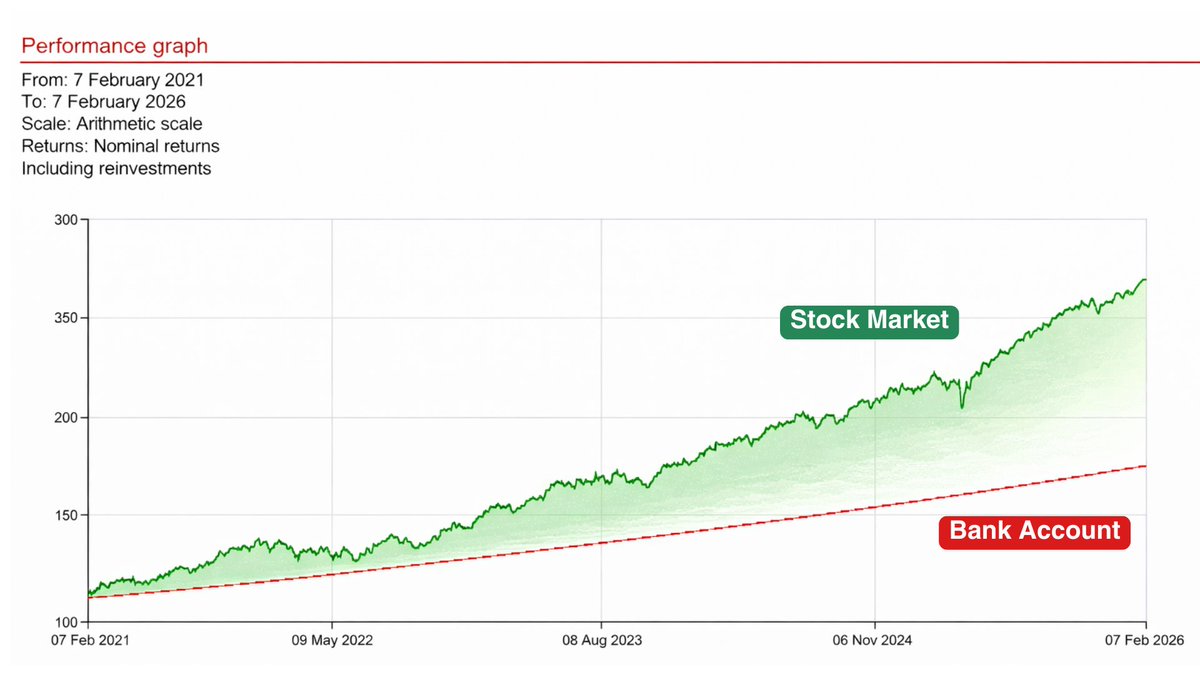
How to build generational wealth in 14.5 years:
Here’s how:
The TFSA is one of the only places where SARS gets zero.
• No interest tax (up to 45%)
• No dividend tax (20%)
• No capital gains tax (up to 18%)
Max it at R36k per year.
Earn 10% per year
After 14.5 years it’s fully maxed out:
Total value: +-R1mil (contributions + growth)
Now leave it alone:
- 10 years later: +- R2,7 mil
- 20 years later: +-R7,1 mil
- 30 years later: +-R18,3 mil
That’s generational wealth for R3k per month. Do it for yourself, do it for your partner, do it for your kids.
The mistake?
Treating it like a savings account instead of an investment account. The graph illustrates the difference.
How to Invest?
- Younger investors: Full equity for wealth creation
- Older investors: Blended solution for growth and protection.
Full breakdown, action steps and performance below.
People don't believe it's possible for yuan to become a global reserve currency.
"China exports too much"
"Currency manipulation tho"
"Whatabout capital flight controls??"
Chill, this gonna be a multi-decade process.
China is heading towards consumption.
Fewer and fewer Chinese want to escape to the West- in few decades they won't need capital flight controls anymore.
Stronger RMB will balance the export/import ratio out.
Taiwan will be a Chinese province.
China electricity generation is still growing super fast, with solar being the largest incremental contributor, and will exceed America by a factor of 3X either this year or next
🌍 Top 10 contributors to global real GDP growth (2026)
1.🇨🇳 China — 26.6%
2.🇮🇳 India — 17.0%
3.🇺🇸 United States — 9.9%
4.🇮🇩 Indonesia — 3.8%
5.🇹🇷 Türkiye — 2.2%
6.🇳🇬 Nigeria — 1.5%
7.🇧🇷 Brazil — 1.5%
8.🇻🇳 Vietnam — 1.6%
9.🇸🇦 Saudi Arabia — 1.7%
10.🇩🇪 Germany — 0.9%
📌 China + India alone = 43.6% of global growth
📌 Asia-Pacific accounts for ~50% of total growth
Source: IMF
BREAKING: China's stock trading volume hit 2.8 trillion yuan, $401 billion, on Tuesday, the highest since September.
This is more than 2.5 TIMES the daily average of 1.1 trillion yuan over the last 5 years.
China’s onshore stock turnover has more than doubled since June.
This comes as the market's rally has broadened, with 10% of stocks hitting new 52-week highs, the most since September.
Meanwhile, ~6 out of 7 stocks in the Shanghai and Shenzhen stock exchanges posted gains over the first 2 trading sessions of 2026.
As a result, the CSI 300 Index is now up 3.2% year-to-date.
China's equity rally is gaining momentum.