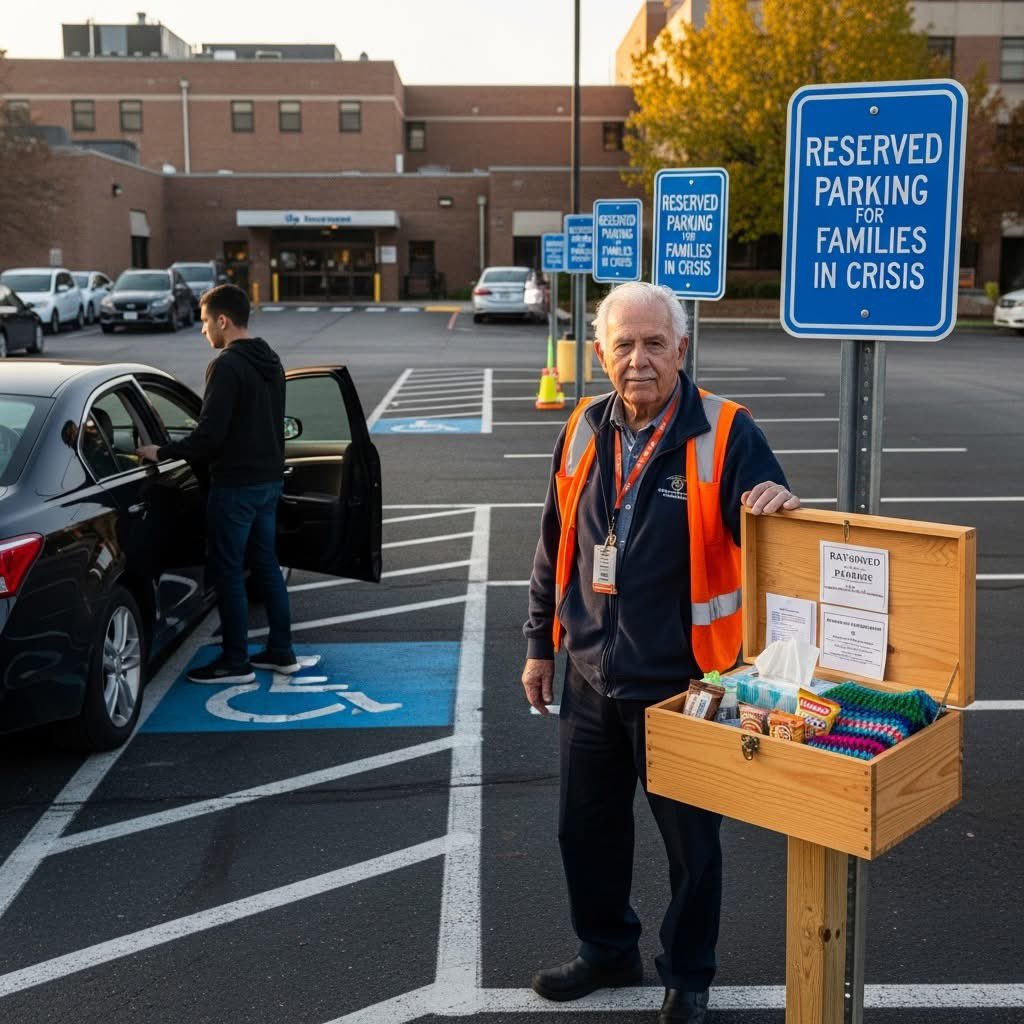
"My name's Raymond. I'm 73. I work the parking lot at St. Joseph's Hospital. Minimum wage, orange vest, a whistle I barely use. Most people don't even look at me. I'm just the old man waving cars into spaces.
But I see everything.
Like the black sedan that circled the lot every morning at 6 a.m. for three weeks. Young man driving, grandmother in the passenger seat. Chemotherapy, I figured. He'd drop her at the entrance, then spend 20 minutes hunting for parking, missing her appointments.
One morning, I stopped him. "What time tomorrow?"
"6:15," he said, confused.
"Space A-7 will be empty. I'll save it."
He blinked. "You... you can do that?"
"I can now," I said.
Next morning, I stood in A-7, holding my ground as cars circled angrily. When his sedan pulled up, I moved. He rolled down his window, speechless. "Why?"
"Because she needs you in there with her," I said. "Not out here stressing."
He cried. Right there in the parking lot.
Word spread quietly. A father with a sick baby asked if I could help. A woman visiting her dying husband. I started arriving at 5 a.m., notebook in hand, tracking who needed what. Saved spots became sacred. People stopped honking. They waited. Because they knew someone else was fighting something bigger than traffic.
But here's what changed everything, A businessman in a Mercedes screamed at me one morning. "I'm not sick! I need that spot for a meeting!"
"Then walk," I said calmly. "That space is for someone whose hands are shaking too hard to grip a steering wheel."
He sped off, furious. But a woman behind him got out of her car and hugged me. "My son has leukemia," she sobbed. "Thank you for seeing us."
The hospital tried to stop me. "Liability issues," they said. But then families started writing letters. Dozens. "Raymond made the worst days bearable." "He gave us one less thing to break over."
Last month, they made it official. "Reserved Parking for Families in Crisis." Ten spots, marked with blue signs. And they asked me to manage it.
But the best part? A man I'd helped two years ago, his mother survived, came back. He's a carpenter. Built a small wooden box, mounted it by the reserved spaces. Inside? Prayer cards, tissues, breath mints, and a note,
"Take what you need. You're not alone. -Raymond & Friends"
People leave things now. Granola bars. Phone chargers. Yesterday, someone left a hand-knitted blanket.
I'm 73. I direct traffic in a hospital parking lot. But I've learned this: Healing doesn't just happen in operating rooms. Sometimes it starts in a parking space. When someone says, "I see your crisis. Let me carry this one small piece."
So pay attention. At the grocery checkout, the coffee line, wherever you are. Someone's drowning in the little things while fighting the big ones.
Hold a door. Save a spot. Carry the weight no one else sees.
It's not glamorous. But it's everything."
Let this story reach more hearts....
Credit: Mary Nelson
On 1Q $SGMO call, CFO comment caught my ear (min 11:01) - "more importantly, this bridge-financing provides the time we believe needed to secure the RIGHT Fabry partnership. One that would fund our neurology mission in the near-term & create shareholder value longer-term.”
This feels like: 1) current term sheets have no/small upfront, 2) no deal is close, 3) signaling of “table stakes”.
@UnionSteel2017@ZinselmeyerB When exercising the warrants, no one will be allowed to own more than 5% of the shares outstanding post-exercise. (stops control influence)
@zeusPharma@ZinselmeyerB@deputydewey3@50C@75c No way bookrunner would not spread it around, nor would autocratic mgmt allow allocations with potential for such influence.
Interestingly, the Mar '24 $24m raise went 87% equity/13% pre-funded wts. This $23m raise is structured 27% equity/73% pre-funded wts. Why? Reporting?
@auditor112017@bill_us I don’t think so. This looks to be an underwritten deal vs a registered direct last year. Likely more expensive. In this pr, they do not call out “institutional investors”, like the last. $sgmo
@mchilberg Hi Marty! IMO, very disappointing $SGMO call. More of the same. In retrospect, do you think Amy Pooler's resignation late last year was then a tell of the December troubles ahead? It was barely addressed, but she seemed a critical inner-circle piece at the time.