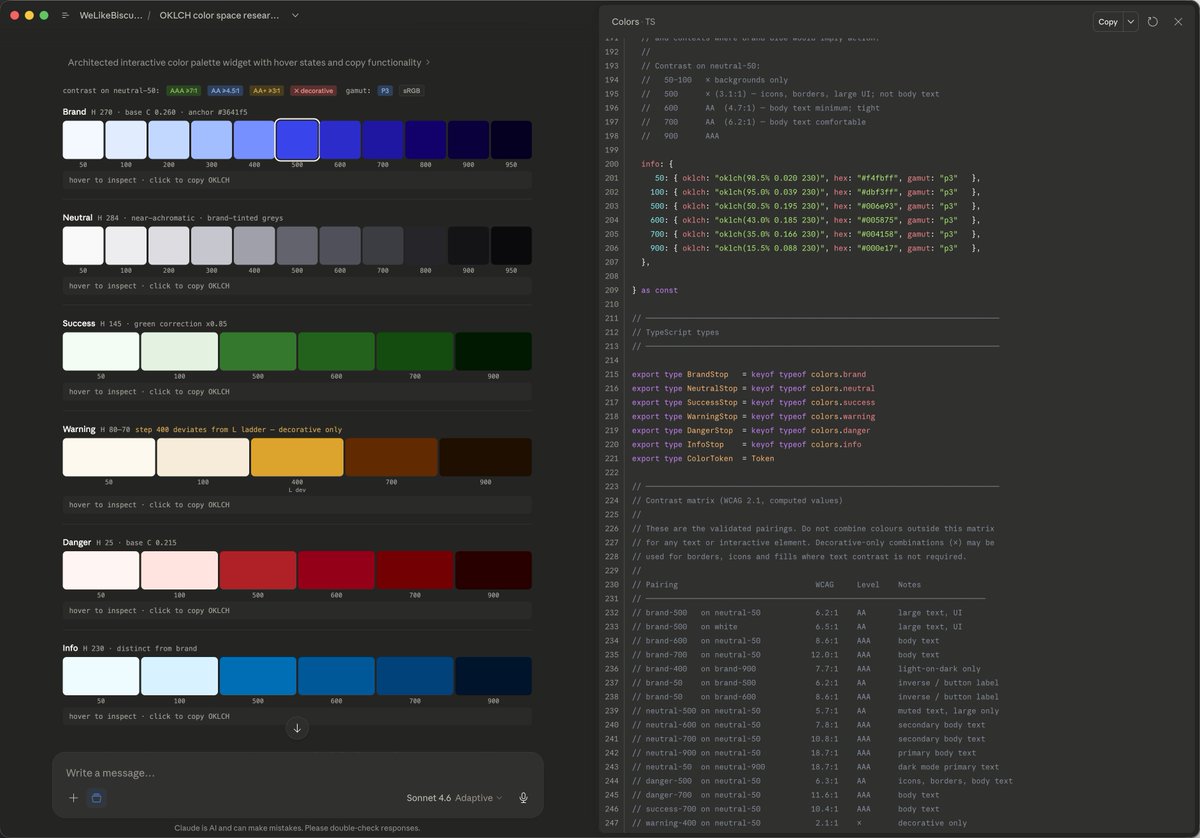
🧵[1/6] Been playing with @figma remote MCP server and @AnthropicAI Claude Code and there is real potential here (imho). A lot of my personal AI use has been more focused around strategy and user experience tasks. #futureofdesign
What happened to @Apple MacOS that requires you to login with password every time you update your Mac!? I'm pretty sure this wasn't the case before Tahoe.
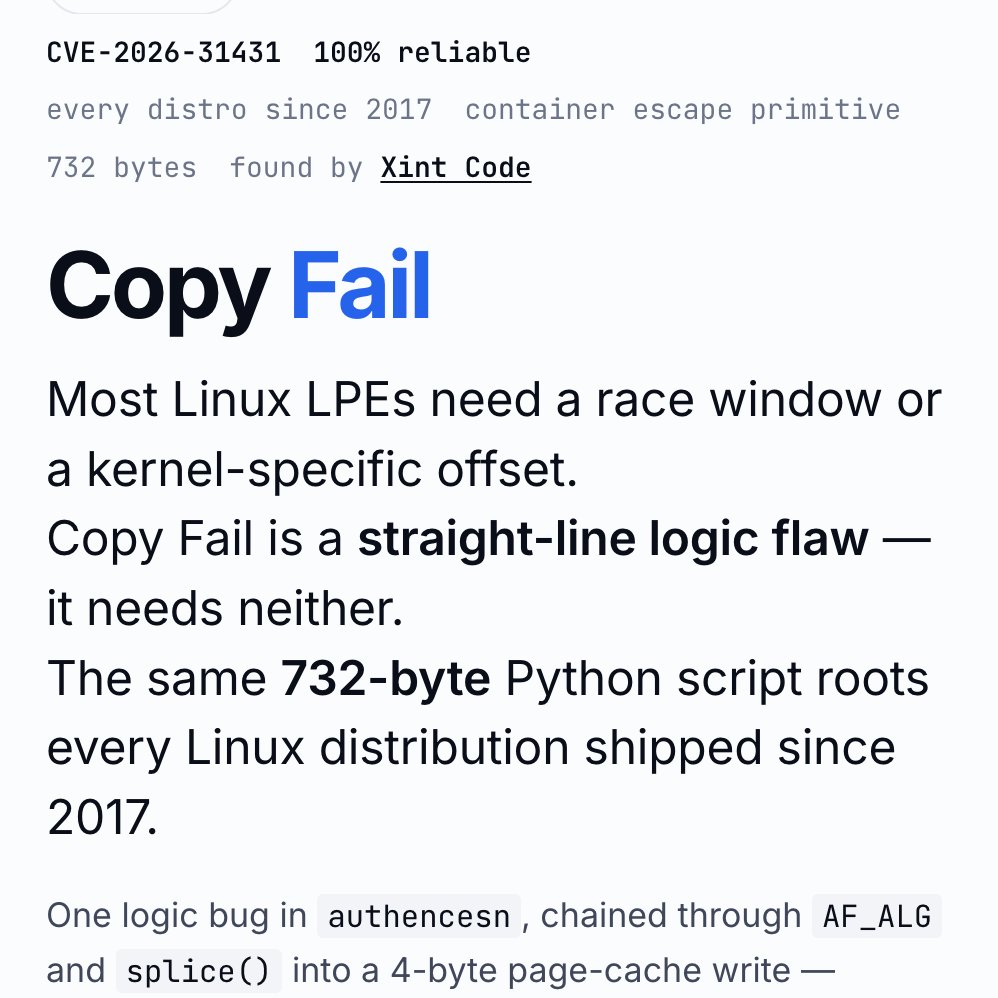
‼️🚨 BREAKING: An AI found a Linux kernel zero-day that roots every distribution since 2017. The exploit fits in 732 bytes of Python. Patch your kernel ASAP.
The vulnerability is CVE-2026-31431, nicknamed "Copy Fail," disclosed today by Theori. It has been sitting quietly in the Linux kernel for nine years.
Most Linux privilege-escalation bugs are picky. They need a precise timing window (a "race"), or specific kernel addresses leaked from somewhere, or careful tuning per distribution. Copy Fail needs none of that. It is a straight-line logic mistake that works on the first try, every time, on every mainstream Linux box.
The attacker just needs a normal user account on the machine. From there, the script asks the kernel to do some encryption work, abuses how that work is wired up, and ends up writing 4 bytes into a memory area called the "page cache" (Linux's high-speed copy of files in RAM). Those 4 bytes can be aimed at any program the system trusts, like /usr/bin/su, the shortcut to becoming root.
Result: the next time anyone runs that program, it lets the attacker in as root.
What should worry most: the corruption never touches the file on disk. It only exists in Linux's in-memory copy of that file. If you imaged the hard drive afterwards, the on-disk file would match the official package hash exactly. Reboot the machine, or just put it under memory pressure (any normal system load that needs the RAM), and the cached copy reloads fresh from disk.
Containers do not help either. The page cache is shared across the whole host, so a process inside a container can use this bug to compromise the underlying server and reach into other tenants.
The original sin was a 2017 "in-place optimization" in a kernel crypto module called algif_aead. It was meant to make encryption slightly faster. The change broke a critical safety assumption, and nobody noticed for nine years. That bug then rode every kernel update from 2017 to today.
This vulnerability affects the following:
🔴 Shared servers (dev boxes, jump hosts, build servers): any user becomes root
🔴 Kubernetes and container clusters: one compromised pod escapes to the host
🔴 CI runners (GitHub Actions, GitLab, Jenkins): a malicious pull request becomes root on the runner
🔴 Cloud platforms running user code (notebooks, agent sandboxes, serverless functions): a tenant becomes host root
Timeline:
🔴 March 23, 2026: reported to the Linux kernel security team
🔴 April 1: patch committed to mainline (commit a664bf3d603d)
🔴 April 22: CVE assigned
🔴 April 29: public disclosure
Mitigation: update your kernel to a build that includes mainline commit a664bf3d603d. If you cannot patch immediately, turn off the vulnerable module:
echo "install algif_aead /bin/false" > /etc/modprobe.d/disable-algif.conf
rmmod algif_aead 2>/dev/null || true
For environments that run untrusted code (containers, sandboxes, CI runners), block access to the kernel's AF_ALG crypto interface entirely, even after patching. Almost nothing legitimate needs it, and blocking it shuts the door on this whole class of bug...
@yocline Not sure you need to say this is 🌶️ feels more like grounded reality. And I think canvas-based tools probably can see the opportunity is there to continue being a critical part of the landscape.
Lots of click-bait design is dead, @figma is dead, AI is the evil design overlord. Blah blah…
Focus on the human elements. Empathy, taste, strategy. AI is a tool, LLM models don’t replace things tangible to humans.
AI has its biggest impact on the ‘doing layers’ so if all you focus on is output, then I feel you’ll experience disruption.
This is a really exciting time in the industry of which I don’t feel I’ve felt since like the early 2000’s.
It’s not the end of product design imho, it’s an evolution based on technology progression, something that’s not been uncommon since the early days of the web. The strategic aspect is the key component here that’s integral to the understanding of a problem and shaping the outcome to solve said problem.
Sure, while we’ll see a shift to consider agents as a type of user that needs to interact with the product or experience, the primary users are still human, the companies and stakeholders are still human, the social-economic elements that contribute to the product are still human systems. Humans still need to form part of that process. We’re still solving human problems here people!
LLM modals simulate empathetic components of the design process. LLM tools imho can’t be solely relied on to translate these aspects of design without guidance and user testing. The tools empower this process, they don’t replace it. LLM tools just empower and accelerate research, synthesis and the doing layers.
What becomes more important to a designer in the age of LLM tools isn’t the doing layer but the thinking layer. Help customers solve their problems, and leverage LLM tools to accelerate and deepen that. Otherwise you’re just potentially solving the wrong problem faster.
I think the time has finally come @Adobe. Increasing the price of my subscription while offering a diminishing presence in my design stack.
I’ve been putting this off for so long, but I just don’t feel paying more for what is already an expensive offering, when the value is eroded by other tools.
It’s an age old problem, and tbh, I feel it’s harder now in many ways. On some level you’re alway looking for someone that reflects your own approach. In my experience, when I was running the design team at CornerStone, it requires a window of opportunity to build trust for both parties. You scale their involvement, as an external, based on that trust building. Gives them the ability to prove their skill and approach, while managing the risk on your side. Down side is that needs a lot of patients as you develop a pipe.









![mrbiscuit's tweet photo. 🧵[1/6] Been playing with @figma remote MCP server and @AnthropicAI Claude Code and there is real potential here (imho). A lot of my personal AI use has been more focused around strategy and user experience tasks. #futureofdesign https://t.co/gEahEmVsRh](https://pbs.twimg.com/media/HBibYrxWMAA5nWq.jpg)