@TemiPopoola_@ngxgrp
Dear Temi and the NGX Team,
Warm greetings from the GreenTickertales community.
We are investor advocates and passionate promoters of the Nigerian capital market. Through our X Spaces under the GreenTickertales banner, we help Nigerians at home and abroad navigate the investment landscape with clarity, confidence, and credible information.
Recently, we have received a steady stream of questions about NGX Group. In our view, no one can present the Exchange’s vision, progress, and opportunities more authoritatively than NGX itself. With this in mind, we would be honoured if you would join us as guests on an X Space to share NGX’s story directly with the investing public.
NGX has been in the news for all the right reasons: from being among the best-performing stock exchanges globally to earning attention from major index providers such as J.P. Morgan, MSCI, S&P, and FTSE Russell. Yet many potential investors—especially those in the diaspora—still find market access frustrating and confusing.
Our community would greatly value hearing from the Exchange on key issues, including:
• NGX’s strategic plans for investors over the next 5–10 years
• Concrete steps to improve market liquidity
• Measures to strengthen investor protection and confidence
• Initiatives to broaden participation in the Nigerian equity market
• Approaches to addressing unclaimed dividends and market infractions
We believe a direct conversation with NGX will go a long way in resolving misunderstandings, building trust, and aligning expectations between the investing public and the Exchange.
Our Spaces are typically held on Sundays to maximise attendance. If this opportunity resonates with you, please let us know your availability and preferred format, and we will coordinate the details promptly. Should you agree, we will collate questions from our various platforms and share them with you in advance to ensure a focused and productive discussion.
GreenTickertales hosts one of the largest and most engaged investment communities in Nigeria. It is an erudite, respectful, and solution-oriented audience, and we are confident that this engagement will help answer many of the pressing, unanswered questions in the market today.
We look forward to your favourable response and to the possibility of hosting NGX on our Space soon.
Warm regards,
The GreenTickertales Team
https://t.co/OvVivO7sMU
We spent months tracking 5,467 bets from Nigeria's biggest sports betting influencers.
The bets were worth ~$4.8 million.
We wanted to answer a simple question:
If you followed their bets exactly, would you make money?
The answer is no.🧵👇
With: @thimmie_onas@temiladeoluwaaa
To be clear, it’s easy to tell someone to go and buy stocks like GTB, Zenith, Nahco, Aradel, Seplat, UACN, and similar names—but that’s no different from telling someone to buy Bitcoin to get rich. Our approach is different. We focus on identifying turnaround opportunities before they become obvious to the wider market. While these companies may not appear strong on the surface or in their balance sheets, there are underlying restructuring efforts that could unlock value over time.
If you already have the capital to invest in fundamentally solid, well-established stocks, then these recommendations may not be suitable for you. As always, please do your own due diligence. Constructive disagreement is welcome, but it should be respectful. This is not a competition to prove who is right or wrong, or who ends up the biggest winner or loser.
I INDEPENDENTLY SEARCHED NIGERIA'S BUDGET DOCUMENTS FROM 2019 TO THE PRESENT. HERE IS WHAT I FOUND ABOUT THE PFIPC SCANDAL THAT NOBODY IS TALKING ABOUT.
THE NAME DID NOT COME FROM NOWHERE
Everyone is focused on Adeyemi the man. Nobody has gone back to ask where the name "Presidential Economic Advisory Council" actually came from. I did. And the answer changes this entire story.
The Presidential Economic Advisory Council is not a Tinubu creation. Tinubu's economic body is called the Presidential Economic Coordination Council. He established it in March 2024, inaugurated it in July 2024, and chairs it himself alongside Dangote, Elumelu, the Senate President and the Governors Forum Chairman. It has a different name, a different structure and a different budget code.
The Presidential Economic Advisory Council is a creation of Buhari. Buhari established it in September 2019 to replace the Economic Management Team that Osinbajo was heading. It had real named members. Prof. Doyin Salami as chairman. Charles Soludo. Bismark Rewane. Eight economists reporting directly to the President with a defined mandate and a legal institutional identity.
When Tinubu came in and created the PECC in 2024, the Buhari-era PEAC was never formally dissolved. No gazette removing it. No Budget Office circular revoking its institutional identity. It simply went dormant. But dormant in Nigeria's government system is not the same as deleted.
That dormant status is exactly what was exploited.
NGX vs Ecobank: A ₦627 Billion Market Cap Discrepancy Investors Cannot Ignore
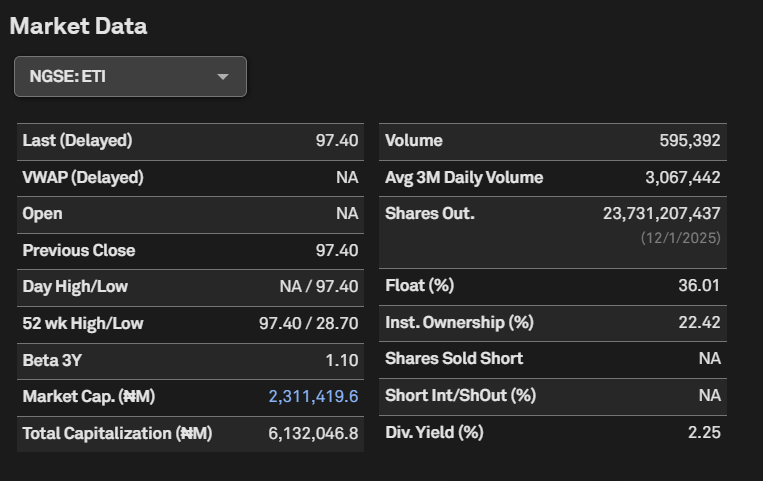
So, I was discussing with the TG members during our usual Sunday session, something we have consistently hosted every Sunday since 2021, free of charge. One of the topics we discussed was why continuous dilution should never be ignored when building long-term positions in companies. As we started breaking down the banking sector, we got to @GroupEcobank. We noticed major discrepancies in the reporting of its outstanding shares compared to what @ngxgrp currently displays on its platform, which, ideally, should be the go-to and most reliable source for investors.
So, I decided to do a deeper dive.
The first screenshot is from the @ngxgrp platform, which currently shows Ecobank’s total outstanding shares at 18,155,073,977. Multiplying that by Friday’s closing price of ₦97.4/share gives a market capitalization of ₦1,768,304,205,359.80.
The second screenshot is from S&P Capital IQ, which reports Ecobank’s outstanding shares at 23,731,207,437 shares. Interestingly, the last update there was dated 1 December 2025. Using the same closing price of ₦97.4/share gives a market capitalization of ₦2,311,419,604,363.80.
The final screenshot is extracted directly from Ecobank’s Q1 2026 financial statement under Note 14, page 29. The company itself reported outstanding shares of 24,592,619,000 shares. Multiplying this by ₦97.4/share gives a market capitalization of ₦2,395,321,090,600. What shocked me even more was that the same outstanding shares figure was also reported in Q1 2025.
Now, today is a weekend, so I do not currently have access to the Bloomberg Terminal to cross-check further, but working with these three data points raises serious questions.
So, who exactly should investors believe here?
Personally, I would naturally rely on the company’s own financial statements because they are the primary source, and I should know their actual outstanding shares.
NGXGROUP Market Cap for ETI = ₦1,768,304,205,359.80
Ecobank Q1 2026 Financial Statement Market Cap = ₦2,395,321,090,600
Difference = ₦627,016,885,240.20
That difference is highly material and honestly quite alarming.
Even if we compare S&P Capital IQ with Ecobank’s reported figures, we still get a discrepancy of about ₦83.9 billion, which remains very material. Meaning even S&P Capital IQ appears to be underreporting Ecobank’s market capitalization.
Now, this becomes a serious issue if @ngxgrp is not accurately reporting something as fundamental as outstanding shares. Market capitalization is one of the most basic valuation metrics investors rely on daily. If discrepancies of this magnitude exist, then it raises broader questions around data integrity and market transparency.
What does this mean for the future of our market if basic company information is either underreported or overstated? This is 2026; these are issues we should have moved past long ago. It honestly breaks my heart because these were part of the same structural issues that contributed to market inefficiencies during the 2007/2008 era.
And Ecobank is not even the only example. Even @ngxgrp previously had issues with the reporting of its own outstanding shares at some point (although I do not know if that has now been rectified).
This is why I always encourage investors to scrutinize everything. It is not just about making money. It is also about ensuring our market institutions uphold accuracy, transparency, and investor confidence.
I drop my pen here.
The research behind this is wild. A baby is born and doesn't breathe. The window to fix it is 60 seconds. Doctors call this window the Golden Minute. And the first rule on the protocol is don't rush, because rushing actively breaks the technique.
Roughly 1 in every 10 babies needs help breathing right after they're born. The American Heart Association and American Academy of Pediatrics worked out the exact sequence years ago, and it's the playbook used in hospitals around the world.
Step one is the simple part: dry the baby, keep them warm, tilt the head a little to open the airway, rub the back, flick the soles of the feet. About 10% of newborns just need that small nudge to start breathing on their own.
If 60 seconds go by and the baby still isn't breathing, or the heart is going slower than 100 beats a minute, you grab a bag and mask. The bag is a rubber bulb. You squeeze it, and air pushes through the mask into the baby's lungs. You can see this in the second clip. Around 5% of all newborns need it. If it's working, the baby's heart speeds up. About 30 seconds later, you check again. If the heart is still under 60 beats a minute, you start chest compressions. Only about 1 to 3 babies out of every 1,000 ever reach that stage.
The bag and mask has one weak point. It only works if the mask seals tight against the baby's face, with no gaps at the rim. If air escapes around the edges, none of it reaches the lungs. The whole effort is just for show. A 2014 study at Leiden University in the Netherlands had medical staff try the technique on a training dummy. Inexperienced people leaked 51% of the air on their first attempt. After two minutes of focused practice, that number dropped to 11%. The seal is the whole thing, and shaky hands wreck it.
The calm in that video is what lets the hands stay steady. A steady hand keeps the seal tight, while a shaky one breaks it. Cochrane is the body that writes the most authoritative medical reviews in this field. Their review on this calls getting the air in cleanly the single most important step in saving a non-breathing baby. A panicking person with a bad seal might as well not be in the room.
Training does the rest. The NIH cites a study from Zambia where they trained midwives and nurses in this exact protocol. Out of every 1,000 babies born, the number who died in their first week dropped from 11.5 to 6.8. About a 41% drop, just from people learning to follow the steps in the right order without freaking out.
Around 900,000 babies a year die from not starting to breathe at birth, per the WHO. Most of those deaths come down to two things: no trained person on hand, or someone trained who rushed. The slow walk in the video is the technique. Slow hands and a steady mask save more babies than any other thing on the checklist.
There’s no version of reality I don’t come out on top,
I will draw success from the fabrics of existence, I will commandeer the host of heaven to fight on my behalf.
I WILL WIN, it’s inevitable
IMPOSSIBLE IS NOTHING.