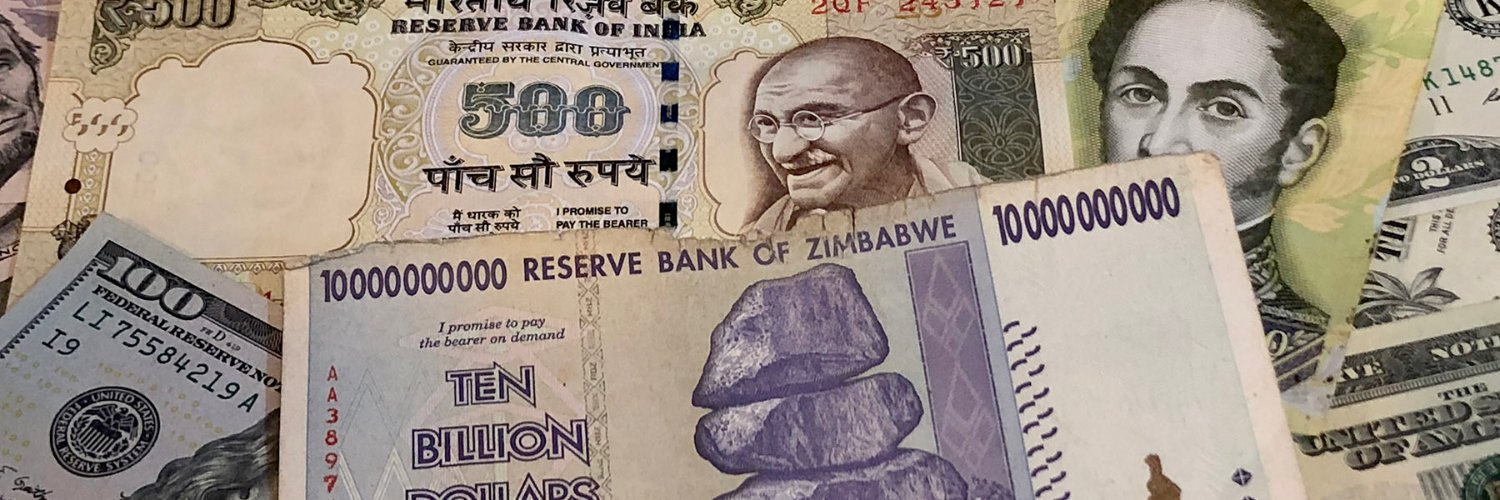
Inflation is the source of most problems society faces today. Real costs decline, prices rise, but wages don't. This illusory phenomenon has disrupted all exchange, entrepreneurship, workers, savers, and borrowers; it's corrupted our lives and culture. 1/
Billionaires didn't make you worse off by getting rich because the wealth pie isn't zero sum, it's POSITIVE sum. Let's use an example.
Assume tax filings cost $300 so Jane starts a tax app that processes taxes for $50 and it's funded with equity:
1. Jane starts with an idea and 100% of a company worth nothing.
2. Investors pay $1M for 20% of it. They swap $1M of cash for $1M of shares, so their wealth doesn't change. But the deal implies the company is worth $5M, which makes Jane's 80% worth $4M. That $4M is new wealth that didn't exist the day before. She didn't take your wealth or mine. It's new, from thin air.
3. She spends the $1M on engineers and servers. That money becomes their income. It isn't gone. It moved to the people building the product.
4. The app works and the company is valued at $2B as revenue grows and consumers save money on tax filings. The investors' 20% is now worth $400M and Jane's 80% is worth $1.6B.
The result: The investors turned $1M into $400M, the employees got paid, customers save $250 each, and Jane is a billionaire. Everyone involved is better off and nobody lost anything (except Jane's competitors, other millionaires/billionaires). The $2B wasn't taken from anyone. It was created when the business started producing something people value and the market priced those future profits.
it's time for you to wake up and smell the roses
there is no reality in which things continue smooth from here. no, bitcoin obviously isn't/wasn't going to stay put in some $70k - 80k range.
this is one of the most volatile eras ever. not just for bitcoin, but for the world. geopolitically, technologically, socially, we're going through rapid and dramatic change, and things aren't about to get simpler.
no, cybersecurity isn't going to all get fixed because you can now use ai to generate machine-checked security proofs in lean. even if you figure out how to write secure code and democratize the skill, there will still be vulnerabilities. if not bugs in the implementation, bugs in the specification. bugs in the assumptions, bugs in the verification.
cybersecurity will continue to be a verifiable domain, that's not changing, which means machines can self-play in it, meaning they can improve in it like in chess, except its actually worse than in chess because here the rules also keep changing, because technology keeps changing, so the gamefield keeps changing, meaning bugs will continue to be problematic, and especially problematic in irreversible systems (where one mistake means you get fully wiped out forever).
it's a hard system to keep stable! lean isn't coming to save you.
you'll continue to hear stories about how cybersecurity is about to improve and all the world's bugs will be fixed, because that is a popular narrative that tends to do well on twitter. no one wants to hear the defeatist point of view. but that means that some of you, who aren't able to figure this stuff out on your own, won't hear the truth very often.
smart people know this, not everyone agrees about it of course, but the negative point of view isn't going to get promoted on x/twitter.
the algorithms that are improving your life are about to learn how to improve themselves. the algorithms that are fucking with your life are about to learn how to improve themselves.
the situation now in which technology is about to enter a supersonic self-improving loop (a much more aggressive form than the baseline self-improving loop that we've been riding on since the dawn of time) is extremely bubble prone.
the prospect of investing in something *self-improving*? people will leverage themselves to the tits.
they will also be scared, flip-flop between being endlessly optimistic to extremely skittish and want security/safety. markets will be volatile. geopolitics will be volatile. everyone has the ability to react faster now, and there will be much more to react to.
no, crypto and bitcoin isn't going to stay non-volatile to that backdrop. the risk asset of risk assets, not even gold stays untroubled during turbulent times. it's going to be volatile. we spent a decade maturing as an industry. yes, we think we are owed some overdue maturity. we've aged through our teenage years and we're supposed to get rid of the acne. sorry, we're aging backwards now, you're going to get more acne and more bedtime erections, not less. the world isn't fair.
what you need to understand and accept is that bitcoin & crypto isn't this solid thing here. it's more of a moonshot thing again. it's a very digital thing in a world where everything digital is getting a shakedown.
you're almost 40 years old and your digital profession can be done by free open source software made in china run with a handcrank. your wife isn't going to let you gamble with your entire financial future in magical coins when you can't even tell her what your career prospects look like anymore. your beard is patchy.
bitcoin & crypto can still do well in this environment, because when technology, markets and geopolitics become ultra-volatile in unison, you're bound to also get weird market dislocations. you have arms races, you have bubbles popping, you might get lots of money printing. most things that can happen will happen.
but you aren't, as an industry, going to be a universal safe haven against this. no one really feels safe with their crypto assets these days. you got a hardware wallet? cool. that doesn't exactly feel like the safest of all places anymore.
you got your funds on an exchange? cool. doesn't feel great either, does it?
oh, but you're not impacted because you choose to hold your exposure through etps/etfs? well, if that's what you have to resolve to, that's not great either.
if you can't be secure with your crypto, if you can't feel safe with it, even though you're a freaking nerd in this industry, how does that bode for the industry at large?
much of the fuel that has driven e.g. defi to where it is today is because the risk was seen as tolerable. during 2020-2022 i knew a lot of people who felt okay with locking in hundreds of thousands of dollars in stablecoins in yield protocols. i don't know people who enjoy doing that today. people are tired of being bug bounties for north korea. they honestly prefer reversible systems for their life earnings.
this doesn't mean it is over for bitcoin & crypto, but it means you're going to have to accept that you may have to think about it differently. it is a diversified bet in your overall portfolio. it is a part of your portfolio. it can't be your entire portfolio.
if this sounds so bearish it sounds like the bottom signal to fully re-enter the market, sure. i'd love to become the pico-bottom perma-joke of our industry. i'm not saying for you to grow out of crypto, i'm saying for you to think of this as the volatile bet it is, the bet that macroeconomic/geopolitic turbulence/dislocations & fiat printing will outrank the fact that we're back in our teenage years again.
embrace that it will be volatile.
what's happening in the markets now is normal.
Corporation: “We made $6 Billion, but after expenses we only made $150 Million.”
Government: “Okay, tax the $150 Million.”
You: “i made $82k, but after rent, groceries, insurance, gas and everything else, I’ve got like $3 left.”
Government: “Cool. Taxing the $82k.”
You: did you hear the part about the $3?”
Government: “April 15th.”
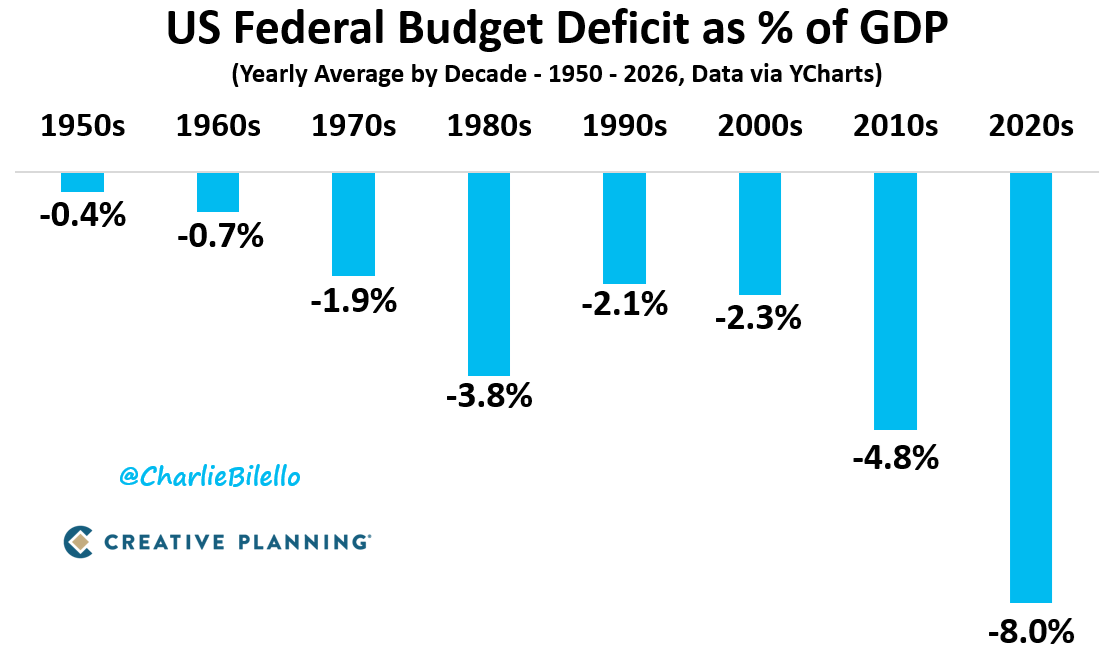
US Federal Budget Deficit as a % of GDP...
1950s: -0.4%
1960s: -0.7%
1970s: -1.9%
1980s: -3.8%
1990s: -2.1%
2000s: -2.3%
2010s: -4.8%
2020s: -8.0%
Borrowing and spending as if there is no tomorrow.
The economy's booming but nobody's hiring.
Because AI is boosting experienced workers -- they can do more, so you don't need to hire.
While AI is replacing entry-level and new college grads.
The Boomer vs Gen Z fight is about to go nuclear.
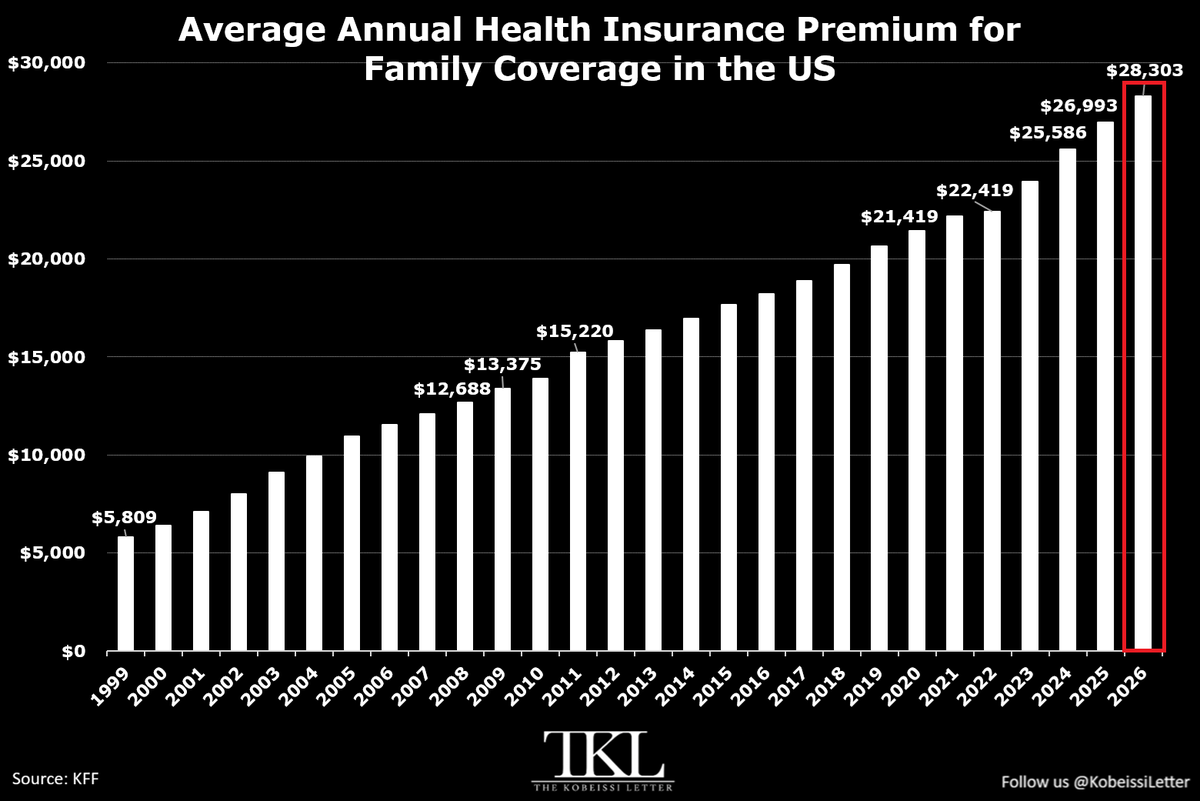
BREAKING: The average cost of a family’s annual health insurance premium in the US is up +$1,303 YoY, or +5%, to a record $28,303.
This marks the 4th consecutive annual increase of at least +$1,300.
Over this period, the average annual premium for family coverage has surged +$5,884, or +26%.
To put this into perspective, CPI inflation has risen +13% over the same period, or half as much.
Since 1999, the average health insurance premium for a family has soared +$22,494, or +387%.
This represents an average annual growth rate of +6.1%, well above CPI inflation at +2.6% over the same period.
Health insurance has never been more expensive.
@TXMCtrades TVs are deflationary despite monetary inflation due to the rapid progress, but most things get cheaper to produce due to innovation (just swallowed by price inflation), why do you claim it's "different" if more things "got cheaper" nominally?
@TXMCtrades You don't think there was much more incentive to HODL in the past when there was 3000x gains on the table?
There's MAYBE 100x left.
And you do think that there would be not "much" less incentive to HODL in the future if it was just potentially a couple % gains/yr?
@TXMCtrades The monetary use comment was layered and is maybe throwing the convo off. My point there was that bitcoin is obviously in a monetization phase, the disincentive-to-spend effects of which diminish if it continues to grow.
Most of our banks in America are anti-American but Bank Of America is the MOST anti-American of all of them.
They debanked me shortly after my channel started growing and they have a long history of helping the enemies of America finance their operations.
In 2018 they publicly stated they wouldn't allow anyone who makes AR15s or AR15 accessories to bank with them.
In 2010 they debanked the NRA-ILA and several of its state organizations after they (the NRA ILA) published reports of Bank Of America debanking local gun shops.
When one of their executives was asked about this behavior in 2024, he stated that Bank of America "updated our policy in 2023 to be clear that we will consider engaging with all manufacturers of firearms, with a risk-based due diligence process."
Oh, they'll consider it? 🤡
One of my favourite Harry Potter loopholes doesn't even involve magic. It involves exploiting the Muggle economy.
Hagrid tells us there are 17 Sickles to a Galleon. Sickles are silver, Galleons are gold. Simple enough.
Except gold and silver don't have a fixed exchange rate in the Muggle world. Their market value fluctuates constantly. Before 1900, the gold-to-silver ratio averaged around 16:1, which is pretty close to the wizarding world's 17:1 rate. Throughout much of the twentieth century, however, it averaged around 45:1.
See where this is going?
Wait until the market heavily favours gold. Melt your Galleons down and sell the gold in the Muggle world. Use the money to buy as much silver as possible, then take that silver to Gringotts and have it converted into Sickles.
Finally, exchange those Sickles for Galleons at the fixed 17:1 rate.
Congratulations. You've potentially turned a small pile of wizarding gold into a much larger pile of wizarding gold, simply by exploiting the difference between Muggle market prices and Gringotts' fixed exchange rate.
No Dark Arts. No Horcruxes. No elaborate schemes.
Just precious metals, a fixed exchange rate and a wizard who understands arbitrage.
The real question is why nobody in the wizarding world seems to have built an entire financial empire around this.
I feel like the whole BoA money laundering thing should be talked about, but what's left to say?
I spent a year in prison for not filling out a form around selling Bitcoin and got in trouble because someone two degrees separate from me allegedly used it to launder funds. The amount in question was around $30k.
BoA launders $5b and has to give one fifth of it back to the government. No jail for anyone.
This is America.