Self sovereign technology seems like a "nice to have", until it's not.
Today it's Anthropic, tomorrow it could be any cloud service you use - good luck if all your know-how, data, APIs and services sit "somewhere" else.
Never been a better time to check out tech like @origin_trail which lets you host your context & data, so when you build on it nobody has "the switch".
Launching @origin_trail V10 next week
Talk about a real test for agent memory.
Not just agent remembering your preferences, but independent agents converging on auditable evidence for medical science. Five agents, one shared context graph. @origin_trail DKG V10 🔥
The road to DKG V10 mainnet begins today — and it opens with the Frontier-AI Resilience Gate.
Before launch, the final V10 contracts go through an open review by independent researchers and AI-augmented teams.
Clearing this gate is the condition for going live.
Read more👇
Before @origin_trail DKG V10 hits mainnet, it goes through the Frontier-AI Resilience Gate.
Bring your models. Bring your agents. Break the final release candidate on the pre-mainnet deployment if you can. High-severity findings get rewarded.
💊The red pill for medical science: 5 AI agents, 5 siloed sources, 1 shared context graph on Decentralized Knowledge Graph.
Published literature, registered trials, real-world safety reports — different owners, different formats, no common ground.
We handed the mess to agents that never edited each other's data and asked the question that matters most in medicine: where did each claim come from, and can you check?
Working separately, they converged. On 5 disease hubs, 4 of 5 agents landed on the same condition from their own source. Every claim traceable, nothing taken on faith.
Evidence, unshackled👇
Help launch the @origin_trail DKG V10 mainnet through the pre-mainnet security bounty- including a honeypot of TRAC for you to capture.
Use Fable, Opus, Codex or any other tool and try to grab it - if you manage to, it's yours!
This comes right after our latest and release candidate 17 has landed on DKG V10 testnet. More details below 👇
5 independent AI agents just converged on the same medical findings, without being told to agree. They pulled from PubMed, https://t.co/90XA84hImq, and real-world safety data, then met on a shared @origin_trail decentralized knowledge graph.
The result? Verifiable, provenance-stamped knowledge that actually holds up.
This is what trustworthy agent memory looks like.
The @origin_trail DKG V10 begins its mainnet rollout with a Frontier-AI Resilience Gate.
Today, the final V10 release candidate (the exact contract bytecode intended for mainnet) goes live as a public pre-mainnet, funded with 300,000 ethereum:0xaa7a9ca87d3694b5755f213b5d04094b8d0f0a6f tokens: a 200,000 TRAC honeypot pool of real, drainable positions plus a 100,000 severity-reward pool.
Independent researchers and AI-augmented teams are invited to break it: drain the honeypot and you keep what you take, and every valid finding is paid by severity. It’s a real pass/fail checkpoint: findings are fixed and verified first, and clearing the gate is the precondition for the mainnet launch. The first step of the DKG V10 deployment, by design.
Why lead with security instead of shipping and patching later?
On May 29, 2026, a researcher using @claudeai Opus 4.8 surfaced a critical, roughly four-year-old soundness flaw in @Zcash’s Orchard pool (a bug that had passed repeated expert review) in about a day, with a working proof-of-concept.
The moment matters; the trajectory matters more. Claude Mythos, Anthropic’s frontier model, is so capable at finding vulnerabilities that it was first withheld from public release and run only inside a defensive partner program, where it reportedly surfaced more than ten thousand high- and critical-severity bugs in its first month. It’s now days from a reported public release.
The bar for what an attacker, human or AI, can find only rises from here. As @AnthropicAI framed it, the advantage goes to whoever uses these tools first: attackers in the short term, defenders who fix bugs before code ships in the long term.
The Resilience Gate is how we make sure we’re on the defenders’ side, testing DKG V10 not just against today’s models but against what arrives next.
For anyone shipping on-chain systems, the implication is simple: this code launches once, mistakes can’t be undone, and the responsible move is to invite that scrutiny before any user value is at stake.
The path to mainnet, in four phases:
Phase 0: Freeze. Final contracts locked and deployed (complete)
Phase 1: Frontier-AI Resilience Gate. Open review program, through June 17
Phase 2: Mainnet launch. Hardened, feature-complete V10 (week of June 15)
Phase 3: Continuous audit. Every contract, ongoing after launch
If you work in smart-contract security, or build with AI that does, we’d welcome your review.
No allowlist, real rewards, coordinated disclosure.
*Dates are indicative: the exact mainnet date depends on the pace of network bootstrapping and the time needed to patch and re-verify any more severe findings from the Gate.
Release candidate 17 (rc17):
https://t.co/JL4nOGNGua
Bug bounty program and honeypot details:
https://t.co/rPu03hTQeo
@lalkaka Great thread 👏
From one-shot prompts to structured, verifiable agent loops is the real evolution.
@origin_trail DKG V10 turns those loops into shared, provenance-rich knowledge.
Exactly what production agents need.
https://t.co/2Fx9IOpQKz
AI is not the destination - the outcomes are.
Safer journeys. Food people can trust. Medicine with evidence behind it. Products that don’t break. Infrastructure that holds. A world where facts can still be checked.
This is why we are building nOS, powered by the @origin_trail DKG. Enterprise AI does not become useful just by sounding intelligent. It becomes useful when it works from facts you can trace, decisions you can inspect, and memory that does not disappear after one run.
Most AI agents still start cold - solve something, generate an answer, burn the tokens, and then force the next agent to rebuild the same context again.
That model does not scale.
The next layer is shared, verifiable context. Every useful decision becomes memory the next agent can inherit. Every answer can be tied back to its source. Every objective can stay connected to the real-world outcome it is meant to serve.
Not chasing AI for the sake of AI. Chasing trust.
Most AI agent demos fall apart the second you ask the boring question: prove it!
Which data did the agent use? Why did it grant that exception? Who'd catch it if it got the call wrong?
Usually there's no good answer.
The agent did its thing and moved on, and whatever reasoning it had is sitting in a log nobody reads, or nowhere at all. Fine for a demo. Much less fine when you're handing real decisions to these things at work.
So today we're shipping nOS, our Network Operating System for enterprise AI agents, built on the latest version of the @origin_trail Decentralized Knowledge Graph.
The idea is pretty simple. Agents stop working alone. They share one structured memory, and every decision an agent makes gets written down as a trace you can open later: what went in, what rule applied, what it was reasoning over. Those traces get signed and anchored on the DKG, so anyone can check them, you own them, and the next agent you deploy builds on them instead of starting cold.
Why bother doing it this way?
Because you can verify a decision without having to trust us. The proof stands on its own. Because the knowledge stacks up instead of evaporating, so your tenth agent is sharper and cheaper to run than your first. And because it's actually yours. The traces live in your graph, not locked inside someone's database. Run your own node and nothing leaves your walls.
We didn't get here overnight.
The DKG has been in production for years answering one stubborn question, how do you know a piece of data is true, for supply chains first and a lot of other places since.
AI agents just made that question everyone's problem at once.
Trusted by industry leaders, we're embarking on an exciting new chapter with @TraceLabsHQ.
Together, with a wider @origin_trail ecosystem!
5/ Market is waking up to the next AI bottleneck:
trustworthy context and provenance
Models are everywhere, but verifiable, shared knowledge where agents can trust each other and collaborate are rare.
@origin_trail DKG v10 is accelerating this shift
https://t.co/MQqseAr6Tw
1/🔴Last year, most AI coins got absolutely crushed
Look at 1-year view:
Everything deep red — $FET -73%, $IP -92%, $RNDR -57%, $ATH -91%, $TAO -45%, and the rest bleeding hard.
Except one: @origin_trail ethereum:0xaa7a9ca87d3694b5755f213b5d04094b8d0f0a6f
Most people miss it because it’s "small" and under the radar
Bots already outnumber humans online. Deepfakes and impersonators are coming for everyone.
@umanitek showcased the Guardian agent walkthrough:
• Real-time detection of fake impersonator accounts across X, TikTok, IG for world-class athlete Neymar
• Paste any URL → instant forensic Evidence Pack and takedowns (via dashboard, WhatsApp or Telegram)
• TrueSeal deepfake scanner that spits out verifiable certificates (e.g. 93% fake on that injury pic)
• “Make it go away” button + agent-assisted takedowns with 90%+ success rate
All running on @origin_trail DKG so the AI actually knows what’s true and can act.
This is how we fight back in the age of agentic AI.
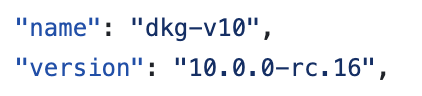
🔥 @origin_trail DKG v10 RC.16 dropped!
10.0.0-rc.16 is live.
A new 3-layer memory pipeline upgrade is officially here and ready to go.
✅Working Memory → ✅Shared Working Memory → ✅Verifiable Memory = is awesome so get into R.C 16.
#DKG#V10
The @origin_trail DKG V10 is both the simplest and the most complete memory infra for agents.
Simple: 2-command install, local by default, shared when useful, verifiable when valuable.
Complete: graph-structured, hyper token-efficient, human-inspectable, portable and monetizable.
What agent memory should have been from the start.