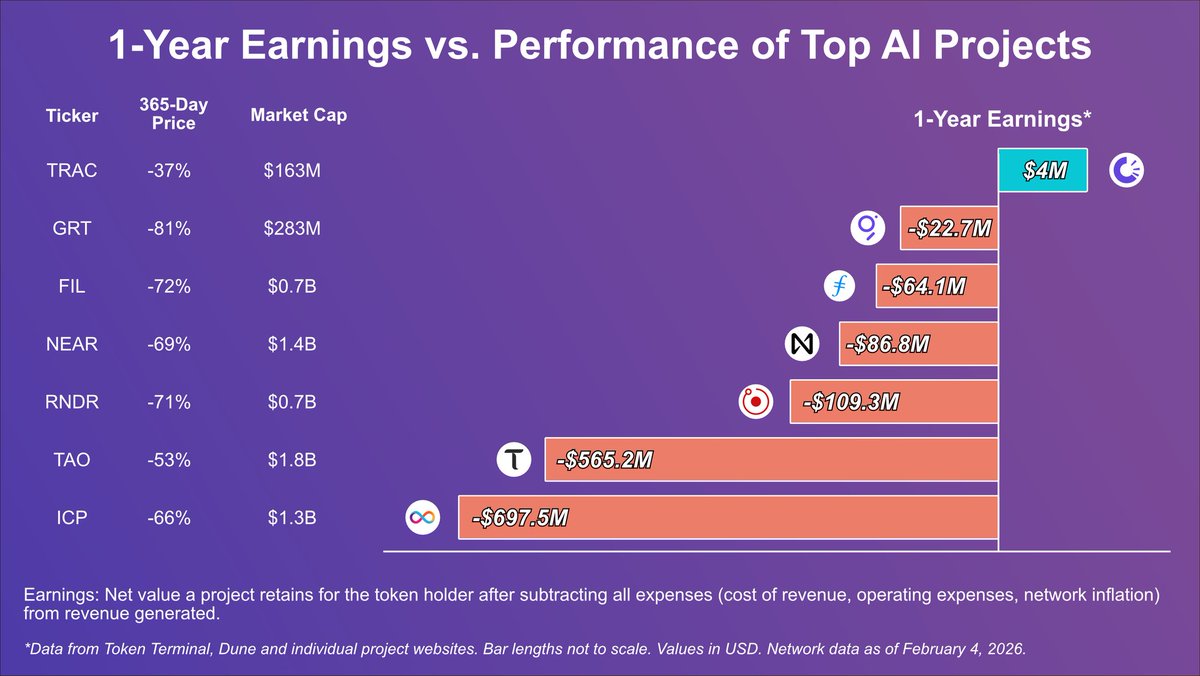
1-Year Earnings vs. Performance of Top AI Projects
$TRAC -37%
$GRT -81%
$FIL -72%
$NEAR -69%
$RNDR -71%
$TAO -53%
$ICP -66%
During market downturns, only projects with actual earnings and good fundamentals will be able to weather the storm ⛈️
@origin_trail@umanitek $TRAC
@TomazOT@origin_trail Couldn't have said it better, still astonishing it can be accessible to everyone with a few commands yet so hard to master and use it to its full extent
Walrus Memory is like giving agents a personal, portable hard drive that works anywhere and is verifiable.
@origin_trail $TRAC memory is like giving agents a shared, evolving Wikipedia where every fact has traceable provenance and agents can collaboratively edit/query it.
@Cointelegraph Solved by @origin_trail through shared context graphs ages ago.
Portable memory for AI agents across three layers.
Best part? Used by world-class organizations.
In hindsight it will be obvious that shared memory is key for reliable and viable AI
Frontier labs don't push it because it further destroys their moat
This is Metcalfe's law in action on cost reduction
Try @origin_trail and see for yourself👇
Most AI agent demos fall apart the second you ask the boring question: prove it!
Which data did the agent use? Why did it grant that exception? Who'd catch it if it got the call wrong?
Usually there's no good answer.
The agent did its thing and moved on, and whatever reasoning it had is sitting in a log nobody reads, or nowhere at all. Fine for a demo. Much less fine when you're handing real decisions to these things at work.
So today we're shipping nOS, our Network Operating System for enterprise AI agents, built on the latest version of the @origin_trail Decentralized Knowledge Graph.
The idea is pretty simple. Agents stop working alone. They share one structured memory, and every decision an agent makes gets written down as a trace you can open later: what went in, what rule applied, what it was reasoning over. Those traces get signed and anchored on the DKG, so anyone can check them, you own them, and the next agent you deploy builds on them instead of starting cold.
Why bother doing it this way?
Because you can verify a decision without having to trust us. The proof stands on its own. Because the knowledge stacks up instead of evaporating, so your tenth agent is sharper and cheaper to run than your first. And because it's actually yours. The traces live in your graph, not locked inside someone's database. Run your own node and nothing leaves your walls.
We didn't get here overnight.
The DKG has been in production for years answering one stubborn question, how do you know a piece of data is true, for supply chains first and a lot of other places since.
AI agents just made that question everyone's problem at once.
Trusted by industry leaders, we're embarking on an exciting new chapter with @TraceLabsHQ.
Together, with a wider @origin_trail ecosystem!
@TraceLabsHQ@origin_trail It's really been that long? Glad to have followed and supported @origin_trail since 2018. Can't wait to see what this new nOS is bringing on the ethereum:0xaa7a9ca87d3694b5755f213b5d04094b8d0f0a6f(ks)!
Today, we are proud to upgrade our 10 + years journey with a new identity and launching a brand new nOS — the Network Operating System for Verifiable Enterprise AI, powered by @origin_trail's new Decentralized Knowledge Graph.
Here's why we built it 🧵
"There may be some neuro-symbolic hybrid much better than we have right now that smoothly transitions between data in a corpus and abstract representations. The kinds of stuff you guys are doing are compatible with that."
— @GaryMarcus
⏱️10 highlights:
00:00 Intro: Gary Marcus & @BranaRakic at DKGCon
02:22 Why AI took a wrong turn
04:42 Deep learning vs. deep understanding
06:16 World models: a foundational idea
08:12 The building blocks of trustworthy AI
09:44 Neuro-symbolic AI & abstract relationships
13:04 Safety is an ecosystem - the airplane lesson
15:03 The real risk of AI agents today
18:36 Testing AI like we test new drugs
22:49 Where @OpenAI is headed
The signal is clear: the path forward runs through world models, abstraction, and an open, accountable ecosystem.
🇰🇷 CoinEasy just dropped Korea’s first onchain Knowledge Asset!
We didn’t just upload another JPEG, we permanently engraved our 𝗘𝗔𝗦𝗬𝗕𝗢𝗬 character onto the @origin_trail blockchain. It’s now a fully verifiable "Knowledge Asset," a major first for a Korean project on a global decentralized graph.
The Tech Specs:
• Stored as 75 data points on the OriginTrail DKG
• 100% public, verifiable + queryable
• Image locked forever on IPFS
(CID: bafkreihetyg5vewd4uiqsqxmv3glpmzsbasq4akq3pxv5jwrthtwufk5yy)
① Now: we engraved EASYBOY forever ✅
② Soon: your turn. Solve quizzes, learn, and your record lands onchain (EasyTree is coming)
③ Next: your learning and achievements become your own permanent, provable record. Once it's engraved, no one can erase it and anyone can verify it. Soon you'll be able to do this yourself.
Huge thanks to the @origin_trail team for making verifiable knowledge real.
🇰🇷 This is Korea, ongraph.
The AI future of 1B+ Europeans and Americans simulated — less than an hour of human effort.
🦈Powered by DKG V9 + MiroShark.
Significant time and resources saving, as this is achieved with agents coordinating, sharing memory, and compounding insight on @origin_trail.
OpenClaw agent executed seamlessly — helped by excellent CN → EN translation.
Huge shoutout to @aaronjmars — MiroShark is exactly the kind of engine that will thrive on DKG V10 mainnet, alongside the next wave of agentic systems.
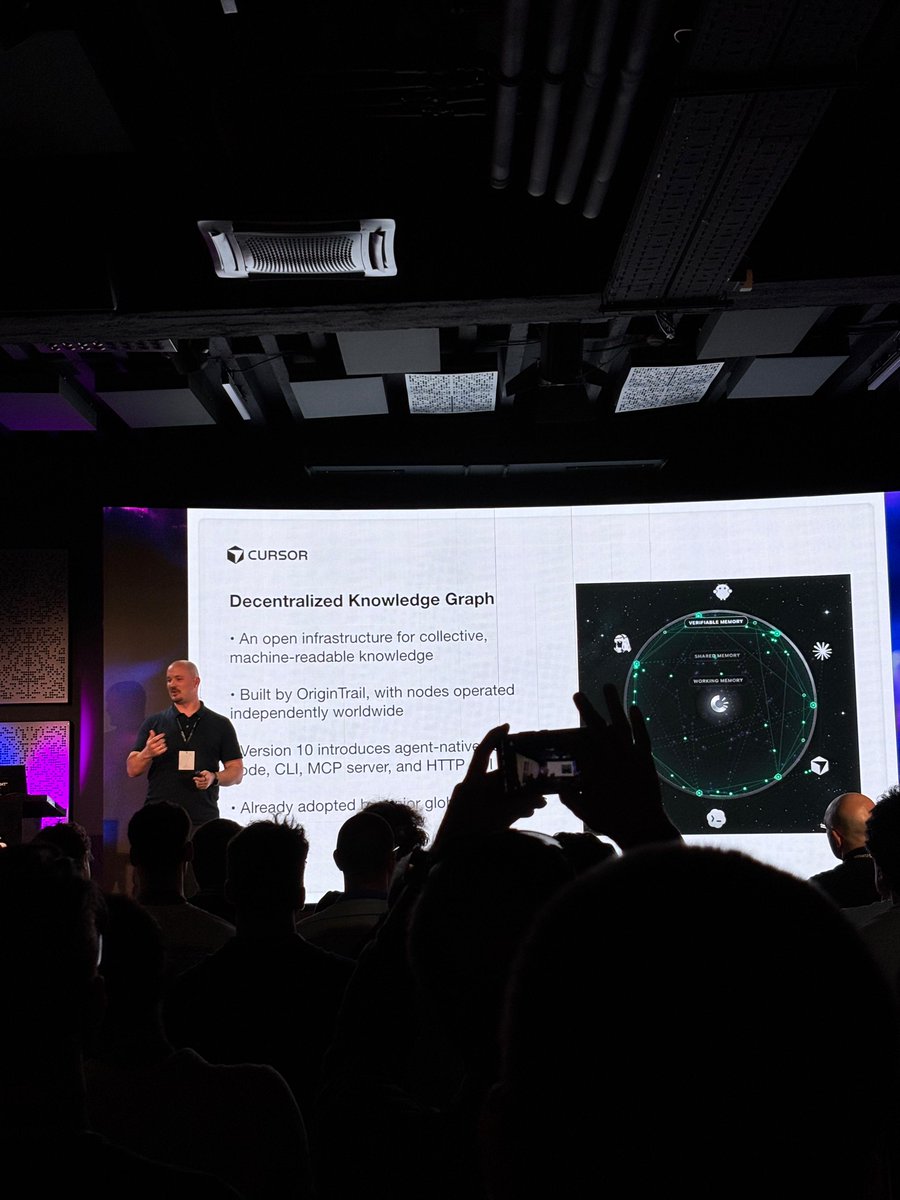
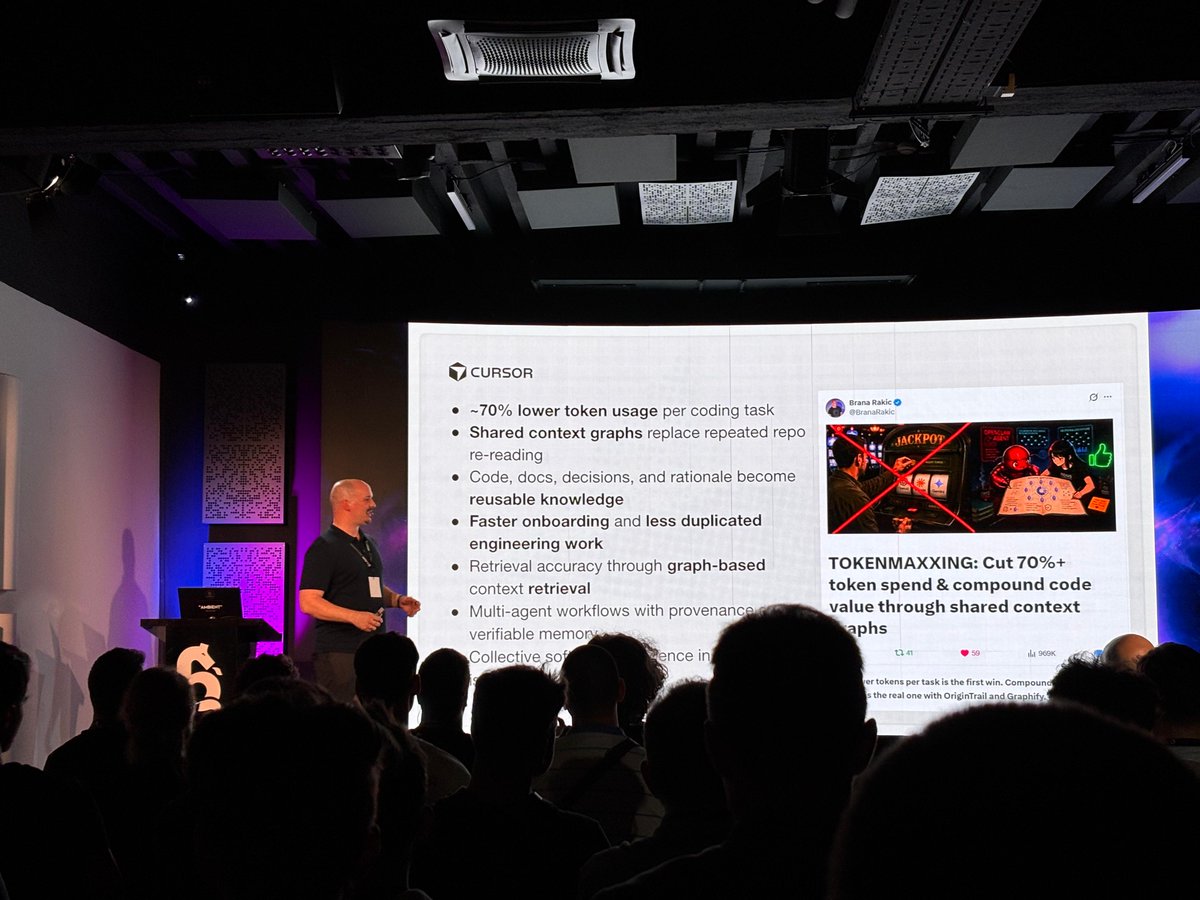
Packed room at today's @cursor_ai meetup in Ljubljana, with @BranaRakic showing Decentralized Knowledge Graph V10 live on stage!
The shift is clear: builders no longer want to just spend tokens - they want compounding value.
Shared context graphs are how.
Everyone wants agent swarms.
Very few people are talking seriously enough about the context layer that makes swarms useful.
Even with one agent, context is fragile. Too little context and the agent guesses. Too much context and it wastes tokens, loses focus, or reasons over irrelevant noise. The sweet spot is precise context: the right knowledge, in the right structure, at the right moment.
With many agents, that challenge explodes.
Each agent produces decisions, assumptions, findings, summaries, risks, and partial conclusions. Unless that knowledge becomes shared, structured, and reusable, every new agent is forced to rediscover what another agent already learned.
That is not a swarm. That is a crowd.
Shared context graphs are what turn agent activity into agent collaboration, and @origin_trail DKG V10 brings them to life.
Was just playing with some final polishing for the V10 release, and it is really powerful to see shared context graphs where multiple agents contribute knowledge into the same connected memory, with attribution visible directly in the graph ui.
That matters for three reasons.
First, agents can access and build on one shared memory instead of staying trapped in isolated sessions.
Second, the graph structure helps them retrieve the exact context they need, instead of stuffing everything into a prompt and hoping the model sorts it out.
Third, verifiability of provenance. You can see which agent contributed each piece of knowledge, trace the source, and decide what to trust.
Tokenmaxxing starts with fewer tokens, but the deeper story is coordination - agents stop reloading the world and start building on shared, verifiable context.
That is the foundation for serious multi-agent work across software engineering, research, finance, operations, project management, and far beyond.
The future is not more agents, it is agents working from shared, verifiable context. But the more the merrier, of course.
Tokenmaxxing with traces on shared context graphs is the ultimate coordination layer for humans and AI agents.
Optimize token spend against business objectives. Compound value through @origin_trail DKG v10.
Update on @origin_trail DKG V10: The release candidate 11 has been released today, after confirmation that random sampling and the graduation of context graphs across all 3 layers is successfully implemented. Last bits of deployments towards the mainnet this week.
Catch me at the @cursor_ai meetup this week in Ljubljana, where I will demonstrate how shared context graphs underpinned by the DKG V10 drive compounding effects in multi-agent environments!