Found a completely free resource to learn Cloud and DevOps from scratch.
It covers Linux, networking, Python, AWS, Azure, GCP, Docker, Kubernetes, Terraform, CI/CD, observability and security.
You’ll also build Linux, networking, cloud deployment and DevOps capstone projects along the way.
https://t.co/A3XC3jYNJq
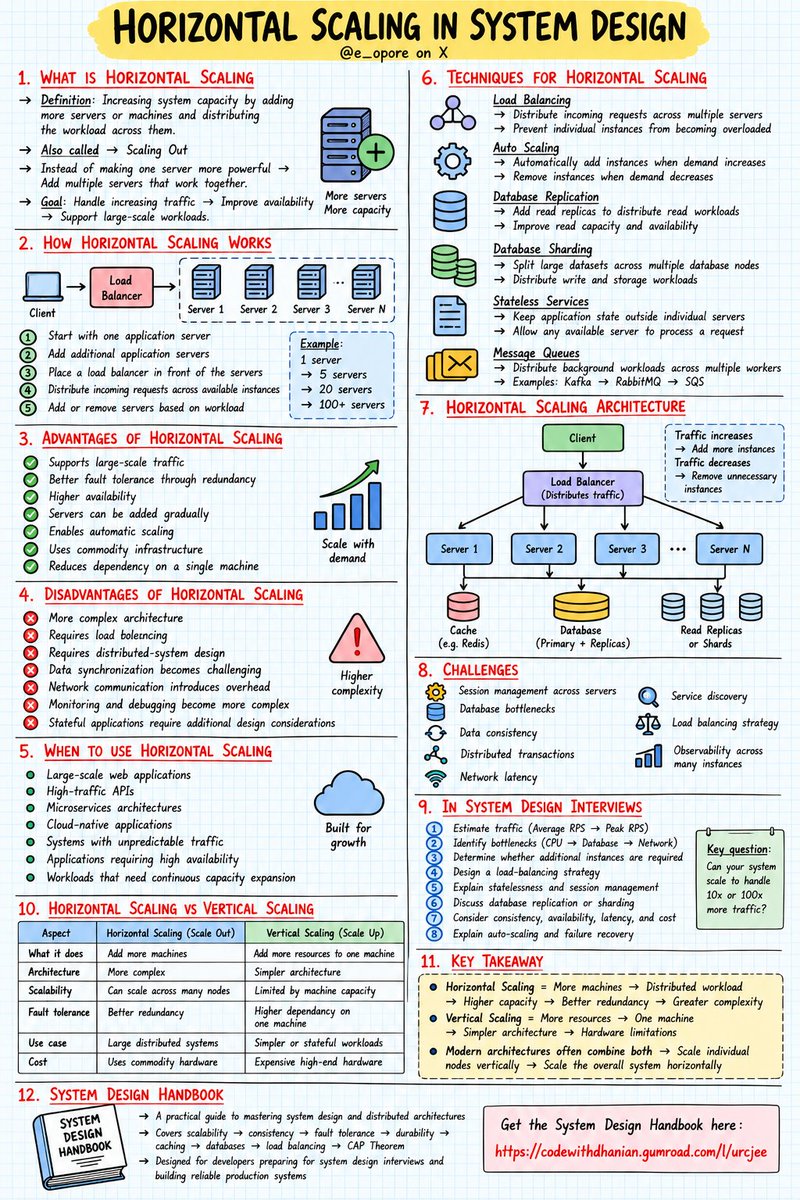
Horizontal Scaling in System Design
➤ What is Horizontal Scaling
→ Definition: Increasing system capacity by adding more servers or machines and distributing the workload across them
→ Also called → Scaling Out
→ Instead of making one server more powerful → Add multiple servers that work together
→ Goal → Handle increasing traffic → Improve availability → Support large-scale workloads
➤ How Horizontal Scaling Works
→ Start with one application server
→ Add additional application servers
→ Place a load balancer in front of the servers
→ Distribute incoming requests across available instances
→ Add or remove servers based on workload
→ Example → 1 server → 5 servers → 20 servers → 100+ servers
➤ Advantages of Horizontal Scaling
→ Supports large-scale traffic
→ Better fault tolerance through redundancy
→ Higher availability
→ Servers can be added gradually
→ Enables automatic scaling
→ Uses commodity infrastructure
→ Reduces dependency on a single machine
➤ Disadvantages of Horizontal Scaling
→ More complex architecture
→ Requires load balancing
→ Requires distributed-system design
→ Data synchronization becomes challenging
→ Network communication introduces overhead
→ Monitoring and debugging become more complex
→ Stateful applications require additional design considerations
➤ When to Use Horizontal Scaling
→ Large-scale web applications
→ High-traffic APIs
→ Microservices architectures
→ Cloud-native applications
→ Systems with unpredictable traffic
→ Applications requiring high availability
→ Workloads that need continuous capacity expansion
➤ Techniques for Horizontal Scaling
→ Load Balancing
→ Distribute incoming requests across multiple servers
→ Prevent individual instances from becoming overloaded
→ Auto Scaling
→ Automatically add instances when demand increases
→ Remove instances when demand decreases
→ Database Replication
→ Add read replicas to distribute read workloads
→ Improve read capacity and availability
→ Database Sharding
→ Split large datasets across multiple database nodes
→ Distribute write and storage workloads
→ Stateless Services
→ Keep application state outside individual servers
→ Allow any available server to process a request
→ Message Queues
→ Distribute background workloads across multiple workers
→ Examples → Kafka → RabbitMQ → SQS
➤ Horizontal Scaling Architecture
→ Client
→ Load Balancer
→ Server 1 → Server 2 → Server 3 → Server N
→ Shared Cache / Database Layer
→ Replicas / Shards
→ Traffic increases → Add more instances
→ Traffic decreases → Remove unnecessary instances
➤ Challenges
→ Session management across servers
→ Database bottlenecks
→ Data consistency
→ Distributed transactions
→ Network latency
→ Service discovery
→ Load balancing strategy
→ Observability across many instances
➤ Horizontal Scaling vs Vertical Scaling
→ Horizontal Scaling → Add more machines
→ Vertical Scaling → Add more resources to one machine
→ Horizontal → Higher architectural complexity
→ Vertical → Simpler architecture
→ Horizontal → Can scale across many nodes
→ Vertical → Limited by machine capacity
→ Horizontal → Better redundancy
→ Vertical → Greater dependency on individual machines
→ Horizontal → Ideal for large distributed systems
→ Vertical → Useful for simpler or stateful workloads
➤ In System Design Interviews
→ Estimate traffic → Average RPS → Peak RPS
→ Identify bottlenecks → CPU → Database → Network
→ Determine whether additional instances are required
→ Design a load-balancing strategy
→ Explain statelessness and session management
→ Discuss database replication or sharding
→ Consider consistency, availability, latency, and cost
→ Explain auto-scaling and failure recovery
➤ Key Takeaway
→ Horizontal Scaling = More machines → Distributed workload → Higher capacity → Better redundancy → Greater complexity
→ Vertical Scaling = More resources → One machine → Simpler architecture → Hardware limitations
→ Modern architectures often combine both → Scale individual nodes vertically → Scale the overall system horizontally
➤ System Design Handbook
→ A practical guide to mastering system design and distributed architectures
→ Covers scalability → Consistency → Fault tolerance → Durability → Caching → Databases → Load balancing → CAP Theorem
→ Designed for developers preparing for system design interviews and building reliable production systems
📘 Get the System Design Handbook here:
https://t.co/WIMretQFPE
BRANCHING STRATEGIES IN DEVOPS EXPLAINED
WHAT IS A BRANCHING STRATEGY?
A branching strategy is a defined approach for creating, managing, merging, and deleting branches in a version control system such as Git. It helps development teams organize parallel work while controlling how features, fixes, releases, and production changes move through the software delivery lifecycle.
→ Organizes parallel development
→ Separates features and fixes from stable code
→ Supports code review and collaboration
→ Integrates with CI/CD pipelines
→ Defines how changes move toward production
WHY BRANCHING STRATEGIES MATTER
A well-defined branching model gives teams a consistent way to manage changes across development and release workflows.
→ Reduces conflicts between developers
→ Protects stable branches
→ Makes code reviews easier
→ Supports automated testing
→ Improves release management
→ Provides clearer development workflows
The appropriate strategy depends on factors such as team size, release frequency, application architecture, and deployment practices.
FEATURE BRANCHING
Feature branching creates a separate branch for each new feature or significant change.
→ Create a feature branch from the main development branch
→ Develop and test the feature independently
→ Open a pull request or merge request
→ Run automated checks
→ Review the code
→ Merge the approved changes
Example:
→ main → feature/user-authentication → review → merge
Feature branches help isolate work without directly modifying the main branch.
GIT FLOW
Git Flow uses several long-lived and temporary branches to organize development and releases.
→ main → production-ready code
→ develop → integration of upcoming changes
→ feature/* → new features
→ release/* → release preparation
→ hotfix/* → urgent production fixes
Git Flow can provide a structured release process, particularly for projects that maintain scheduled releases.
TRUNK-BASED DEVELOPMENT
Trunk-based development centers development around a shared main branch, often called the trunk.
→ Developers make small changes frequently
→ Short-lived branches may be used
→ Changes are integrated into the main branch regularly
→ Automated tests validate changes
→ Feature flags can hide incomplete functionality
This approach works particularly well with strong automated testing and continuous integration practices.
RELEASE BRANCHING
Release branching creates a dedicated branch when preparing a specific software release.
→ Development continues on the main development branch
→ A release branch is created
→ Final testing and stabilization occur
→ Critical fixes can be applied to the release
→ The release is deployed
→ Relevant fixes are synchronized with the main development line
Release branches can provide additional control during release stabilization.
HOTFIX BRANCHING
Hotfix branches are used for urgent production issues.
→ Identify the production problem
→ Create a hotfix branch
→ Implement and test the fix
→ Run automated validation
→ Merge the fix into the production branch
→ Synchronize the fix with active development branches
→ Deploy the corrected version
Hotfixes should still pass the team's normal review and testing controls where practical.
BRANCHING STRATEGY WORKFLOW
→ CREATE BRANCH
Create an isolated branch for the required change.
→ DEVELOP
Implement the feature, improvement, or fix.
→ COMMIT
Record focused and meaningful changes.
→ PUSH
Upload the branch to the remote repository.
→ PULL REQUEST
Request review and automated validation.
→ TEST
Run unit tests, integration tests, security checks, and other validations.
→ MERGE
Combine approved changes into the target branch.
→ DEPLOY
Allow the CI/CD pipeline to build and release the validated changes.
BEST PRACTICES FOR BRANCHING
→ KEEP BRANCHES SHORT-LIVED
Merge completed work regularly to reduce divergence.
→ PROTECT IMPORTANT BRANCHES
Require reviews and automated checks before merging.
→ USE CLEAR BRANCH NAMES
Examples include feature/payment-api, bugfix/login-error, and hotfix/database-issue.
→ AUTOMATE VALIDATION
Run tests, linting, security checks, and builds automatically.
→ DELETE MERGED BRANCHES
Remove branches that are no longer needed.
→ KEEP COMMITS FOCUSED
Small, meaningful commits make reviews and troubleshooting easier.
BRANCHING STRATEGIES IN CI/CD
Branching strategies work closely with CI/CD pipelines.
→ Developer pushes a branch
→ CI pipeline runs automatically
→ Automated tests execute
→ Code quality and security checks run
→ Pull request is reviewed
→ Approved changes are merged
→ Build artifacts are created
→ Deployment pipeline releases the application according to the team's workflow
BRANCHING STRATEGY COMPARISON
→ FEATURE BRANCHING
Useful for isolating individual features and changes.
→ GIT FLOW
Provides a structured model for development and scheduled releases.
→ TRUNK-BASED DEVELOPMENT
Emphasizes frequent integration into a shared main branch.
→ RELEASE BRANCHING
Provides a dedicated area for stabilizing a specific release.
→ HOTFIX BRANCHING
Provides an isolated workflow for urgent production fixes.
No single branching strategy is appropriate for every development team. The choice should reflect the team's delivery process, testing maturity, release model, and operational requirements.
BENEFITS OF EFFECTIVE BRANCHING
→ Better collaboration
→ Cleaner code reviews
→ Reduced integration conflicts
→ Safer releases
→ Better CI/CD automation
→ Easier rollback and troubleshooting
→ Clearer software delivery workflows
QUICK TIP
Branching strategies provide structure for managing code changes throughout the DevOps lifecycle. Whether a team uses feature branches, Git Flow, trunk-based development, release branches, or a combination of approaches, the strategy should support frequent integration, automated validation, effective code review, and reliable software delivery.
DEVOPS HANDBOOK
Get the complete DevOps guide here:
https://t.co/fFkAVQhtzv
FREE DevOps academy applications are OPEN.
We cover:
- Linux
- Networking
- Git
- Docker
- Kubernetes
- AWS
- Terraform
- CI/CD
- Monitoring & Logging
- DevOps Interviews
You build a real project.
We build your CV together and prep your interview.
20 spots are open.
Apply: https://t.co/FfLSqQh9ZU
Stop paying AWS just to learn AWS. Build a mini cloud on your laptop instead. ☁️
Use Floci, an open-source AWS emulator that lets you run and test AWS services locally.
Here’s how I’d use it to actually learn AWS:
1️⃣ Start with AWS CLI + Floci:
→ Run Floci locally and point AWS CLI to localhost:4566
→ Create, inspect and delete resources using normal aws commands
→ Learn regions, endpoints, ARNs, resource names and AWS CLI syntax
→ Practice with aws s3, aws sqs, aws lambda and aws dynamodb
2️⃣ Learn S3 properly:
→ Create buckets, upload objects and organize them using prefixes
→ Practice object metadata, versioning and bucket policies
→ Upload files from an application using the AWS SDK
→ Understand object storage instead of treating S3 like another filesystem
3️⃣ Build a serverless API:
→ Use API Gateway for HTTP endpoints, Lambda for backend logic and DynamoDB for data
→ Learn routes, methods, request payloads and Lambda event objects
→ Design DynamoDB partition keys and access patterns
→ Connect all three services into one working application
Now you're learning how AWS services actually work together.
4️⃣ Learn asynchronous systems:
→ Use SQS to queue jobs between producers and consumers
→ Learn visibility timeouts, message retention, retries and dead-letter queues
→ Use SNS when one event needs to reach multiple subscribers
→ Use EventBridge for event routing between different services
This teaches queues, pub/sub, event buses and loose coupling instead of just memorizing service names.
5️⃣ Learn DynamoDB beyond basic CRUD:
→ Create tables using partition keys and sort keys
→ Practice PutItem, GetItem, Query and Scan
→ Understand why Query is usually preferred over scanning an entire table
→ Learn secondary indexes and design tables around application access patterns
6️⃣ Learn IAM and AWS security:
→ Create IAM policies and understand Effect, Action, Resource and principals
→ Learn users, roles and temporary credentials
→ Practice least privilege instead of giving everything AdministratorAccess
→ Use SSM Parameter Store for configuration and Secrets Manager for sensitive values
7️⃣ Manage everything with Terraform:
→ Provision S3, DynamoDB, SQS, SNS, IAM and other resources from .tf files
→ Learn resources, variables, outputs, dependencies and Terraform state
→ Practice terraform plan, apply and destroy
→ Delete the environment and rebuild the whole thing from code
This is much closer to how cloud infrastructure should actually be managed.
8️⃣ Connect a real application:
→ Build something with Python, Node.js, Go or Java
→ Use the official AWS SDK to communicate with your local AWS services
→ Store files in S3, data in DynamoDB and background jobs in SQS
→ Learn credentials, regions, endpoints and SDK clients inside actual application code
9️⃣ Containerize everything:
→ Run Floci and your application with Docker
→ Use Docker Compose to manage the local environment
→ Pass AWS endpoints and configuration through environment variables
→ Persist anything that needs to survive container restarts
Now your laptop becomes a disposable local cloud development environment.
🔟 Build one complete AWS project:
→ Create an API with API Gateway and Lambda
→ Store application data in DynamoDB
→ Store uploaded files in S3
→ Push background work into SQS
→ Send notifications through SNS
→ Manage the entire infrastructure with Terraform
One project like this teaches far more than creating random services from the AWS console.
1️⃣1️⃣ Add CI/CD:
→ Start Floci during your CI pipeline
→ Provision temporary AWS-compatible resources with Terraform
→ Run integration tests against S3, DynamoDB, SQS and Lambda
→ Destroy the environment after the tests finish
Now every pipeline can have disposable infrastructure without creating real AWS resources.
1️⃣2️⃣ Then move to real AWS:
→ Create an AWS account and set up billing alerts first
→ Deploy the project you already understand instead of randomly exploring the console
→ Remove the local endpoint overrides and connect your SDKs to AWS
→ Reuse your Terraform where possible
→ Then learn real VPCs, security groups, CloudWatch, KMS, IAM boundaries, scaling and AWS pricing
Build locally. Understand the architecture. Then deploy for real. ☁️
A complete SaaS payment flow involves much more than just charging a card.
To help you build one, in this guide Magnus shows how to connect Stripe Checkout, webhooks, and transactional emails.
You’ll learn how to handle successful payments, async events, and automated user communication.
https://t.co/MuixaI6egM
@phalaphala11@zizipho50 Foreigners do have their foreign documents which are not valid here, e.g all foreigners have id's from their countries of birth, they are just not documented here and whetjer the ID is valid or not we can't prove it
Your phone runs more than Android or iOS behind the scenes.
In this handbook, Nikheel explores QuRT, Qualcomm’s real-time operating system that powers DSP workloads for audio, AI, sensors, and more.
You’ll learn about scheduling, memory management, interrupts, and how RTOS systems differ from general-purpose OSes.
https://t.co/rsXvxAFwcE
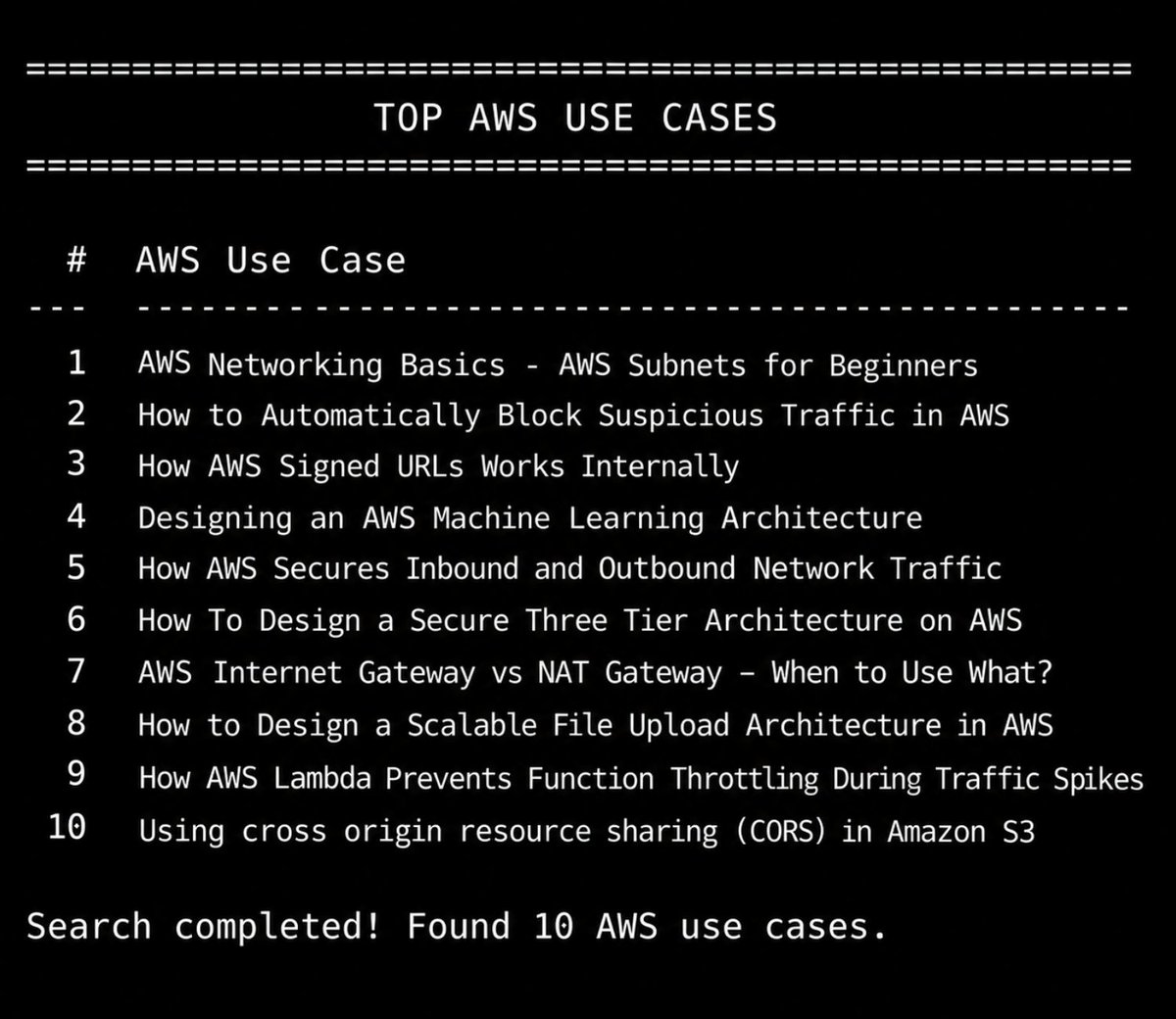
AWS skills are still some of the highest paid tech skills in 2026.
These 10 practical AWS use cases are worth saving:
1: // AWS Networking Basics - AWS Subnets for Beginners
↳ https://t.co/EPwe1GTxMs
2: // How to Automatically Block Suspicious Traffic in AWS
↳ https://t.co/5yjkbkA8p8
3: // How AWS Signed URLs Works Internally
↳ https://t.co/crha9IhMbO
4: // Designing an AWS Machine Learning Architecture
↳ https://t.co/jMwBQ0KLPd
5: // How AWS Secures Inbound and Outbound Network Traffic
↳ https://t.co/FXjFP5d50p
6: // How To Design a Secure Three Tier Architecture on AWS
↳ https://t.co/7NJ2MByHku
7: // AWS Internet Gateway vs NAT Gateway - When to Use What?
↳ https://t.co/75zBT2vnGT
8: // How to Design a Scalable File Upload Architecture in AWS
↳ https://t.co/QZFqsaCCAm
9: // How AWS Lambda Prevents Function Throttling During Traffic Spikes
↳ https://t.co/S2GyjDcvql
10: // Using Cross Origin Resource Sharing (CORS) in Amazon S3
↳ https://t.co/hzpg2tw148
Save this list. It'll save you hours and help to get 10x better at practical AWS.
--
P.S. 50K+ read my DevOps and Cloud newsletter: https://t.co/WBucLdwLhJ
What do we cover:
DevOps, Cloud, Kubernetes, IaC, GitOps, MLOps
🔁 Consider a Repost if this is helpful