Antigone may be the origin of independent thought in Western literature.
Here is a young woman who stands against the king, against the state, against the consensus of everyone around her, because she believes a higher law demands it. She buries her brother knowing it will cost her life.
When I teach Sophocles to students, I don't start with literary analysis. I start with a question: "Have you ever known something was right even though everyone around you disagreed?"
Every student has a story. The shy kid who wouldn't go along with bullying. The teenager who questioned a rule that seemed unjust. They know what it feels like to stand alone with their own conviction.
Then we read Antigone, and suddenly a 2,500-year-old play becomes personal.
What Sophocles teaches, and what no amount of lecturing about "critical thinking" can replicate, is the lived experience of watching someone reason through an impossible moral situation and choose based on principle. Students don't learn independent thought from being told to think independently. They learn it from inhabiting the minds of those who actually did.
This is why I believe great literature is not a nice supplement to education. It's foundational. These texts are where young people encounter the full weight of what it means to think for yourself and accept the consequences.
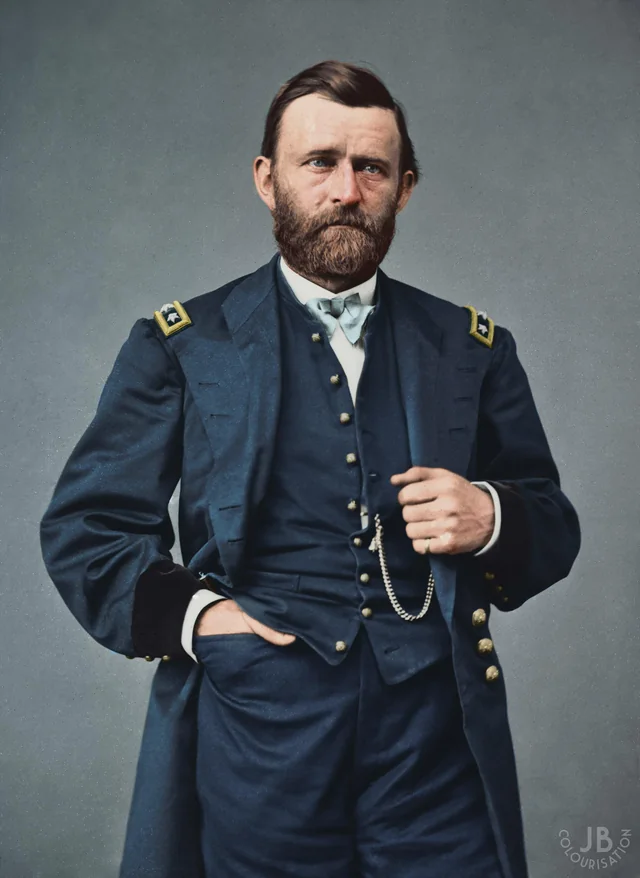
He won the Civil War, broke the Klan, went bankrupt at 62, got terminal throat cancer, and wrote one of the greatest books in American literature in the final year of his life. He finished it 5 days before he died.
Ulysses S. Grant was born 204 years ago today.
His name wasn't even Ulysses S. Grant. He was born Hiram Ulysses Grant in Point Pleasant, Ohio on April 27, 1822. The congressman who nominated him to West Point wrote down the wrong name. Grant kept it. The "S." stands for nothing.
He hated his father's tannery and loved horses. Graduated 21st of 39 at West Point. Fought in the Mexican-American War, then came home convinced it was an unjust war designed to expand slavery. He later said he believed the Civil War was divine punishment for it.
He married Julia Dent in 1848, into a slave-owning Missouri family. His abolitionist father refused to attend the wedding. In 1859, broke and desperate, Grant freed the one enslaved man he'd briefly owned instead of selling him. He could have gotten a year's wages.
In the Civil War he became what no other Union general was: relentless. Vicksburg (July 4, 1863) split the Confederacy in half. Lincoln then gave him every Union army. His Appomattox surrender terms: officers kept sidearms, men kept horses for spring planting, no one prosecuted.
As president (1869 to 1877) he did something no president would do again until LBJ: used federal troops to crush the Ku Klux Klan. He suspended habeas corpus in 9 South Carolina counties, prosecuted Klansmen before predominantly Black juries, and broke the first Klan.
His presidency was also rocked by scandal: Black Friday 1869. Crédit Mobilier. The Whiskey Ring. Belknap. Grant himself never took a dime. He was just disastrously loyal to corrupt friends. The pattern damaged his reputation for a century.
After the White House, he toured the world for 2 years. Dined with Queen Victoria. Met the emperor of Japan. Then in 1884, a Wall Street partner named Ferdinand Ward ran what we'd now call a Ponzi scheme. Grant was wiped out. 62 years old. Penniless.
Weeks later he was diagnosed with terminal throat cancer. Mark Twain offered to publish his memoirs. Grant wrote in agony, sometimes 50 pages a day, racing the disease to leave Julia an inheritance. He finished the manuscript July 18, 1885. He died July 23.
The book made Julia $450,000, about $14M today. It's now considered one of the finest memoirs in the English language. For decades historians ranked Grant a failure. Since 2000 he's jumped 13 spots in the C-SPAN survey, the biggest rise of any president.
Happy birthday, General 🇺🇸
It was #OTD in 1976 that Rick Monday, playing center field for the #Cubs, saved the American flag from being burned on the field by two protesters at Dodgers Stadium. Rick Monday, who served six years in the Marine Corps Reserves, realized what was happening, he rushed the arsonists, and snatched the flag away from them. When Monday came to bat an inning later, the Dodger Stadium scoreboard flashed the message: “Rick Monday…You made a great play.” Today is the 50th anniversary of this play!
Thank you to the Lyric Opera of Chicago for the great honour and distinction of being invited to join Lyric’s Board of Directors. I personally aim to make the Lyric, our great opera house of Chicago, the most exciting and dynamic opera house in the world. Stay tuned for the 2026/2027 season.
PARAPROSDOKIANS: (Winston Churchill loved them.)
I had to look up "paraprosdokian".?
Here is the definition:
"Figure of speech in which the latter part of a sentence or phrase is surprising or unexpected; frequently used in a humorous situation."?? "Where there's a will, I want to be in it," is a type of paraprosdokian.
1. Do not argue with an idiot. He will drag you down to his level and beat you with experience.
2. The last thing I want to do is hurt you. But it's still on my list.
3. Light travels faster than sound. This is why some people appear bright until you hear them speak.
4. If I agreed with you, we'd both be wrong.
5. We never really grow up, we only learn how to act in public.
6. War does not determine who is right - only who is left.
7. Knowledge is knowing a tomato is a fruit. Wisdom is not putting it in a fruit salad.
8. Evening news is where they begin with 'Good Evening,' and then proceed to tell you why it isn't.
9. To steal ideas from one person is plagiarism. To steal from many is research.
10. A bus station is where a bus stops. A train station is where a train stops. On my desk, I have a work station.
11. I thought I wanted a career. Turns out I just wanted paychecks.
12. Whenever I fill out an application, in the part that says, 'In case of emergency, notify:' I put 'DOCTOR.'
13. I didn't say it was your fault, I said I was blaming you.
14. Women will never be equal to men until they can walk down the street with a bald head and a beer gut, and still think they are sexy.
15. Behind every successful man is his woman. Behind the fall of a successful man is usually another woman.
16. A clear conscience is the sign of a fuzzy memory.
17. You do not need a parachute to skydive. You only need a parachute to skydive twice.
18. Money can't buy happiness, but it sure makes misery easier to live with.
19. There's a fine line between cuddling and holding someone down so they can't get away.
20. I used to be indecisive. Now I'm not so sure.
21. You're never too old to learn something stupid.
22. To be sure of hitting the target, shoot first and call whatever you hit the target.
23. Nostalgia isn't what it used to be.
24. Change is inevitable, except from a vending machine.
25. Going to church doesn't make you a Christian any more than standing in a garage makes you a car.
26. Where there's a will, there's relatives.
Players to score their 500th career goal vs Vancouver
Frank Mahovlich
Stan Mikita
Wayne Gretzky
Joe Sakic
Patrick Marleau
Steven Stamkos
Patrick Kane
No opponent in history has allowed more players to score their 500th career goal than the Canucks
Illinois State’s Cinderella story comes to an end…
Beat No.1 NDSU 29-28 as 23.5-point underdogs
Beat No.8 UC Davis 42-31 as 10.5-point underdogs
Beat No.12 Villanova as 30-14 as 2.5-point underdogs
Fell to No.2 Montana State 35-34 in OT
What a run.
In 1936, Tolkien published a Christmas poem called "Noel" in the annual journal of a Catholic school near Oxford. For about 80 years the text of the poem was lost to history until Wayne Hammond and Christina Scull visited the school and found it in the archives. Here is the poem:
Voyager 1 is the loneliest pioneer humanity has ever launched, and it is still flying perfectly, forty-eight years later, on a course set in 1977 that has never needed a single correction.Imagine that: on September 5, 1977, a 825-kilogram golden spacecraft lifted off from Cape Canaveral. Engineers gave it one decisive push with gravity assists from Jupiter and Saturn, then essentially said, “Go. We’ll never touch you again.” And it listened. For thirty-seven straight years (until the first tiny trim in 2017, only to align the antenna), Voyager 1 hurtled through space without a single thruster firing to fix its path. Not one. That’s like throwing a paper airplane from New York and having it glide untouched through a window in Paris, four decades later.Right now, in December 2025, Voyager 1 is 163 times farther from the Sun than Earth is, more than 24.4 billion kilometers away, the farthest human-made object in history. It crossed the heliopause (the Sun’s protective bubble) in 2012 and is now sailing through true interstellar space, where the wind between the stars is colder than anything we can create on Earth. Yet its trajectory is still so impeccable that the flight team jokes the spacecraft could hit a cosmic bullseye drawn half a century https://t.co/Ivypyn1uvT has already given us the pale blue dot photo, the first portraits of Jupiter’s raging storms and Saturn’s rings in impossible detail, and the discovery that moons like Io and Titan are worlds stranger than fiction. Now, with its power fading to barely four watts (less than a refrigerator lightbulb), it still whispers data back across the void on a 23-watt signal that takes 22 hours and 55 minutes to reach us, one-way.Voyager 1 isn’t just a probe. It’s a message in a bottle flung toward the galaxy, carrying the sounds of Earth (whales, Chuck Berry, and a baby’s cry) on its golden record. And it’s still flying straight, as if to prove that human foresight, once aimed true, can outrun time itself.Out there in the dark, a tiny golden speck keeps its ancient promise: keep going, perfectly, forever.