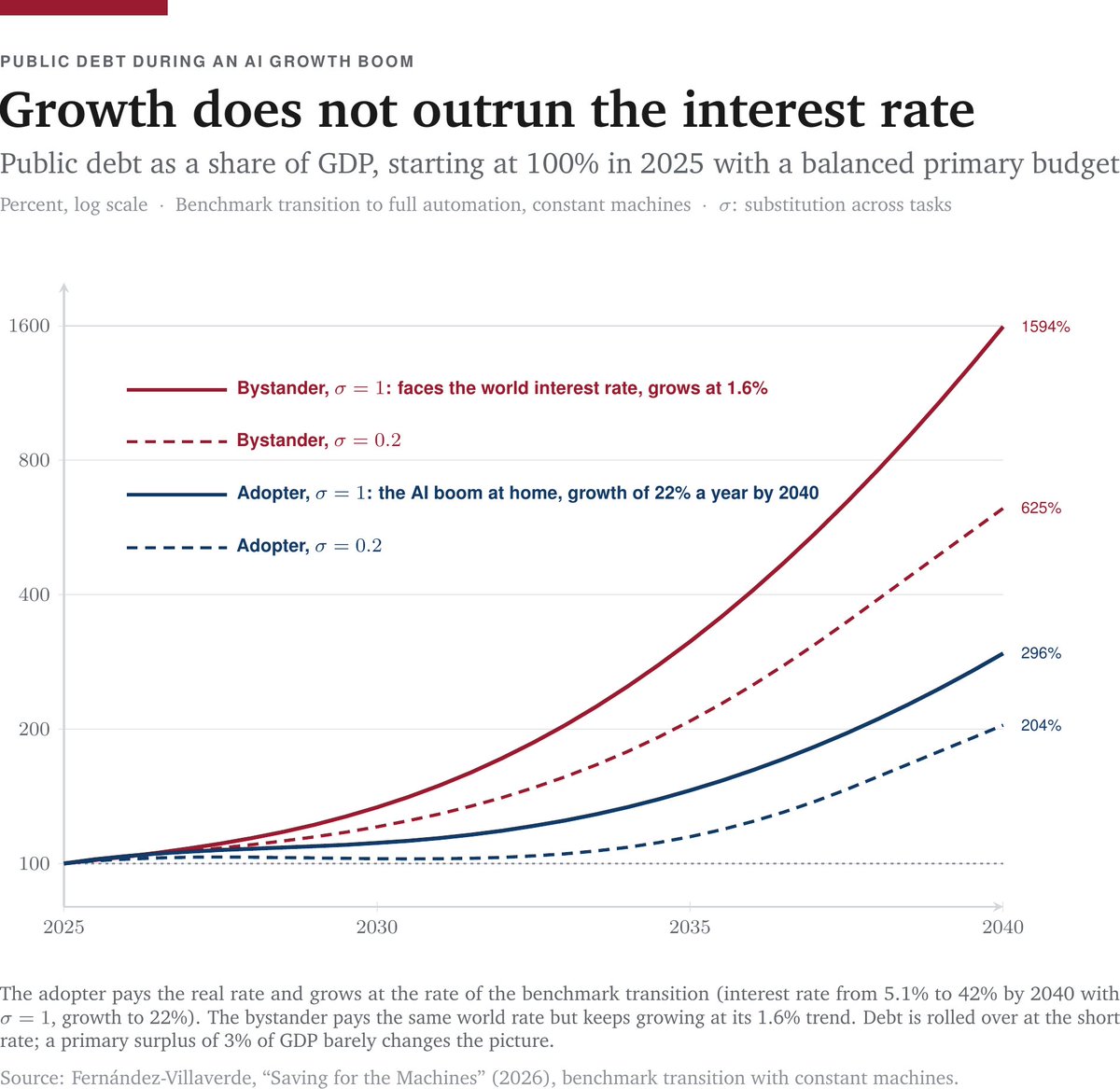
Will AI poison the public finances of many modern states? There is a real risk that it will.
Yesterday, I circulated a new paper, “Saving for the Machines,” which makes a simple point. Building the AI transformation will require enormous investment. The only way to induce agents to save for that investment is through a large increase in the real interest rate. For instance, in my benchmark scenario, the ten-year real yield jumps from 5.1% to 13.6% on impact.
But that means government borrowing will become much more expensive. Here is a back-of-the-envelope calculation.
Take a government that owes 100% of GDP in 2025 (a typical case in Western Europe) and runs a balanced primary budget from then on (not so typical but never mind; I want to build an optimistic scenario). That means the debt ratio changes only with the gap between the real interest rate and growth.
I input the interest rate and the growth rate for my benchmark transition to full automation, and I roll over the debt at the short rate. I consider two economies. The first economy is an AI adopter, for example, the U.S., which experiences an AI boom at home. The government pays the new interest rate but also enjoys faster growth.
The second economy is a bystander, for example, Spain. This economy lives in an integrated financial market but does not adopt AI (this is an extreme case of zero adoption, just to make the exercise transparent): it pays the same world interest rate and continues growing at its old 1.6% trend.
Let’s first consider the adopter. With an intertemporal elasticity of substitution of one-half, the Euler equation implies that consumption growth is about half the real interest rate. Hence, the gap between the interest rate and growth does not close during the AI-driven growth boom. Instead, it widens. For example, with a unit elasticity of substitution among tasks, the real rate rises from 5.1% to 42% by 2040, while growth increases only from 1.6% to 22%. Debt doubles by 2038, reaches 296% of GDP in 2040, and 907% in 2045. To hold the ratio at 100%, the government needs a primary surplus of 10% of GDP in 2035 and 24% from 2045 onward. With a low elasticity of substitution of 0.2, the numbers are milder, but the pattern is the same: 204% in 2040, 397% in 2045, and a stabilizing surplus of 13% of GDP.
But the adopter has a way out. The capital share goes to one, so net capital income is about 88% of GDP, and a flat tax on it can cover the surplus. A 36% tax on net capital income holds the debt at 100% of GDP in the limit with unit elasticity, and a 20% tax does so with strong complementarity across tasks. The tax is above the gap because it slows growth, from 21.9% to 13.6% with unit elasticity and from 11.7% to 9.1% with an elasticity of 0.2, while it does nothing to the rate the Treasury pays, which technology pins at the machines' net return. Painful, but the boom survives and the adopter can pay its debt.
The grim news is that the bystander economy has no way out. Its capital income is still a third of GDP, which grows at 1.6%, and the surplus it needs is 11% of GDP in 2030, 26% in 2035, and 44% forever with unit elasticity (18% and 24% with an elasticity of 0.2). On a balanced primary budget, its debt doubles by 2033 and triples by 2035. No tax system raises that.
Two more bad pieces of news for the bystander. First, long yields jump on impact, so a Treasury that issues ten-year debt pays more, and sooner, than rolling over at the short rate assumes: it is the same bill but front-loaded. Second, the bystander’s own capital flows to the machines abroad, so its GDP and tax base fall below trend. One relief is that households can save for other people’s machines and get rich on the returns, which the bystander’s government can tax to some extent.
This back-of-the-envelope calculation is a benchmark, not a forecast of what is to come. But the arithmetic is simple, and it runs counter to the hope that an AI-fueled growth boom will take care of public debt, because growth comes with an interest rate that is twice as high.
Not a pretty future for most of Western Europe. Due to AI, the choice is between default, inflation, or, most likely, financial repression: capital controls that keep domestic savers from investing in machines abroad.
Let me close with a practical implication. If you believe in the transformative effects of AI, you disagree with the bond market, since today’s long real yields have not risen nearly as much as they should in that scenario. Therefore, the time to term out the debt is now, before repricing, because every year of coupon locked in at today’s rates is a transfer from today’s bondholders to taxpayers. A treasury that believes in transformative AI should be issuing fifty-year bonds; one that is shortening its maturity is betting the other way.
Amazing Science Reality nugget from Andrew Cockburn in The Spectator yesterday.
Kevin Warsh, Chair of the Fed, uses generative AI to recreate his favourite dead economists and apparently spends large parts of the day speaking to the bots about policy ...
BREAKING NIUS: Der nächste absolut verheerende Satz von Bundeskanzler Friedrich Merz: "Meine größte Sorge ist NICHT unsere Wirtschaft. Meine größte Sorge ist die Auswirkung, die Russland auf unsere Gesellschaft hat."
This piece is a good example of what goes wrong when you have some story but not economy theory to map that to the data.
For example, it asks “So how could bird-flu-driven scarcity explain a price increase of 138%?”
The answer is in the article: demand for eggs is inelastic.
I know this isn't LinkedIn, but nonetheless, some professional news.
After 18 years, five books, three dozen papers and thousands of articles, presentations, podcasts, videos, media appearances etc etc – I am leaving the IEA in a few weeks' time.
I am, however, neither joining Novara Media, nor the Guardian, nor SOAS. I am not starting a podcast with Gary Stevenson either.
I'll continue to promote extremely uncool, cringey low-status opinions in other ways. Watch this space.
I'm rather baffled by this. From housing to energy policy, infrastructure through the living wage, the idea UK govt policy prioritises low consumer prices is...a stretch.
A bit late to this, but this is very good (along with Ed's @NewStatesman essay). Well worth a read.
I think there is a lot to his fundamental point that in the UK we have become focused on short term consumer benefit over longer term strategy (something we've been pondering internally too).
Part of the problem is that this approach has worked in some areas (look at the relative price of TVs for example) but it obviously doesn't work in more structural areas (energy, housing etc).
Furthermore, an obsession with short term prices, can often end up costing more in the long term.
Finally, it also links to the fact we have a bit of an obsession with the demand side of the economy but often aren't all that interested in the supply side.
I think a better frame is trying to make up for the effects of their own supply-crushing policies by mandating various cross-subsidies, discounts, benefits and other things to reduce the political salience, so compounding the inefficiency. See recent rent control by back door.
But I think Ed is, at other times, trying to go further than that and suggest free trade itself is misguided if we give up certain forms of production. He's on a journey on this stuff.
Isabella Weber recognized earlier than most economists how politically explosive high inflation would be. (I worried too: hence The War on Prices). But, ultimately, her account of the inflation is misguided & her policy suite unnecessary or dangerous. https://t.co/sspxPDTn69
@fiat_money the first chart that showed me clearly shows that a) there was some supply-side weakness b) this effect was swamped in the eurozone by total spending rising...
BREAKING NIUS: Für mich ist es einer der unglaublichste Auftritte von Bundeskanzler Friedrich Merz in dessen Amtszeit. Seit 17 Monaten erzählt Merz, er wolle Deutschland deregulieren, unnötige und schädliche Bürokratie beseitigen. Dann hat dieser Bundeskanzler die Möglichkeit, auf der Weltbühne, vor milliardenschweren Investoren dem Nvidia-Chef Jensen Huang eine Frage zu stellen. Und was fragt der Bundeskanzler? Er will wissen, wie man Künstliche Intelligenz am besten REGULIEREN kann. Als Huang antwortet, nunja, erstmal müsse die KI-Industrie in Deutschland aufblühen, bevor man sie regulieren könne, legt Merz nach. Er erklärt Huang, aus seiner Sicht sei entweder eine europäische oder gar eine globale Regulierung notwendig, um die "Schädlichkeit" von KI zu begrenzen.
BREAKING NIUS: Für mich ist es einer der unglaublichste Auftritte von Bundeskanzler Friedrich Merz in dessen Amtszeit. Seit 17 Monaten erzählt Merz, er wolle Deutschland deregulieren, unnötige und schädliche Bürokratie beseitigen. Dann hat dieser Bundeskanzler die Möglichkeit, auf der Weltbühne, vor milliardenschweren Investoren dem Nvidia-Chef Jensen Huang eine Frage zu stellen. Und was fragt der Bundeskanzler? Er will wissen, wie man Künstliche Intelligenz am besten REGULIEREN kann. Als Huang antwortet, nunja, erstmal müsse die KI-Industrie in Deutschland aufblühen, bevor man sie regulieren könne, legt Merz nach. Er erklärt Huang, aus seiner Sicht sei entweder eine europäische oder gar eine globale Regulierung notwendig, um die "Schädlichkeit" von KI zu begrenzen.
@fiat_money For the UK, it was about 50% supply struggling vs 50% monetary policy causing nominal spending growing way above trend. For the U.S. though it was pretty much 100% nominal spending for the period as a whole. I don't have Eurozone compositions to hand, but imagine between the two.
The sanctity of contracts in England played a huge role in its pre-eminence and helped underpin a high-trust society. Eroding that principle will lead people to retreat to dealing with only those they know and trust, where agreements can be enforced through informal sanctions.