In the age of evolving computational threats, compromise is defeat.
Join @worldlibertyfi , @MovaChain , and @NaorisProtocol in the ultimate cryptographic leap:
#ChooseTheFutureOfFinance.
This isn't just a campaign. It’s the first global checkpoint toward the next-generation account security standard.
60 seconds to bind your consensus.
Become a certified Future Finance Signer.
🔗 Secure the horizon: https://t.co/umNC3ouYyd
The US National Security Agency estimates scalable quantum attacks are 2-5 years away. Most of Web3 is secured by ECDSA, the first cryptography quantum will break.
Tracking projects like @NaorisProtocol, already running post quantum cryptography on a live mainnet.
The arrival of $100 million USD1 natively on #MOVA marks a defining moment for the future of institutional finance.
It signals the beginning of institutional-scale adoption for the next generation of financial infrastructure.
Powered by @NaorisProtocol’s post-quantum trust and validation layer, MOVA is establishing three critical pillars for compliant, real-world financial operations:
💳 PayFi & Payroll Infrastructure
Enabling programmable B2B payments, automated invoicing, and seamless cross-border settlement.
🏦 Institutional-Grade RWA Infrastructure
Providing a secure, long-term settlement foundation for tokenized real-world assets designed to operate across multi-decade investment horizons.
📊 Continuous Proof of Reserves (PoR)
Delivering real-time, on-chain reserve transparency secured by post-quantum cryptographic verification.
The foundational framework for sovereign-scale capital, institutional finance, and next-generation stablecoin infrastructure is now taking shape.
Builders, institutions, and innovators — what will you deploy first on MOVA? 🛠️
Bonjour mes amis! 🇫🇷
Our team will be on the ground at @proofoftalk at the iconic Louvre Palace in Paris on June 2–3, 2026, as the conversation around quantum computing and post-quantum infrastructure continues to gain momentum.
If you're attending and would like to connect with the Naoris Protocol team, send us a DM 👋
See you there.
🇪🇺 Europe’s quantum push is accelerating.
JUPITER, Europe’s new exascale supercomputer developed through the EuroHPC initiative, has reportedly set a new world record for quantum simulation at the 50-qubit level.
Why does this matter?
Because breakthroughs in quantum computing are no longer happening only through quantum hardware itself.
Advanced simulation systems, hybrid HPC architectures, error correction research, and mathematical optimisation are all accelerating the path toward practical quantum capability.
The timelines are compressing from multiple directions at once.
And this is becoming a global shift:
→ China accelerating quantum deployment
→ Google bringing forward post-quantum migration timelines
→ NIST advancing a second wave of PQC signature candidates
→ Governments and institutions rapidly expanding quantum investment and infrastructure strategies
The industry is waking up to the same reality:
Today’s cryptographic assumptions will not hold indefinitely.
That matters enormously for blockchain infrastructure.
Digital assets, validators, wallets, and financial systems still rely heavily on ECDSA-based security models designed for a pre-quantum world.
Retrofitting security later becomes exponentially harder than designing for it from the start.
That is the direction Naoris was built around.
A post-quantum infrastructure layer designed to secure digital assets, networking, validators, and system communication before the industry is forced into reactive migration.
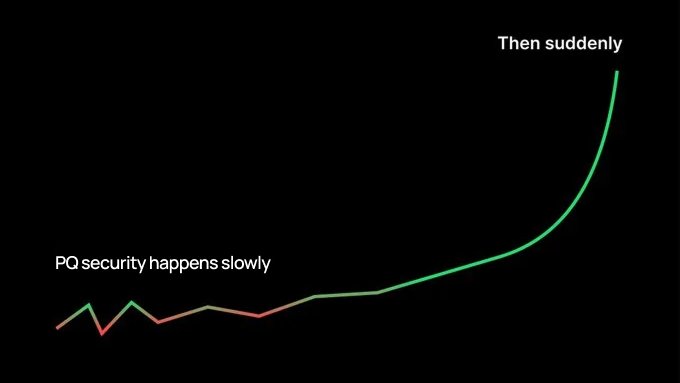
Slowly, then suddenly.
📢In August 2024, NIST finalized its first post-quantum cryptography standards:
• ML-KEM (FIPS 203)
• ML-DSA (FIPS 204)
• SLH-DSA (FIPS 205)
➡️Last week, NIST advanced a second wave of PQC signature candidates, including:
SQIsign, HAWK, MAYO, FAEST, SNOVA, MQOM, SDitH, QR-UOV, and UOV.
The goal is clear:
improve efficiency, reduce signature overhead, and diversify the mathematical foundations behind post-quantum security itself.
Because the industry is realising something important:
There is no perfect one-size-fits-all replacement for ECDSA.
The great quantum awakening is now happening before our eyes.
Governments, enterprises, financial institutions, and blockchain ecosystems are beginning to realise that today’s ECDSA cryptography will become obsolete in a quantum environment.
And the transition away from it is not a simple cryptographic swap.
It is an infrastructure-level redesign.
This is exactly why Naoris was architected around NIST-standardized post-quantum cryptography from inception.
Naoris uses:
• ML-DSA (FIPS 204) for post-quantum transaction authorization and validator security
• ML-KEM (FIPS 203) for quantum-safe key exchange and encrypted node communication
• SLH-DSA (FIPS 205) as a hash-based fallback security layer built on entirely different mathematical assumptions
Why ML-DSA?
Because blockchain infrastructure prioritizes:
– verification throughput across validators
– deterministic integer arithmetic
– implementation safety
– interoperability with emerging standards
– operational reliability at scale
Verification happens across every node, every block, every epoch.
For blockchain infrastructure, that matters more than simply minimizing signature size.
Naoris also separates security models by operational role:
• ML-DSA-87 secures validator block signing and chain integrity
• ML-DSA-65 secures DPoSec communication sessions between consensus and execution layers, reducing overhead while maintaining quantum resistance
The deeper challenge is that post-quantum migration impacts far more than transactions.
It affects validators, networking, consensus, replay protection, key management, and long-term trust assumptions across the entire stack.
NIST’s latest announcement reinforces something important:
Post-quantum migration will not be a single upgrade.
It will redefine the cryptographic foundation of the entire industry.
NAORIS, ZEC, AND CELL RALLY AS QUANTUM-RESISTANT NARRATIVE HEATS UP
@NaorisProtocol's $NAORIS is up 43.9% on the week at a $72M cap, $ZEC is up 18.6% at $421, and $CELL is up 10.6%. Naoris' mainnet went live in April with NIST-approved Dilithium-5 encryption.
Combined with @paradigm's PACTs proposal and Bitcoin Core v31 shipping, quantum is no longer sci-fi narrative. It's a tradable theme.
“The nation that leads in quantum will set the rules of the road for the next generation of technological innovation.”
Chairman @RepBrianBabin makes the stakes clear.
“Quantum technology is not a distant concept… it is a foundational capability that will shape the future of computing, communications, energy, and national security… it will define which nations lead, and which fall behind.”
The National Quantum Reauthorization Act builds on the 2018 initiative, but the focus is shifting. Less emphasis on basic research, more on applied systems, deployment, and commercialisation. Government, industry, and academia being aligned to move faster. NASA now being brought into the strategy, extending this into space-based research and applications.
In terms of competition, he names it directly.
The Chinese Communist Party has already identified quantum as mission-critical and is moving aggressively to deploy systems at scale.
“If we fail to keep pace, the consequences will be significant… impacting cybersecurity, military readiness, and economic competitiveness.”
The conversation moves from capability to consequence.
Quantum advances unlock new systems across computing, communications, energy, and materials. At the same time, they put pressure on the foundations those systems rely on.
Encryption. Identity. Financial infrastructure. Blockchains. Crypto. Digital assets.
Among the first directly exposed.
All built on cryptographic assumptions that do not hold in a quantum environment.
This is where sovereignty shifts.
It used to be defined by land.
Now it is defined by technological capability, data, and trust.
Quantum introduces a new level of offensive capability.
Without quantum-safe security, that capability introduces fragility across the systems it touches.
This is the gap now coming into focus.
Nations are accelerating investment, legislation, and deployment. Far less attention has been given to how infrastructure remains secure once those capabilities are in place.
That is the problem Naoris has been working on.
Post-quantum infrastructure designed to secure digital assets, blockchains, and critical systems so they can operate in a quantum environment, without needing to be rebuilt from scratch.
Leadership in quantum will not be defined by capability alone.
It will be defined by who can secure it.
Nations continue to accelerate investment in quantum technology:
🇨🇳 China: $15B+
🇪🇺 EU: $8B+
🇺🇸 US: $3.7B+
🇩🇪 Germany: ~$3B
🇬🇧 UK: $3B+
🇫🇷 France: $2B+
🇨🇦 Canada: $1B+
🇯🇵 Japan: $300M+
🇰🇷 South Korea: ~$500M
🇮🇳 India: $700M+
🇦🇺 Australia: $1B+
🇮🇱 Israel: $300M+
Quantum systems are scaling in power and stability, bringing real-world capability closer than expected.
But while nations race to build quantum capability, post-quantum security remains unsolved at the infrastructure level.
Blockchains still rely on ECDSA.
That means exposed public keys, static signatures, and long-term assumptions about cryptographic hardness.
Those assumptions don’t hold in a quantum environment.
This is not just a research problem. It’s an infrastructure problem.
The next phase of crypto depends on whether trust can be redefined at the cryptographic layer.
With mainnet rolling out in phases, Naoris introduces a post-quantum L1 where transactions, validators, and system integrity are secured with NIST-standardized cryptography.
The shift isn’t narrative. It’s architectural.
Slowly, then suddenly. $NAORIS
This is the kind of story that should make everyone uncomfortable.
CISA, the leading cybersecurity agency protecting U.S. critical infrastructure, doesn't have access to the most advanced AI hacking tools. Not Anthropic's Mythos. Not OpenAI's latest models.
Meanwhile, foreign nations and hacking groups are already using these exact tools to accelerate their attacks.
One CISA employee put it bluntly: "We aren't even allowed to say the name Anthropic right now."
This is the core problem with the current moment. AI is moving faster than the institutions designed to protect us. Attackers don't wait for procurement cycles, leadership vacancies, or political disputes to be resolved.
Defenders have to.
https://t.co/z0BjC9YDIB
The recent Kelp DAO exploit exposed a deeper problem.
One of the main reasons the industry still cannot progress at the pace it should:
It cannot verify trust across its own infrastructure.
A forged cross-chain message, exploiting LayerZero’s DVN, was accepted as valid. Funds moved through Aave, Compound, and into ETH.
We’ve seen this pattern before across bridges, DeFi, and protocols like Drift Protocol.
Different systems. Same weakness.
Messages are trusted. Validators are trusted. Systems execute.
Nothing proves they are secure in real time.
This is the gap.
We built Naoris to address it at the foundation.
Through dPoSec (Decentralized Proof of Security), nodes, validators, and systems must continuously prove their integrity before trust is extended.
Not just transaction validation...
System-level validation
With mainnet rolling out in phases, this moves from theory toward real infrastructure.
Trust is no longer assumed. It is verified.
Full breakdown 👇
Every crypto cycle tells a story 📖
BTC → ETH → Wallets → L1s → L2s → Modular → Interop → Stablecoins → DeFi → Liquid Staking → NFTs → Gaming → Social → RWAs → AI → DePIN → Identity → Agents → Privacy
Next: Quantum → Post-Quantum Infrastructure
Each layer builds on the last.
Each assumes the layer beneath it can be trusted.
But that foundation still relies on classical cryptography.
ECDSA. Static keys. Exposed signatures.
That’s what secures trillions in value today.
Post-quantum isn’t another vertical. It’s a rewrite of the base layer.
With mainnet rolling out in phases, Naoris is establishing a post-quantum foundation where trust is continuously verified, not assumed.
The next cycle doesn’t add to the stack.
It secures it.
Happy Monday ☕️
100M+ post quantum transactions processed during Naoris testnet.
That number reflects more than throughput.
In traditional chains, signatures are created once but verified continuously across validators, nodes and execution layers.
Verification is the real bottleneck at scale.
Post quantum signatures introduce:
• larger key sizes
• heavier verification overhead
• increased bandwidth and state load
This is not a simple upgrade.`
It is a systems level constraint.
Scaling PQC requires:
• optimized verification pathways
• efficient state handling
• architecture designed for repeated distributed validation
That is what testnet proved.
Not just that PQC works
but that it can operate continuously under load inside a live distributed network.
100M+ times.
Mainnet is now live, extending this into a fully operational network where post quantum verification runs continuously across validators, securing live transactions, network state and cross node consensus in real time.
The world’s largest players are all waking up to the same reality.
@Google@Cloudflare@nvidia@ethereum and the broader Bitcoin community are preparing for post-quantum security.
Now @coinbase's latest paper reinforces the urgency to act early.
We built Naoris for this moment, with post-quantum security enforced at the protocol level.
Slowly, then suddenly.
Naoris PQ L1 🆚 Classical L1s
What makes Naoris different isn’t just post-quantum support. It’s where that security is enforced.
Most blockchains today still rely on elliptic curve cryptography (ECDSA) at their foundation. Some are exploring migration paths. All face the same constraint: upgrading live systems without breaking compatibility.
Naoris starts from a different premise.
Built from inception as a post-quantum system using NIST-standardized cryptography (ML-DSA-87), security is embedded across the stack, not added later.
It shows up at every critical layer:
• Transactions → Every transaction is signed with post-quantum cryptography (FIPS 204 / ML-DSA), removing reliance on ECDSA
• Consensus → dPoSec (Decentralized Proof of Security) ensures validators must continuously prove their integrity, not just validate blocks
• Communication → Data between execution and consensus layers can be encrypted and authenticated using post-quantum key exchange
• Smart contracts → Fully EVM-compatible, with quantum-secure execution by default using existing developer tooling
No migration path. No added complexity.
Other chains are asking how to transition.
Naoris is already built for the environment they’re moving toward.
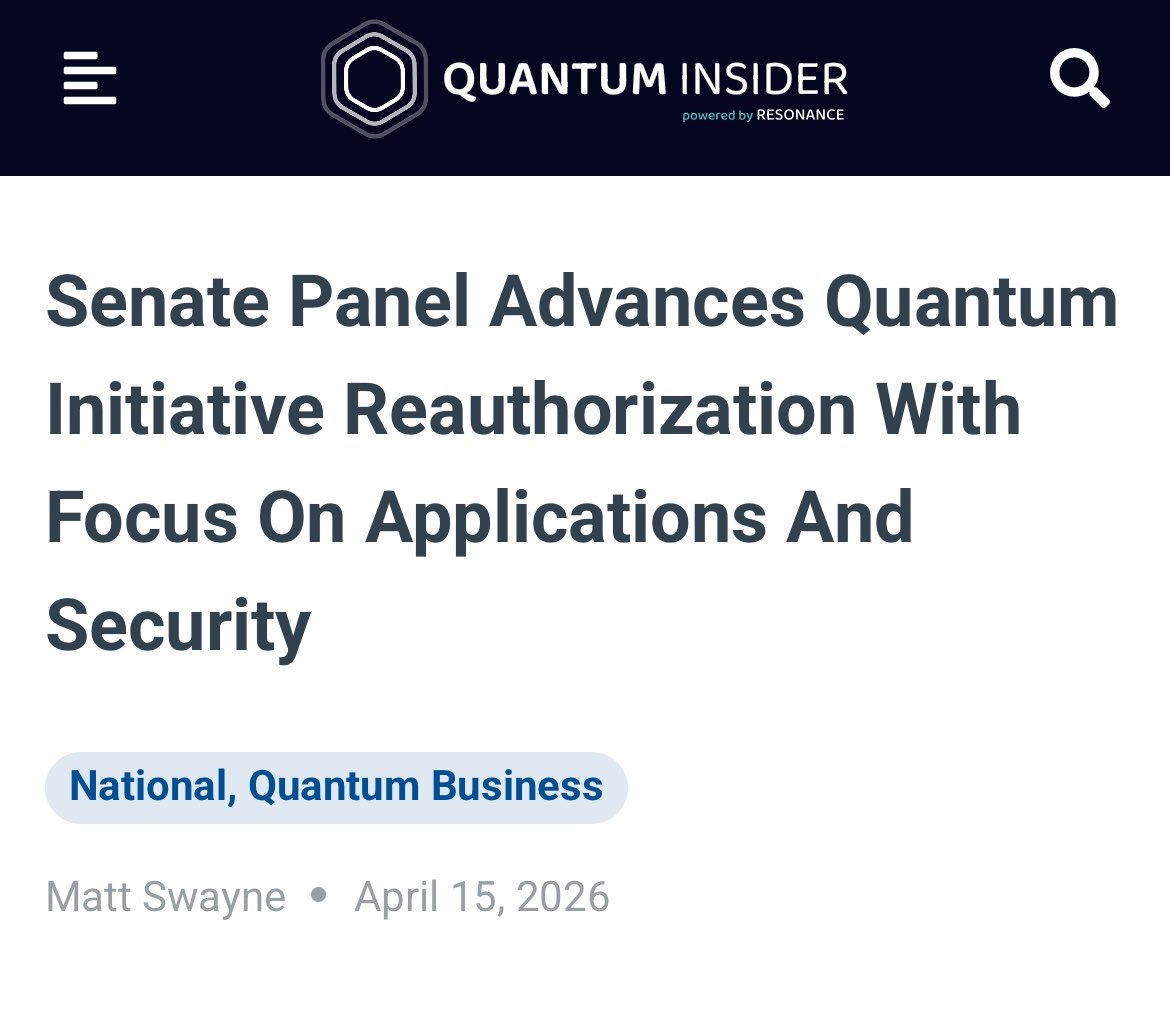
Momentum is building around quantum at the highest levels.
The latest U.S. Senate move puts applications and cybersecurity front and centre, showing a clear shift toward real-world deployment and resilience.
Governments are now preparing for quantum-era threats at the infrastructure level.
The priority is no longer just capability, but whether systems can withstand what’s coming.
This is exactly what Naoris has been building toward for years.
Post-quantum cybersecurity, enforced at the protocol level.
Slowly, then suddenly.