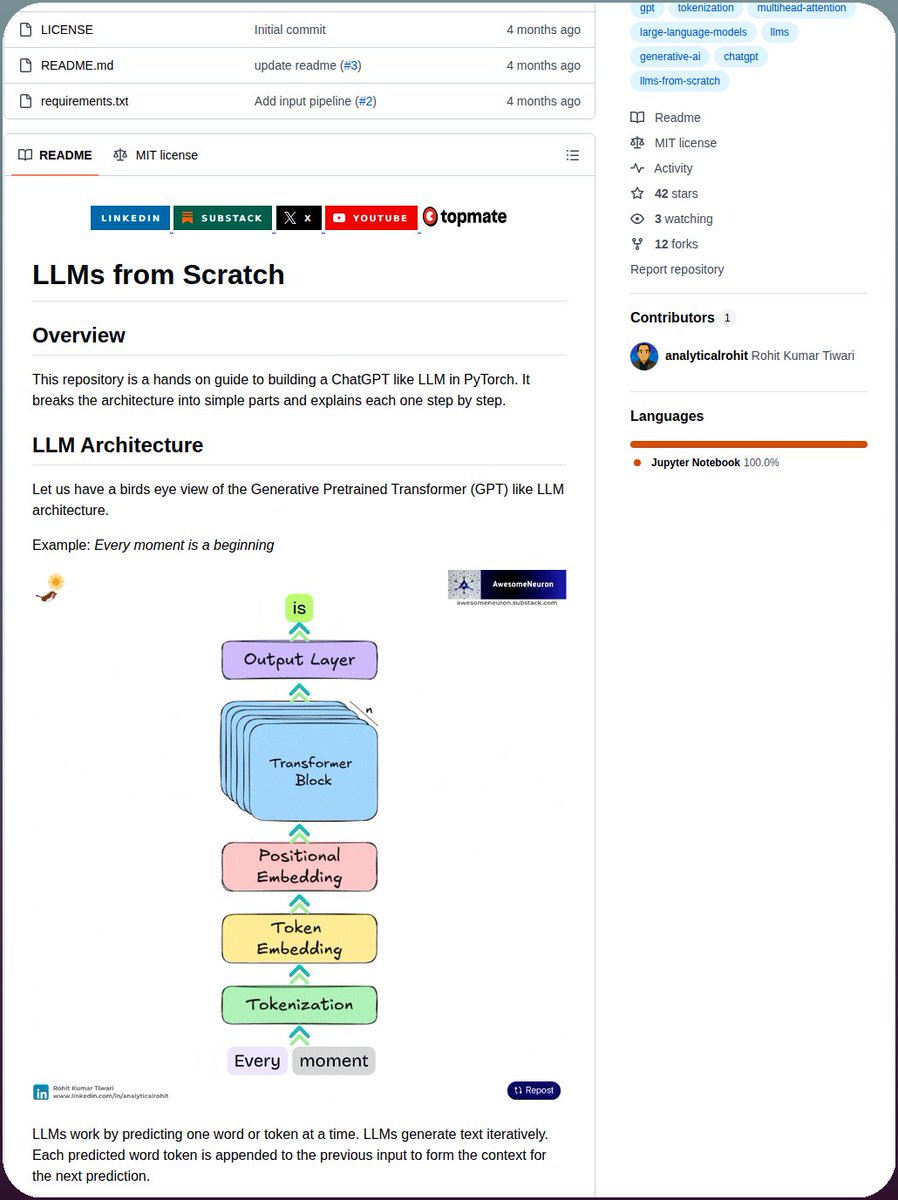
A TEAM OF AI RESEARCHERS JUST OPEN-SOURCED THE BLOOMBERG TERMINAL FOR QUANT FINANCE.
A Bloomberg Terminal costs $25,000 per year per seat. Banks pay for thousands of them.
This thing reads every quant paper, every financial blog, every SEC filing, every arXiv preprint, and turns it into a searchable knowledge base. For free.
It's called QuantMind.
It just got accepted to the NeurIPS 2025 GenAI in Finance Workshop.
Here's what it actually does:
→ Ingests arXiv quant papers, financial news, blogs, and reports automatically
→ Parses PDFs, HTML, tables, and figures into structured knowledge
→ Tags every paper by research area and topic
→ Builds a semantic knowledge graph you can query in plain English
→ Plugs into DeepResearch, RAG, and MCP for multi-hop reasoning
→ Two-stage architecture: extract once, retrieve forever
Here's the wildest part:
The financial research industry publishes around 500 new papers and reports every single day.
Hedge funds pay six-figure salaries to junior analysts whose entire job is reading them.
QuantMind reads all of it. Tags it. Embeds it. Lets you ask it questions.
154 stars. 22 forks. 173 commits. MIT license. Python.
One honest note: this is a framework, not a magic alpha machine. You still need to know what to ask. But the "I haven't read that paper yet" excuse is officially dead.
The thing Wall Street charges $25,000 a year for is sitting on GitHub. Free.
Link in the comments.
It's been 10 years since we published Spectral Graph Convolutional Networks at @NeurIPSConf! 🎂
So much has happened since then, with the growth of the #GNN community.
It is dangerous to predict the future but GNNs+AI4Science feels just getting started :)
https://t.co/rIt2dKAMcr
What's in a neuron? 💫 (an atypically long, almost personal post)
Neurons in LMs have always been a fascinating object to study. I've been studying them since 2020, viewing them as key-value memory cells, analyzing what they capture in vocabulary space, and how they compose together to form features.
https://t.co/jHiZ7wLmrH
https://t.co/tYgtR6vxNi
https://t.co/eZfHTnVrgp
https://t.co/kukRY6RsDU
But many neurons still remain opaque! They do many things.
Our recent work led by @AsafAvrahamy tackles this challenge by decomposing neuron weights in vocabulary space. We do this by taking the neuron weight vector and learning different ways to rotate it (just a bit) to reveal monosemantic vocabulary channels that it captures. The nice thing about our method ROTATE is that it's data-free and super efficient, relying only on vocabulary kurtosis as a search signal.
I've been thinking about this idea since 2024, proposed it to multiple students, but only Asaf was brave enough to take this ;)
Very happy with the final outcome. Check out the paper! 👇
https://t.co/oHLMAtY1F0
Kernel Mean Embeddings are a powerful framework that represents probability distributions as elements of a reproducing kernel Hilbert space (RKHS). Instead of working directly with probability densities, a distribution P is mapped to a feature representation
μₚ = E[k(X, ·)]
where k is a kernel function. This allows complex distributions to be analyzed using geometric and functional-analytic tools.
In probability and statistics, kernel mean embeddings provide nonparametric methods for comparing distributions, hypothesis testing, density estimation, and causal inference. They form the basis of powerful techniques such as Maximum Mean Discrepancy (MMD), which is widely used for two-sample testing.
In machine learning, kernel mean embeddings enable learning directly on distributions rather than individual data points. They are used in domain adaptation, generative modeling, distribution regression, and uncertainty quantification. In deep learning, MMD and related kernel methods appear in generative adversarial learning, representation learning, and self-supervised learning. In reinforcement learning, kernel embeddings help model transition dynamics, value functions, and belief states in partially observed environments.
The deeper insight is that many learning problems involve distributions rather than individual observations. Kernel mean embeddings provide a mathematically elegant way to transform probability distributions into geometric objects that can be manipulated, compared, and learned efficiently.
Image: https://t.co/8OivktctlP
$350K–$785K total comp. Most people haven't heard of this role yet.
It's called Forward Deployed Engineer. OpenAI, Anthropic, and Google are hiring for it right now—and the skills that get you there are Python, SQL, cloud infra, and hands-on AI/ML.
DataCamp has two tracks built for this. And today is the last day of Free Access Week—start free until midnight.
→ For developers: https://t.co/STIZMMdCaV
→ For data scientists: https://t.co/sv5NRhJHPZ
#ForwardDeployedEngineer #AI #TechCareers #FreeAccessWeek
This is the best way to learn how LLMs work.
Interactive. 3D. Step-by-step.
Covers:
→ Embedding
→ Layer Norm
→ Self-Attention
→ MLP
→ Transformer layers
→ Softmax
→ Output
Stop reading papers. Start seeing.
Link in comments.
Save this immediately.
Horace He wrote torch.compile, the one line that makes almost any model run 2-4x faster. He also built FlexAttention.
If your training got quietly faster the last two years, it was probably him.
His point: your GPU isn't slow, it's starving. The bottleneck was never compute. It's memory.
Everyone obsesses over model size. The man who makes them run shows you the wall they're all hitting.
GITHUB JUST CREATED AN OFFICIAL CERTIFICATION FOR THE MOST IN-DEMAND DEVELOPER ROLE OF 2026.
It is called Agentic AI Developer.
GH-600.
And it is the first formal signal that running AI agent teams is now a recognized engineering discipline with a credential behind it.
Not a prompt engineer.
Not a vibe coder.
An Agentic AI Developer.
The person who operates, supervises, and integrates AI agents across the entire software development lifecycle.
The person who knows where agents fail in production.
The person who understands how to build autonomous workflows that do not introduce catastrophic failure modes into CI/CD pipelines.
The person every engineering team is going to need and almost none of them have right now.
GitHub certifying this role changes the hiring conversation permanently.
Before GH-600: "Do you work with AI agents?" is an interview question with no standard answer.
After GH-600: the credential tells the hiring manager exactly what you know and what you can do before the interview starts.
The engineers who get certified in the first wave of GH-600 will have a credential for a role that has more demand than supply for the next 3 to 5 years.
The engineers who wait until it is mainstream will be competing with everyone who moved first.
If you are already working with GitHub Copilot or building agent-driven workflows you are already doing this job.
GH-600 is how you prove it.
Bookmark this.
Follow @cyrilXBT for every AI certification worth your time the moment it drops.
Parsing messy files for RAG shouldn’t be five separate pipelines
OmniParse is a local ingestion and parsing platform for turning unstructured documents, images, audio, video, and web pages into structured Markdown/data for GenAI workflows.
It helps you prepare RAG or fine-tuning inputs by wrapping OCR, document parsing, media transcription, image captioning, and web crawling behind a server/API flow you can run locally.
Key features:
• Multi-format ingestion – supports documents, images, video, audio, and web pages in one parsing stack
• Structured Markdown output – converts documents, multimedia, and web pages into GenAI-friendly structured text
• Local-first setup – README says it runs without external APIs and can fit on a T4 GPU
• API endpoints included – separate routes for PDFs, PowerPoint, Word docs, images, video, audio, and websites
• Deployment paths – includes Docker instructions, a Colab notebook, and a Gradio-powered interactive UI
It’s open-source (GPL-3.0 license).
Link in the reply 👇
LLM inference is where AI prototypes start getting expensive.
ai-inference-resources is a curated learning guide for engineers working on AI inference systems.
It helps you build a real study path by grouping resources across LLM serving, GPU kernels, attention, quantization, distributed inference, and production deployment instead of leaving you to stitch together random tutorials.
Key features:
• Tiered reading path – README recommends Tier 1 across all topics first, then Tier 2, then Tier 3
• 18-topic map – covers LLM fundamentals, serving systems, attention/memory optimization, quantization, CUDA, benchmarking, and more
• Serving-system focus – includes resources on vLLM, SGLang, inference engines, routing, batching, and deployment tradeoffs
• Systems-level depth – goes beyond model APIs into GPU kernels, multi-GPU inference, compiler/DSL approaches, and hardware co-design
• Easy contribution flow – accepts PRs or issues with a link, short description, and suggested category/tier placement
It’s open-source (MIT license).
Link in the reply 👇








![probnstat's tweet photo. Kernel Mean Embeddings are a powerful framework that represents probability distributions as elements of a reproducing kernel Hilbert space (RKHS). Instead of working directly with probability densities, a distribution P is mapped to a feature representation
μₚ = E[k(X, ·)]
where k is a kernel function. This allows complex distributions to be analyzed using geometric and functional-analytic tools.
In probability and statistics, kernel mean embeddings provide nonparametric methods for comparing distributions, hypothesis testing, density estimation, and causal inference. They form the basis of powerful techniques such as Maximum Mean Discrepancy (MMD), which is widely used for two-sample testing.
In machine learning, kernel mean embeddings enable learning directly on distributions rather than individual data points. They are used in domain adaptation, generative modeling, distribution regression, and uncertainty quantification. In deep learning, MMD and related kernel methods appear in generative adversarial learning, representation learning, and self-supervised learning. In reinforcement learning, kernel embeddings help model transition dynamics, value functions, and belief states in partially observed environments.
The deeper insight is that many learning problems involve distributions rather than individual observations. Kernel mean embeddings provide a mathematically elegant way to transform probability distributions into geometric objects that can be manipulated, compared, and learned efficiently.
Image: https://t.co/8OivktctlP](https://pbs.twimg.com/media/HKS6qamWgAAzEKV.jpg)