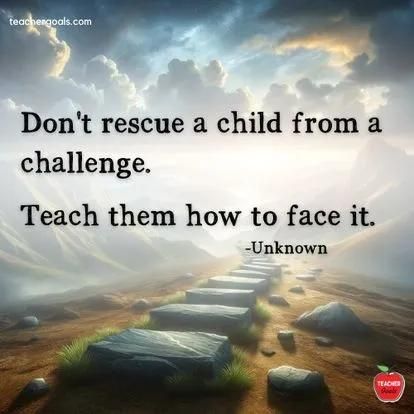
Overprotected kids become unprepared adults.
Dawn Staley nailed it.🔥
You can’t shelter your child from every hard moment and then expect them to handle adversity when it counts.
Hard is the lesson.
What’s one hard lesson sports taught you that helped later in life? 👇
Teachers often notice the cracks before the data does.
Right now, many are seeing:
– A sharp drop in focus during reading and writing (thanks to cell phones)
– A growing dependence on AI to think and write
We’re not heading for a learning crisis.
We’re already in one.
Dr. Daniel Amen said something that made me pause and think about how we parent today.
“We are raising mentally weak children because we overdo for them.”
He explained that when you do too much for your kids, you’re actually increasing your own self-esteem by stealing theirs. Mental toughness comes from solving problems — not from having every problem solved for you.
If your daughter forgets her homework, don’t bring it to school.
If she doesn’t bring a jacket on a cold day, she feels the cold.
When she says “I’m bored,” don’t rush to fix it — just say, “I wonder what you’re going to do about it,” and then stay quiet.
It’s tough love, but according to Dr. Amen, that’s how you build resilience instead of helplessness.
Coach K shares a universal truth about failure, resilience, and growth.
"When you're getting your butt kicked, it's called changing a limit."
"So many parents today don't allow their kids to change limits...They're worried about them failing instead of learning. You learn through the experience of failure and success."
Growth requires discomfort. You have to be willing to look bad before you get better.
The problem isn't failure - it's protecting people from it.
"Failure was never a destination."
You can't grow without accepting that there will be challenges and adversity.
(🎥 Duke Fuqua School of Business )
Wise words
“My name’s Frank. I’m 64, a retired electrician.
Forty-two years I spent running wires through houses, fixing breakers, making sure people had light in their kitchens and heat in their winters. Never once did anyone ask me where I went to college. Mostly, they just wanted to know if I could get the power back on before their ice cream melted.
Last May, I was at my granddaughter Emily’s school career day. You know the drill — doctors, lawyers, a software guy in a slick suit talking about “scaling startups.” I was the only one there with a tool belt and work boots.
When it was my turn, I told the kids, “I don’t have a degree. I’ve never sat in a lecture hall. But I’ve wired schools, hospitals, and your principal’s house. And when the hospital generator failed during a snowstorm in ’98, I was the one in the basement with a flashlight, keeping the lights on for newborn babies upstairs.”
The kids leaned forward. They had questions — real ones. “How do you fix stuff in the dark?” “Do you make a lot of money?” “Do you ever get zapped?” (Yes, once, and it’ll curl your hair.)
When the bell rang, one boy hung back. Small kid, freckles, hoodie too big for him. He mumbled, “My uncle’s a plumber. People laugh at him ’cause he didn’t finish high school. But… he’s the only one in the family who can fix anything.”
I looked that boy in the eye and said, “Kid, your uncle’s a hero. When your toilet overflows at midnight, Harvard ain’t sending anyone. A plumber is.”
Here’s the thing nobody told me when I was young — the world doesn’t run without tradespeople. You can have all the engineers you want, but if nobody builds the house, wires the power, or lays the pipes, those blueprints just sit in a drawer.
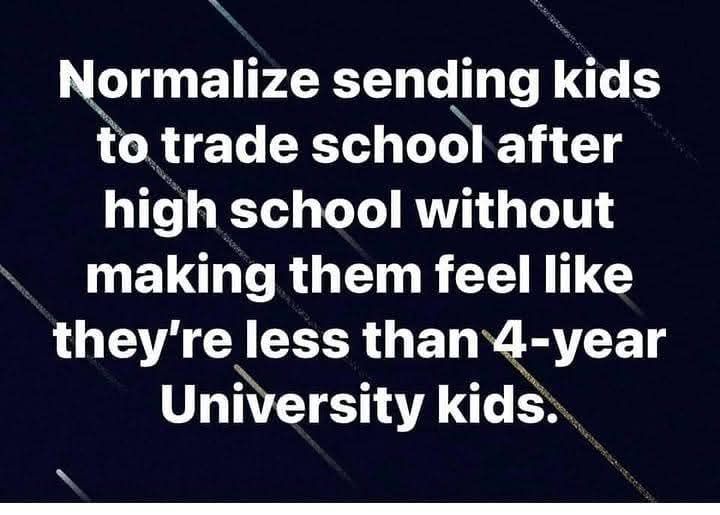
We’ve made it sound like trades are what you do if you can’t go to college, instead of a path you choose because you like working with your hands, solving problems, and seeing your work stand solid for decades.
Four years after high school, some kids walk away with diplomas. Others walk away with zero debt, a union card, and a skill they can take anywhere in the world. And guess what? When your furnace dies in January, it’s not the diploma that saves you.
A few weeks ago, that same freckled kid’s mom stopped me at the grocery store. She said, “You probably don’t remember, but you told my son trades are important. He’s shadowing his uncle this summer. First time I’ve seen him excited about anything in years.”
That’s the part we forget — for some kids, knowing their path is respected changes everything. It’s not about “just” fixing wires or pipes. It’s about pride. Purpose. The kind that sticks with you long after the job’s done.
So next time you meet a teenager, don’t just ask, “Where are you going to college?” Ask, “What’s your plan?” And if they say, “I’m learning to weld,” or “I’m starting an apprenticeship,” smile big and say, “That’s fantastic. We’re going to need you.”
Because we will. More than ever. And when the lights go out, you’ll be glad they showed up.”
Congratulations to Coach Johnson & the vb team on an exciting win over the Hawks last night. Coach Johnson is now 16-3 in her career as a head coach against the Hawks. We are well on our way to winning the Iowa Corn Cy-Hawk series for the fourth time in the past five years
Rules of engineer’s life:
1. See failure as a beginning, not an end.
2. Never stop learning.
3. Assume nothing, question everything.
4. Teach others what you know.
5. Analyze objectively.
6. Practice humility.
7. Respect constructive criticism.
8. Give credit where it’s due.
9. Take initiative.
10. Ask the tough questions early.
11. Love what you do or leave.